Divorce & Family · Texas
Child Custody and Child Support in a Texas Divorce: What Parents Should Know
Texas calls custody 'conservatorship' and visitation 'possession and access.' Here's how judges decide, what the standard schedule looks like, how child support is calculated, and how orders can change.

The short answer: in a Texas divorce, the court decides custody, called conservatorship, and visitation, called possession and access, based on the best interest of the child. Texas presumes both parents should be joint managing conservators, and the Standard Possession Order sets the default schedule. Child support usually follows guideline percentages of the paying parent's net income: 20% for one child, rising with each additional child.
When parents divorce, the questions that matter most are often about the kids. Where will they live during the week? Who decides which school they attend? How often will they see each parent, and how will holidays work? How much child support will be paid?
Texas has its own terms and rules for all of these, and they can be confusing at first. This guide explains conservatorship, how judges decide what's in a child's best interest, the Standard Possession Order, how child support is calculated, a 2020 Texas Supreme Court case about a parent's rights, and how orders can be changed later. For the divorce process, see our guide on how to file for divorce in Texas, and for property, our guide to property division.
- Texas custody terms in plain English
- Joint and sole managing conservatorship
- How judges decide best interest
- The child's wishes
- The Standard Possession Order
- How child support is calculated
- Medical and dental support
- A real Texas case: In re C.J.C. (2020)
- Changing the orders later
- Tips for parents going through divorce
- When to talk to a lawyer, checklist and FAQ
Texas custody terms in plain English
- Conservatorship is Texas's word for custody: the rights and duties to make decisions for the child.
- Managing conservator is a parent with decision-making rights. Parents can be joint managing conservators, or one can be sole managing conservator.
- Possessory conservator is a parent who has time with the child but not the main decision-making rights.
- Possession and access is Texas's term for visitation: the schedule of when each parent has the child.
- Primary residence, often called the right to designate the child's primary residence, decides where the child mainly lives, sometimes within a geographic area.
Joint and sole managing conservatorship
Texas law creates a rebuttable presumption that appointing both parents as joint managing conservators is in the child's best interest (Tex. Fam. Code § 153.131). Joint managing conservatorship means both parents share rights and duties, like access to school and medical records and participating in major decisions. Some decisions may still go to one parent, such as the right to decide the child's primary residence.
It's important to know what joint managing conservatorship is not: it doesn't automatically mean a 50/50 schedule or no child support. Often one parent has the right to designate the primary residence and receives child support, while the other has a standard or expanded possession schedule.
A court may name one parent sole managing conservator when joint conservatorship isn't in the child's best interest, for example when there's a history of family violence, substance abuse, neglect, or the parents simply can't communicate about the child at all.
How judges decide best interest
The best interest of the child is always the court's primary consideration (§ 153.002). Texas courts look at many factors, often drawn from the Texas Supreme Court's list in Holley v. Adams (1976), including:
- The child's emotional and physical needs, now and in the future
- Any emotional or physical danger to the child
- Each parent's parenting abilities
- The stability of each home
- The child's wishes, depending on age and maturity
- Each parent's willingness to support the child's relationship with the other parent
- Any history of family violence, abuse or neglect
Judges look closely at who has handled day-to-day parenting: school, doctor's appointments, meals, bedtimes and activities. Records like school emails, medical portals and calendars can help show that.
The child's wishes
No Texas child gets to decide where they live. But in a case without a jury, if a parent asks, the judge must interview a child 12 or older in chambers about their wishes for conservatorship and possession, and may interview a younger child (§ 153.009). The judge considers the child's wishes alongside everything else. Pressuring a child to pick a side usually backfires.
The Standard Possession Order
Texas presumes that the Standard Possession Order (SPO) is in the best interest of a child age three or older (TexasLawHelp). Parents can always agree to a different schedule, and the SPO applies whenever they can't agree. When parents live within 100 miles of each other, the parent without the primary residence generally has:
- The first, third and fifth weekends of every month
- Thursday evenings during the school year
- Alternating holidays, such as Thanksgiving and parts of the winter break
- 30 days in the summer
When parents live within 50 miles, Texas law gives the parent with possession an expanded schedule by default in cases filed on or after September 1, 2021, unless that parent chooses otherwise or the court finds it isn't in the child's best interest. When parents live more than 100 miles apart, the schedule changes: weekends may be reduced to one a month, and the parent gets more summer time and every spring break. Courts can set different schedules for children under three.
How child support is calculated
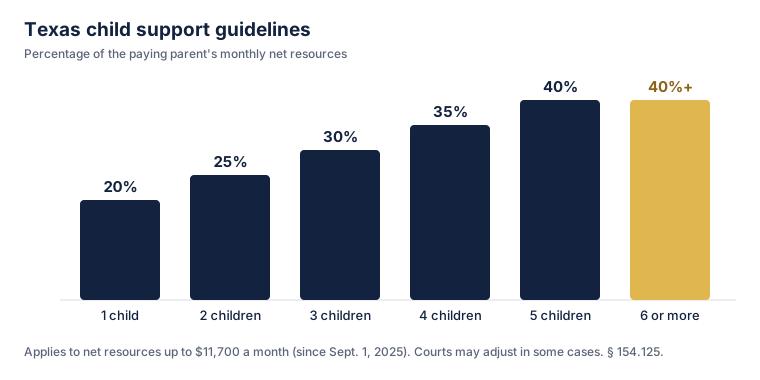
Texas uses a percentage-of-income guideline based on the paying parent's net resources: generally their gross income from all sources, minus taxes, Social Security, union dues and the cost of the child's health insurance (§ 154.125). The guideline percentages are:
| Number of children | Percentage of net resources |
|---|---|
| 1 | 20% |
| 2 | 25% |
| 3 | 30% |
| 4 | 35% |
| 5 | 40% |
| 6 or more | Not less than 40% |
The guideline applies to net resources up to a monthly cap, which increased to $11,700 on September 1, 2025 (divorce.law). For higher incomes, the court can order more based on the child's proven needs. The percentages are lower when the paying parent supports children in another household.
Example: a parent with $5,000 a month in net resources and two children would pay a guideline amount of about $1,250 a month (25%).
Courts can depart from the guideline when it would be unjust or inappropriate, considering things like the child's age and needs, each parent's ability to contribute, travel costs for visitation, and special needs. The Texas Attorney General's Child Support Division can help establish and enforce support, and its website explains parenting-time orders (Texas Attorney General).
Child support generally continues until the child turns 18 or graduates from high school, whichever is later, and can continue indefinitely for some disabled children.
Medical and dental support
Texas orders also require medical support and dental support: usually one parent provides health and dental insurance for the child, and the other reimburses part of the cost. Uninsured medical expenses, like copays and deductibles, are usually split between the parents, often 50/50.

A real Texas case: In re C.J.C. (2020)
On June 26, 2020, the Supreme Court of Texas decided In re C.J.C., No. 19-0694, an important case about a fit parent's rights in a custody dispute (case summary; concurring opinion; TexasLawHelp explanation).
What happened
A girl's parents had a custody order. Her mother later moved in with a boyfriend and, four months after that, started a proceeding to modify custody. While that case was pending, the mother died in a car accident. The mother's boyfriend then intervened and asked for partial custody of the girl, over the objection of her father, who was a fit parent. The trial court allowed it and gave the boyfriend possession of the child.
What the Supreme Court decided
The Supreme Court ruled for the father. It held that the long-standing presumption that a fit parent acts in the child's best interest applies when a nonparent asks to modify an order to get custody or visitation over a parent's objection. The trial court hadn't applied that presumption, so the Court granted the father's request and set aside the order giving the boyfriend time with his daughter.
What this means for you
- Parents have strong rights. A fit parent's decisions about their child get special weight against claims by nonparents, like grandparents, stepparents or partners.
- Between two parents, the test is best interest. In a divorce, both parents start on equal footing, and the court decides what's best for the child.
- Plan ahead. If you want a relative or partner to have a role if something happens to you, talk to a lawyer about wills and other planning.
- Courts must follow the presumptions. When a trial court skips a required legal presumption, an appeal or mandamus may be possible.
Changing the orders later
Life changes after divorce: new jobs, moves, new partners, and children's changing needs. Texas courts can modify orders:
- Custody and possession can be modified if circumstances of the child or a parent have materially and substantially changed and the change is in the child's best interest. A child 12 or older can also tell the court which parent they want to have the primary residence.
- Child support can generally be modified after a material and substantial change, or if it's been at least three years and the guideline amount would differ by at least 20% or $100 a month (§ 156.401).
Until a court signs a new order, the old one still applies. Informal agreements to change support aren't enforceable, so put any change in a court order.
Tips for parents going through divorce
- Keep the children out of the conflict. Don't discuss the case with them, ask them to carry messages, or criticize the other parent in front of them.
- Stay involved. Keep going to school events, appointments and activities.
- Communicate in writing. Co-parenting apps and email create a record and reduce arguments.
- Follow temporary orders exactly. Judges notice who follows the rules.
- Be careful on social media. Posts can be used as evidence.
- Get help if there's danger. If you or your children are in immediate danger, call 911. The National Domestic Violence Hotline is 800-799-7233.
When to talk to a lawyer
Talk to a licensed Texas family lawyer if:
- You and the other parent disagree about where the children will live or the schedule
- There's family violence, substance abuse or concerns about the children's safety
- One parent wants to move far away with the children
- Income is hard to figure out, such as self-employment, cash income or high income
- A grandparent, stepparent or other nonparent is seeking custody or visitation
Free forms and instructions for divorces with children are at TexasLawHelp.org. For a referral, contact the State Bar of Texas Lawyer Referral and Information Service at (800) 252-9690, Monday to Friday, 8:30 a.m. to 4:30 p.m., or texasbar.com/LawyerReferral.
Checklist: custody and support in a Texas divorce
- Learn the terms: conservatorship, possession and access, primary residence
- Write down your proposed schedule, including holidays and summer
- Gather school, medical and activity records showing your involvement
- Collect pay stubs and tax returns to estimate child support
- Check the cost of the children's health and dental insurance
- Communicate with the other parent in writing
- Follow temporary orders exactly
- Keep the children out of the conflict
- Put any later changes in a new court order
Frequently asked questions
How is custody decided in Texas?
The judge's main consideration is always the best interest of the child. Texas presumes that naming both parents joint managing conservators is in the child's best interest, unless that presumption is overcome, for example by evidence of family violence. Joint managing conservatorship is about decision-making; it doesn't mean equal time.
What is the Standard Possession Order in Texas?
It's the default visitation schedule in Texas law, presumed to be in the best interest of children three and older. When parents live within 100 miles, the noncustodial parent generally has the first, third and fifth weekends of each month, Thursday evenings during the school year, alternating holidays and 30 days in the summer. Parents can agree to a different schedule.
How much is child support in Texas?
Texas guidelines set child support as a percentage of the paying parent's net resources: 20% for one child, 25% for two, 30% for three, 35% for four and 40% for five, with at least 40% for six or more. The guideline applies to net resources up to a monthly cap, which rose to $11,700 on September 1, 2025. Courts can go above or below the guideline in some cases.
At what age can a child choose which parent to live with in Texas?
No child gets to decide on their own. But in a nonjury case, if a parent asks, the judge must interview a child 12 or older in chambers about their wishes, and may interview a younger child. The child's wishes are one factor in deciding the child's best interest.
Can a custody or child support order be changed in Texas?
Yes. A court can modify custody or possession orders if circumstances have materially and substantially changed and the change is in the child's best interest. Child support can generally be modified after a material and substantial change, or after three years if the guideline amount would differ by at least 20% or $100 a month.
Sources
- Tex. Fam. Code § 153.002: best interest of the child
- Tex. Fam. Code § 153.009: interviewing the child
- Tex. Fam. Code § 153.131: joint managing conservatorship presumption
- Tex. Fam. Code § 154.125: child support guidelines
- Tex. Fam. Code § 156.401: modifying child support
- TexasLawHelp.org: child visitation and possession orders
- divorce.law: Texas child support cap increase
- Texas Attorney General: parenting time overview
- In re C.J.C., No. 19-0694 (Tex. June 26, 2020), summary
- In re C.J.C., concurring opinion (Tex. 2020)
- TexasLawHelp.org: custody disputes between a parent and nonparent
Keep reading
 Divorce & Family · Texas
How Property Is Divided in a Texas Divorce: Community Property Explained
Texas is a community property state, but that doesn't always mean a 50/50 split. Here's how courts decide who keeps the house, the retirement accounts and the debts, and how to protect what's yours.
 Divorce & Family · Texas
How to File for Divorce in Texas: Steps, Costs and the 60-Day Waiting Period
Thinking about divorce in Texas? Here's the whole process in plain English: who can file and where, what it costs, why you have to wait 60 days, and how agreed and contested divorces end.
 Work Injuries · Texas
Oilfield Accidents in Texas: Injury Claims, Workers' Comp and Who Is Liable
Texas leads the nation in oil and gas worker deaths. If you were hurt on a rig, at a well site or on the road to one, several companies may share responsibility. Here's how Texas law sorts it out.