Car Accidents · Texas
Rear-End Collisions and Whiplash in Texas: Who Is at Fault and What Your Claim Is Worth
Rear-end crashes are among the most common in Texas, and whiplash is the injury insurers doubt most. Here's how fault works, what can change it, and how to prove a neck or back injury.

The short answer: in most Texas rear-end crashes, the driver in back is found at fault, because Texas law requires drivers to keep a safe distance and be able to stop. But it isn't automatic: the front driver can share the blame in some situations. For neck and back injuries like whiplash, prompt medical care, consistent treatment and good records are what turn a sore neck into a claim the insurer has to take seriously.
You're stopped at a red light on a Texas frontage road, glance in the mirror, and see a pickup coming too fast. There's a bang, your head snaps forward and back, and the car lurches into the intersection. You feel shaken, maybe a little stiff. By the next morning, you can barely turn your head.
Rear-end collisions are among the most common crashes on Texas roads, from stop-and-go traffic on I-35 to school zones and parking lots. They're also the source of one of the most common, and most disputed, injury claims: whiplash. This guide explains how fault works in rear-end crashes, the exceptions, what whiplash is, how insurers fight soft-tissue claims, a Texas Supreme Court case about a rear-end crash with an 18-wheeler, and what to do to protect yourself.
- Who is at fault in a rear-end crash
- When the front driver shares the blame
- Chain-reaction crashes
- What whiplash is
- What to do after a rear-end crash
- Why insurers fight whiplash claims
- A real Texas case: JLG Trucking v. Garza
- What a whiplash claim can be worth
- When an 18-wheeler or company vehicle hits you
- Deadlines and when to call a lawyer
- Checklist and FAQ
Who is at fault in a rear-end crash
Texas Transportation Code § 545.062 requires a driver following another vehicle to maintain an assured clear distance, so that, considering the speed of the vehicles, traffic and road conditions, the driver can safely stop without colliding with the vehicle ahead (§ 545.062).
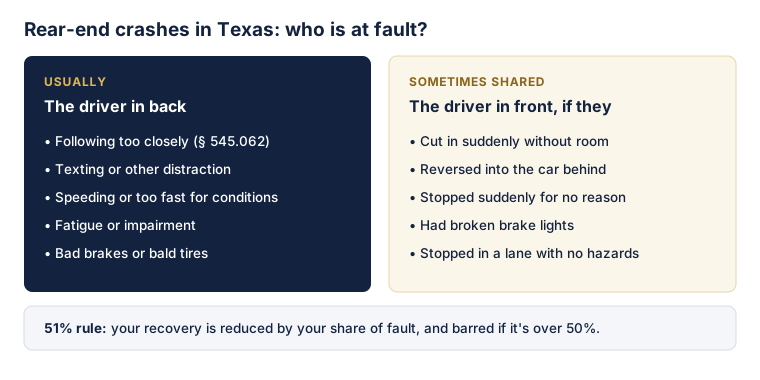
That rule is why the rear driver is usually found at fault. Common reasons rear-end crashes happen:
- Following too closely, especially at highway speeds
- Distraction. Texas has banned texting while driving statewide since 2017 (§ 545.4251), and phones remain a leading cause of rear-end crashes.
- Speeding, or driving too fast for rain, fog or traffic
- Fatigue or impairment
- Bad brakes or bald tires on the rear vehicle
But Texas has no rule that a rear-end crash automatically proves the rear driver was negligent. The injured driver still has to show what the rear driver did wrong, and the rear driver's insurer may argue that something else caused the crash. In most cases, though, the evidence points clearly at the driver in back.
When the front driver shares the blame
Texas uses proportionate responsibility, the 51% rule: the jury assigns each driver a percentage of fault, your damages are reduced by your share, and you recover nothing if you're more than 50% responsible. In rear-end crashes, the front driver may share some blame if they:
- Cut in suddenly in front of the other car without leaving room
- Reversed into the car behind them, for example at a light or in a parking lot
- Stopped suddenly for no reason, or to cause a crash on purpose (a staged-accident scam)
- Had broken brake lights, so the driver behind had no warning
- Stopped in a travel lane without hazard lights, or merged at a very low speed onto a highway
Even then, the rear driver is often still mostly at fault, because a safe following distance is supposed to allow for sudden stops. Dash camera video, witnesses and the police report's contributing factors usually decide these disputes. See our guide to how fault works in Texas car accidents.
Chain-reaction crashes
In a multi-car pileup, one driver hits the car ahead and pushes it into the next. Usually the driver who started the chain is mainly at fault, but each driver's following distance and speed matters. If you were the middle car, you may have claims against the driver behind you, and you may face a claim from the driver ahead. Get the names, insurance and statements of every driver, and photos of every vehicle's damage, which can help show the order of impacts.
What whiplash is
Whiplash is an injury to the neck caused by a rapid back-and-forth motion, like the crack of a whip. In a rear-end crash, your car is pushed forward, your body moves with the seat, and your head lags behind and then snaps forward. That motion can strain or sprain the muscles, ligaments and other soft tissues of the neck.
Common symptoms include:
- Neck pain and stiffness, and pain when turning your head
- Headaches, often starting at the base of the skull
- Pain or tingling in the shoulders, upper back or arms
- Fatigue, dizziness, and trouble sleeping
Symptoms often start or get worse in the hours or days after a crash. Most people improve within weeks to a few months with care, but some have pain that lasts much longer. A rear-end crash can also cause more serious injuries, like herniated discs, nerve compression, or a concussion or brain injury, which may need imaging, injections or surgery.
What to do after a rear-end crash
1. Check for injuries and call 911
Move to safety if you can, call 911, and let officers create a crash report. In Texas, crashes involving injury must be reported, and the report will often note "following too closely" or "driver inattention" as a contributing factor.
2. Photograph everything
- Both vehicles, including the rear of yours and the front of theirs
- Where the cars came to rest, skid marks and debris
- Brake lights and traffic signals
- The other driver's license, insurance card and plate
3. Look for video and witnesses
Ask nearby drivers what they saw and get their numbers. Note any businesses with cameras. If either car had a dash camera, save the footage right away.
4. Get medical care within a day or two
Even if you feel okay at the scene, see a doctor or urgent care soon, and describe every symptom, including headaches and tingling. Insurers look hard at how soon you got care. A long delay is one of the first things they'll use against you.

5. Follow your treatment plan
Go to physical therapy, follow-up visits and referrals. Gaps or missed appointments will be used to argue you weren't really hurt or that you recovered quickly.
6. Be careful with the insurers
Report the claim, but don't give the other driver's insurer a recorded statement or blanket medical release, and don't accept a quick offer before you know how your recovery is going. See our guide to talking to insurance adjusters.
Why insurers fight whiplash claims
Soft-tissue injuries don't usually appear on X-rays, and they're common, so insurers often treat them with suspicion. Expect some of these arguments:
- "Low damage means no injury." Insurers sometimes label cases "minor impact, soft tissue" and value them low. But bumpers are designed to absorb impact without visible damage, and people can be hurt in crashes that leave little damage.
- "You waited too long to see a doctor." A gap between the crash and first treatment is used to suggest something else caused your pain.
- "You had neck problems before." If the crash made an earlier condition worse, you can still recover for that worsening. Your doctor can explain what changed.
- "Something else caused it." A later accident, a sports injury or heavy lifting at work may be blamed, as the case below shows.
- "Too much treatment." Insurers may challenge the length or cost of chiropractic care or therapy. Following your doctor's plan, and the records explaining why each treatment was needed, helps.
A real Texas case: JLG Trucking v. Garza
On April 24, 2015, the Supreme Court of Texas decided JLG Trucking, LLC v. Garza, No. 13-0978, a rear-end case that shows how other possible causes of a neck injury can decide a trial (opinion; Texas Tech Law Review summary).
What happened
On July 16, 2008, Lauren Garza was driving south on U.S. Highway 83 in Zapata County when an 18-wheeler driven by a JLG Trucking employee rear-ended her truck. She had neck and back pain and went through about eleven weeks of physical therapy.
On October 9, 2008, less than three months later, Garza was in a second car accident. She was taken to the hospital by ambulance on a backboard with a neck collar, complaining of head, neck and chest pain. Later MRIs showed herniated discs in her neck, and in January 2012 she had spinal fusion surgery.
The trial
Garza sued JLG over the first crash. Before trial, the judge excluded all evidence of the second accident, finding no proof that it caused her injuries. The jury found the truck driver negligent and awarded Garza about $1.17 million.
What the Supreme Court decided
The Supreme Court reversed and sent the case back for a new trial. Writing for the Court, Justice Debra Lehrmann explained that the second accident was relevant to whether the first crash caused Garza's herniated discs. Garza had the burden to prove causation, and JLG was entitled to cross-examine her medical expert about the other accident as a possible cause. Excluding it was harmful error.
What this means for you
- Other accidents and injuries will come out. Tell your lawyer and doctors about earlier and later injuries. Hiding them can sink a case.
- Your doctor has to address other causes. A strong medical opinion explains why the crash, not something else, caused your injury.
- Records from right after the crash matter. Garza's therapy right after the first crash showed her symptoms began then. Prompt treatment creates that timeline.
- Rear-end liability is only half the case. Even with clear fault, the defense can fight hard over what your injuries are and what caused them.
What a whiplash claim can be worth
There's no formula or standard amount. Insurers and juries look at:
- Medical expenses: ER, doctor, therapy, chiropractic care, imaging, injections, surgery. In Texas, recovery is limited to amounts actually paid or incurred.
- How long symptoms lasted, and whether a doctor expects them to continue
- Objective findings, like a herniated disc on an MRI or nerve test results
- Lost wages, and any lasting effect on your ability to work
- Pain and the effect on daily life: sleep, childcare, exercise, hobbies
- Fault: any share of blame on you reduces the amount
- Insurance limits: Texas drivers need only $30,000 per person in liability coverage, so your own underinsured motorist coverage may matter
Our guide to what a Texas injury case is worth explains each type of damages in detail.
When an 18-wheeler or company vehicle hits you
If a truck, delivery van or other company vehicle rear-ends you while the driver is working, the company is generally responsible for the driver's negligence, and it usually carries much more insurance. Trucks also carry electronic data and dash cameras that can show speed, braking and following distance. A lawyer should send a letter quickly asking the company to preserve that evidence. See our guide to Texas truck accidents.
If a city bus, police car or other government vehicle hit you, much shorter notice deadlines apply. See our guide to government vehicle accidents.
Deadlines
- Two years from the crash for injury and property damage lawsuits
- Prompt notice to your own insurer under your policy
- As little as 90 days for notice of a claim against some government entities
See our guide to Texas injury claim deadlines.
When to call a lawyer
You may be able to handle a minor claim that resolves quickly on your own. Talk to a licensed Texas lawyer if:
- Your pain has lasted more than a few weeks, or you've been referred for an MRI, injections or surgery
- The other driver says you stopped suddenly or were at fault
- You've had earlier neck or back injuries or another accident
- An 18-wheeler or company vehicle hit you
- The insurer's offer doesn't cover your bills
For a referral, contact the State Bar of Texas Lawyer Referral and Information Service at (800) 252-9690, Monday to Friday, 8:30 a.m. to 4:30 p.m., or texasbar.com/LawyerReferral. Our Find a Lawyer page has questions to ask.
Checklist: after a rear-end crash
- Call 911 and get a crash report
- Photograph both vehicles, the scene and brake lights
- Get witness names and save any dash camera video
- See a doctor within a day or two, and describe every symptom
- Follow your treatment plan and keep every appointment
- Tell your doctor about earlier neck or back problems
- Give the other driver's insurer only basic facts
- Keep bills, receipts and a pain journal
- Mark the two-year deadline
Frequently asked questions
Is the rear driver always at fault in a rear-end collision in Texas?
Usually, but not always. Texas law requires drivers to keep a safe distance so they can stop without hitting the car ahead, so the rear driver is most often found at fault. But the front driver can share the blame if they cut in suddenly, reversed, stopped for no reason, or had broken brake lights. Fault is decided under Texas's 51% rule.
How much is a whiplash claim worth in Texas?
It depends on the medical treatment, how long symptoms last, lost income and how the injury affects your life. Minor cases that resolve in a few weeks often settle for modest amounts, while cases with herniated discs, injections or surgery can be worth much more. There's no standard figure.
Can I have whiplash if there was little damage to my car?
Yes. Modern bumpers are built to absorb impact without showing much damage, and the body can still be thrown forward and back. Insurers often argue that low property damage means no injury, so medical records and consistent treatment are important.
What if I had neck problems before the accident?
You can still recover if the crash made an earlier condition worse. But the defense can point to earlier injuries and later accidents as other causes. In JLG Trucking v. Garza (2015), the Texas Supreme Court held that a jury should hear evidence of a second accident that could have caused the plaintiff's neck injuries.
How long do I have to file a rear-end accident claim in Texas?
Generally two years from the date of the crash for injury and property damage lawsuits. Claims involving government vehicles have much shorter notice deadlines.
Sources
- Tex. Transp. Code § 545.062: following distance
- Tex. Transp. Code § 545.4251: texting while driving
- JLG Trucking, LLC v. Garza, No. 13-0978 (Tex. Apr. 24, 2015)
- Texas Tech Law Review: Supreme Court of Texas update on JLG Trucking v. Garza
- Tex. Civ. Prac. & Rem. Code § 33.001: proportionate responsibility
- Tex. Civ. Prac. & Rem. Code § 16.003: two-year deadline
- State Bar of Texas Lawyer Referral and Information Service (TexasLawHelp.org)
Keep reading
 Car Accidents · Texas
Brain Injury After a Car Accident in Texas: Symptoms, Proving Your Claim and Compensation
A brain injury can hide behind a normal CT scan and a 'you're fine' at the scene. Here's how to spot the warning signs after a Texas crash, prove the injury and protect your claim.
 Car Accidents · Texas
Hit by a City Bus, Police Car or Government Vehicle in Texas? Your Rights Under the Tort Claims Act
Crashes with city buses, police cars, garbage trucks and other public vehicles follow special rules in Texas. Miss a notice deadline that can be as short as 90 days and your claim may be gone.
 Car Accidents · Texas
Hit by a Drunk Driver in Texas? How to Get Compensated, Including From the Bar That Served Them
More than 1,000 people died in alcohol-related crashes in Texas in 2024. If a drunk driver hurt you or someone you love, you may have claims against the driver, a bar that kept serving them, and the state's crime victims fund.