Divorce & Family · Texas
How Property Is Divided in a Texas Divorce: Community Property Explained
Texas is a community property state, but that doesn't always mean a 50/50 split. Here's how courts decide who keeps the house, the retirement accounts and the debts, and how to protect what's yours.

The short answer: Texas is a community property state. Most property acquired by either spouse during the marriage is community property, and the court divides it in a way it finds "just and right," which is often close to equal but doesn't have to be. Separate property, like what you owned before the marriage or received by gift or inheritance, stays yours, but you have to prove it by clear and convincing evidence.
For many couples, the hardest part of a divorce isn't the paperwork. It's deciding what happens to the house, the savings, the cars, the retirement accounts and the credit card balances. These are often the result of years of work, and the decisions will shape both spouses' finances for a long time.
Texas has its own rules for dividing property, different from most states. This guide explains what counts as community and separate property, how courts decide a "just and right" division, how the house, retirement accounts, businesses and debts are handled, a Texas Supreme Court case about separate property, and steps you can take to protect your share. For the divorce process itself, see our guide on how to file for divorce in Texas.
- What community property is
- What separate property is
- Proving separate property
- The "just and right" division
- A real Texas case: Eggemeyer v. Eggemeyer
- The house
- Retirement accounts and pensions
- Businesses, cars and other assets
- Debts
- Reimbursement and hidden assets
- Spousal maintenance (alimony)
- How to protect yourself
- When to talk to a lawyer, checklist and FAQ
What community property is
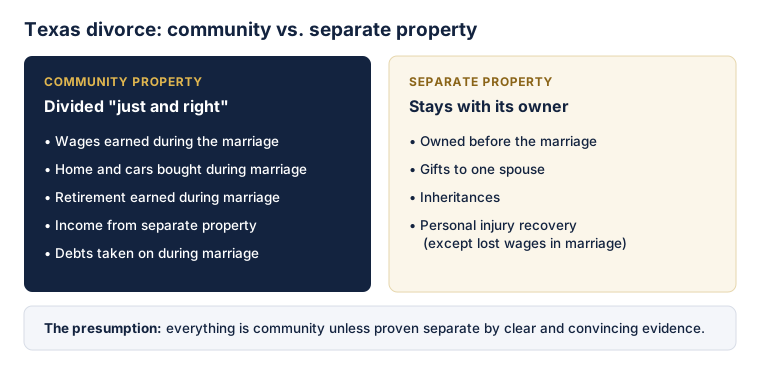
Under Texas law, community property is property, other than separate property, acquired by either spouse during the marriage (Tex. Fam. Code § 3.002). It doesn't matter whose name is on the account or who earned the money. Common examples:
- Wages and salaries earned by either spouse during the marriage
- A house, cars and furniture bought during the marriage
- Retirement contributions and growth earned during the marriage
- A business started during the marriage
- Income from separate property, like interest, dividends and rent, unless a written agreement says otherwise
Texas presumes that property either spouse has when the marriage ends is community property (§ 3.003). A spouse who claims something is separate has to prove it.
What separate property is
A spouse's separate property is (§ 3.001):
- Property owned or claimed before marriage
- Property acquired during marriage by gift, inheritance or devise
- Recovery for personal injuries during the marriage, except any recovery for lost earning capacity during the marriage
Separate property can also be created by a valid prenuptial or postnuptial agreement. The key point: separate property isn't divided in a divorce. The spouse who owns it keeps it.
Proving separate property
Because of the community presumption, a spouse claiming separate property must prove it by clear and convincing evidence, a higher standard than most civil cases. That usually means tracing: following the money from its separate source to the asset you have now.
Tracing gets hard when separate and community money are mixed, for example when an inheritance is deposited into a joint checking account used for household bills. Over years, it can become impossible to prove which dollars were separate. Useful evidence includes:
- Bank and brokerage statements from before the marriage
- Inheritance documents, wills, and gift letters
- Closing documents showing a separate-property down payment
- Records showing separate money stayed in a separate account
If you can't trace it, the property is likely treated as community property.
The "just and right" division
Texas Family Code § 7.001 requires the court to divide the community estate "in a manner that the court deems just and right, having due regard for the rights of each party and any children of the marriage" (§ 7.001). That gives judges a lot of discretion. Many divisions are close to 50/50, but courts can award a larger share to one spouse after considering factors like:
- Differences in earning power, education and business opportunities
- Each spouse's age and health
- Fault in the breakup, such as adultery or cruelty
- Which spouse will have primary custody of the children
- Each spouse's separate property
- The size of the estate and any waste or fraud on the community
Most couples never have a judge decide this. They negotiate, often in mediation, and the court approves their agreement.
A real Texas case: Eggemeyer v. Eggemeyer
The Supreme Court of Texas set a basic rule of Texas property division in Eggemeyer v. Eggemeyer, 554 S.W.2d 137 (Tex. 1977) (case brief; opinion text).
What happened
Homer Eggemeyer owned a one-third interest in a family farm, which he had received as a gift from his mother. That made it his separate property. In the divorce, the trial court gave Virginia Eggemeyer custody of the couple's four minor children and transferred Homer's one-third farm interest to her, with a $10,000 lien payable to Homer when the youngest child turned 18. It also ordered Homer to pay child support.
What the Supreme Court decided
The Supreme Court held that a Texas divorce court cannot take one spouse's separate real property and give it to the other. Only the community estate is divided. The Court explained that the Texas Constitution defines separate property, and taking it from one private person to give to another, without a public purpose, would violate the constitution's due course of law protection. The Court noted that a spouse's separate property, or its income, can still be used to support the children, but title can't be transferred.
What this means for you
- Separate property is protected. If you can prove something is separate, the court can't award it to your spouse.
- Proof is everything. The protection only helps if you can trace the asset by clear and convincing evidence.
- Children's needs still count. Separate property and its income can be considered for child support.
- Separate property can affect the community split. A spouse with significant separate property may receive a smaller share of the community estate.
The house
A home bought during the marriage is generally community property, even if only one spouse is on the deed. Common outcomes:
- One spouse keeps the house, and the other receives other assets of similar value or a cash payment. The spouse keeping it often must refinance to remove the other spouse from the mortgage.
- The house is sold, and the proceeds are divided.
- The sale is delayed, for example until children finish school, with clear terms about who pays what in the meantime.
If one spouse owned the house before marriage, it's generally that spouse's separate property. But if community money paid down the mortgage or improved the house, the community may have a claim for reimbursement. Texas homestead laws also add protections, so get advice before signing any agreement about the home.
Retirement accounts and pensions
The portion of a 401(k), 403(b), IRA, pension or military retirement earned during the marriage is generally community property. Amounts earned before the marriage are generally separate, if they can be traced.
Employer plans usually require a qualified domestic relations order (QDRO), a separate court order telling the plan administrator to pay part of the account to the other spouse. A properly drafted QDRO can let the receiving spouse roll the money into their own retirement account without early-withdrawal penalties. Mistakes in QDROs are common and costly, so they should be prepared carefully and approved by the plan.

Businesses, cars and other assets
- A business started during the marriage is generally community property, and its value may need to be determined by an expert. Ownership rules in a partnership or LLC agreement can limit how it's transferred, so one spouse often keeps the business and the other receives other assets.
- Cars bought during the marriage are community property, along with their loans.
- Bank and investment accounts opened or funded during the marriage are generally community, unless traced to separate funds.
- Stock options, bonuses and commissions earned during the marriage may be partly community, even if paid later.
- Pets are treated as property in Texas, though spouses often agree on arrangements.
Debts
Debts taken on during the marriage, like credit cards, car loans and personal loans, are generally divided along with the assets. But there's a catch: a divorce decree doesn't bind your creditors. If your name is on a credit card or loan, the lender can still pursue you if your ex doesn't pay, even if the decree says it's their debt. Where possible:
- Pay off or close joint credit cards before or at the divorce
- Refinance joint loans into the name of the spouse who keeps the asset
- Remove authorized users from your accounts
- Check your credit report after the divorce
Reimbursement and hidden assets
Texas lets the court consider reimbursement claims when one marital estate paid for the benefit of another, for example when community funds paid down the mortgage on one spouse's separate house, or one spouse's separate money paid community debts (§ 3.402).
Courts can also respond when a spouse wastes or hides community property, such as by secretly transferring money, gambling it away, or spending it on an affair. Under § 7.009, a court that finds fraud on the community can calculate a "reconstituted estate" and adjust the division to make up for it (§ 7.009).
Spousal maintenance (alimony)
Texas limits court-ordered spousal maintenance. Generally, a spouse who will lack enough property to meet minimum reasonable needs may qualify in certain situations, such as a marriage of 10 years or longer combined with an inability to earn enough income, a disability, care of a disabled child, or family violence by the other spouse. When maintenance is awarded, the amount is generally capped at the lesser of $5,000 a month or 20% of the paying spouse's average monthly gross income, and the length depends on the length of the marriage (§ 8.055). Spouses can also agree to contractual alimony in their settlement.
How to protect yourself
- Make copies of financial records: tax returns, bank, credit card, retirement and loan statements, and deeds and titles.
- List everything, including what each spouse owned before the marriage and any gifts or inheritances.
- Don't hide or move money. It can backfire badly, and standing orders in many counties prohibit it.
- Keep separate money separate going forward.
- Get values right. Houses, businesses and pensions may need appraisals or experts.
- Think about taxes. A dollar in a retirement account and a dollar in a checking account aren't worth the same after taxes.
When to talk to a lawyer
Talk to a licensed Texas family lawyer if:
- You or your spouse owns a business, significant investments or a pension
- You're claiming separate property, or your spouse is
- You suspect your spouse is hiding or wasting money
- There's a prenuptial or postnuptial agreement
- You're offered a settlement and aren't sure it's fair
For a referral, contact the State Bar of Texas Lawyer Referral and Information Service at (800) 252-9690, Monday to Friday, 8:30 a.m. to 4:30 p.m., or texasbar.com/LawyerReferral. Free information and forms for uncontested divorces are available at TexasLawHelp.org.
Checklist: protecting your property in a Texas divorce
- Copy tax returns and account statements for several years
- List all assets and debts, with values
- Gather proof of separate property: pre-marriage statements, gift and inheritance documents
- Find the deed, mortgage and car titles
- Get statements for every retirement account and pension
- Pull your credit report and list joint accounts
- Don't move, hide or waste money
- Plan for a QDRO if retirement accounts will be divided
- Close or refinance joint debts as part of the settlement
Frequently asked questions
Is Texas a 50/50 divorce state?
Not exactly. Texas is a community property state, but the law requires the court to divide community property in a way that is 'just and right,' which isn't always equal. Courts can consider things like each spouse's earning power, health, fault in the breakup and which spouse has the children.
What is separate property in Texas?
Separate property is property a spouse owned before marriage, property received during marriage by gift or inheritance, and recovery for personal injuries (except lost earnings during the marriage). A Texas court can't take one spouse's separate property and give it to the other.
Who gets the house in a Texas divorce?
If the house was bought during the marriage, it's generally community property and the court divides its value as part of the overall division. One spouse may keep it and the other receives other assets, or the house may be sold. If one spouse owned the house before marriage, it's generally that spouse's separate property, though the community may have a claim for payments made during the marriage.
How are retirement accounts divided in a Texas divorce?
The portion of a 401(k), pension or similar account earned during the marriage is generally community property. Dividing an employer plan usually requires a separate court order called a qualified domestic relations order (QDRO), so the plan can pay the other spouse's share without early-withdrawal penalties.
Am I responsible for my spouse's debts in a Texas divorce?
Debts taken on during the marriage are generally divided along with the assets. But the divorce decree doesn't bind creditors: if your name is on a loan or credit card, the lender can still come after you even if the decree assigns that debt to your ex. Closing or refinancing joint accounts protects you.
Sources
- Tex. Fam. Code § 3.001: separate property
- Tex. Fam. Code § 3.002: community property
- Tex. Fam. Code § 3.003: presumption of community property
- Tex. Fam. Code § 3.402: reimbursement
- Tex. Fam. Code § 7.001: just and right division
- Tex. Fam. Code § 7.009: fraud on the community
- Tex. Fam. Code § 8.055: amount of spousal maintenance
- Eggemeyer v. Eggemeyer, 554 S.W.2d 137 (Tex. 1977), case brief
- Eggemeyer v. Eggemeyer, opinion text
- TexasLawHelp.org: divorce guides and forms
Keep reading
 Divorce & Family · Texas
Child Custody and Child Support in a Texas Divorce: What Parents Should Know
Texas calls custody 'conservatorship' and visitation 'possession and access.' Here's how judges decide, what the standard schedule looks like, how child support is calculated, and how orders can change.
 Divorce & Family · Texas
How to File for Divorce in Texas: Steps, Costs and the 60-Day Waiting Period
Thinking about divorce in Texas? Here's the whole process in plain English: who can file and where, what it costs, why you have to wait 60 days, and how agreed and contested divorces end.
 Work Injuries · Texas
Oilfield Accidents in Texas: Injury Claims, Workers' Comp and Who Is Liable
Texas leads the nation in oil and gas worker deaths. If you were hurt on a rig, at a well site or on the road to one, several companies may share responsibility. Here's how Texas law sorts it out.