Divorce & Family · Texas
How to File for Divorce in Texas: Steps, Costs and the 60-Day Waiting Period
Thinking about divorce in Texas? Here's the whole process in plain English: who can file and where, what it costs, why you have to wait 60 days, and how agreed and contested divorces end.

The short answer: to divorce in Texas, one spouse must have lived in Texas for six months and in the filing county for 90 days. You file an Original Petition for Divorce with the district clerk, pay the county's filing fee, and serve your spouse. Texas then requires a 60-day waiting period before a judge can sign the final decree. You don't need to prove fault: Texas allows no-fault divorce.
Deciding to end a marriage is hard enough. Figuring out the paperwork shouldn't add to the stress. Texas divorce follows a clear set of steps, and many couples who agree on the big issues finish without ever going to trial. Others need mediation or a judge to decide what they can't settle themselves.
This guide walks through the Texas divorce process from start to finish: who can file and where, grounds, costs, the 60-day waiting period, serving your spouse, temporary orders, mediation, a Texas Supreme Court case about a mediated agreement, and the final decree. For what happens to your house, savings and debts, see our guide to property division in a Texas divorce. If you have children, see our guide to child custody and support.
- Who can file, and where
- Grounds: no-fault and fault
- Uncontested vs. contested divorce
- The steps, from petition to decree
- What it costs
- The 60-day waiting period
- Temporary orders and protective orders
- Mediation and settlement
- A real Texas case: Milner v. Milner
- Documents to gather
- When to talk to a lawyer
- Checklist and FAQ
Who can file, and where
Texas has two residency rules (Tex. Fam. Code § 6.301):
- State: at least one spouse must have been domiciled in Texas for the past six months.
- County: the person filing must have lived in the county where they file for the past 90 days.
If you've just moved, you may need to wait, or file in the county where your spouse lives if they meet the rules. Time spent away on military service generally counts as Texas residence for service members who lived here before.
Divorces are filed in the district court of the county, through the district clerk's office. Many counties accept electronic filing through eFileTexas.gov.
Grounds: no-fault and fault
Most Texas divorces are filed on the no-fault ground of insupportability: the marriage has become insupportable because of discord or conflict that has destroyed the relationship, and there's no reasonable expectation of reconciliation (§ 6.001). You don't have to prove your spouse did anything wrong, and your spouse can't stop the divorce by refusing to agree.
Texas also recognizes other grounds:
- Cruelty that makes living together insupportable
- Adultery
- Conviction of a felony with imprisonment for at least a year
- Abandonment for at least a year, with intent to abandon
- Living apart for at least three years
- Confinement in a mental hospital for at least three years, if recovery is unlikely
Why would anyone plead fault when no-fault is easier? Because in Texas, fault can be considered when the court divides community property. A spouse who proves adultery or cruelty may ask for a larger share. Fault claims add cost and conflict, though, so they're worth discussing with a lawyer first.
Uncontested vs. contested divorce
- Uncontested: you and your spouse agree on everything: dividing property and debts, and, if you have children, custody, visitation and child support. You prepare an agreed final decree, and once the waiting period ends, one spouse usually attends a short hearing (sometimes called a "prove-up") or the court signs it without one.
- Contested: you disagree on one or more issues. The case goes through exchanging information (discovery), often mediation, and, if needed, a trial where a judge (or in some issues a jury) decides.
Many divorces start contested and end agreed after mediation. Agreeing doesn't mean giving in: it means you, not a judge, decide the result.
The steps, from petition to decree
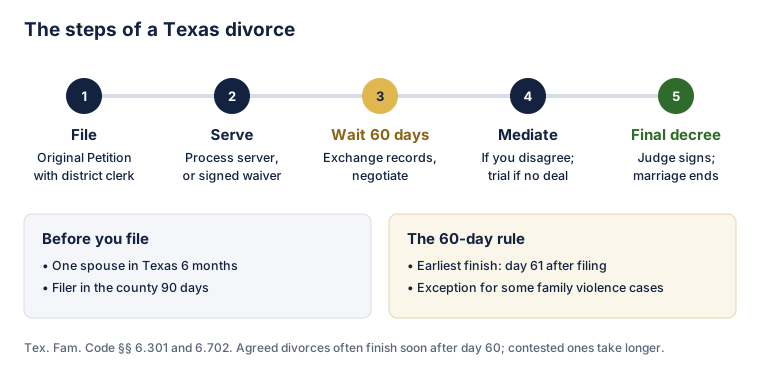
1. File the Original Petition for Divorce
The spouse who files is the petitioner; the other is the respondent. The petition gives basic information about the marriage, any children, and what you're asking the court to do. If you have children, you'll usually also file information about them for the court and the child support office.
2. Serve your spouse, or get a waiver
Your spouse must be formally notified. Options include:
- Waiver of service: your spouse signs a waiver, often in front of a notary, after the petition is filed. It's the fastest and cheapest option in an agreed divorce.
- Personal service: a constable, sheriff or private process server delivers the papers.
- Other methods: if your spouse can't be found, the court can allow other service, such as by publication, after you show you tried.
3. Answer and exchange information
A served respondent typically has until 10 a.m. on the Monday after 20 days to file an answer. If they don't, the petitioner may be able to get a default judgment after the waiting period. In contested cases, both sides exchange financial information, such as bank statements, pay stubs, retirement accounts and debts.
4. Negotiate and mediate
Many courts require mediation before a contested divorce can go to trial. See mediation and settlement below.
5. Finalize the decree
The Final Decree of Divorce is the court order that ends the marriage and spells out who gets what and, for parents, the custody, visitation and support orders. Once the judge signs it, you're divorced. Read it carefully: the decree, not anything you agreed to informally, is what controls.
What it costs
- Filing fee: set by each county, commonly about $250 to $400. For example, Harris County lists $350 without children and $365 with children (divorce.law guide). Check your district clerk's current fee schedule.
- Service: about $50 to $100 or more for a constable or process server, or nothing with a signed waiver.
- Parenting course: some counties require one for parents.
- Mediation: mediators charge by the hour or half-day; some counties offer low-cost programs.
- Lawyers: costs vary widely. An uncontested divorce costs far less than a contested one with trial.
If you can't afford court costs, you can file a Statement of Inability to Afford Payment of Court Costs under Texas Rule of Civil Procedure 145. If you receive benefits like SNAP or Medicaid, or your income is low, the court may waive the fees.
The 60-day waiting period
A Texas court can't grant a divorce until at least 60 days after the petition was filed (§ 6.702). The earliest your divorce can be final is the 61st day. The waiting period gives spouses time to reconsider, and it applies even if you agree on everything.
There's one main exception: the waiting period doesn't apply when the respondent has been convicted of, or received deferred adjudication for, family violence against the petitioner or a member of their household, or when the petitioner has an active protective order based on a finding of family violence.
Keep in mind that 60 days is a minimum, not a deadline. If you can't agree, or the court's docket is busy, the case will take longer.
Temporary orders and protective orders
Divorces take time, and life doesn't stop. While the case is pending, either spouse can ask the court for temporary orders covering things like who lives in the house, who pays which bills, temporary custody and child support, and use of cars and accounts. Many Texas counties also have standing orders that apply automatically once a divorce is filed, telling both spouses not to hide or waste property, cancel insurance, or disrupt the children's routine.
If you're in danger, you can ask for a protective order. If you are in immediate danger, call 911. The National Domestic Violence Hotline is available 24/7 at 800-799-7233.

Mediation and settlement
In mediation, a neutral mediator helps spouses negotiate. Each spouse often sits in a separate room with their lawyer while the mediator goes back and forth. Mediation is confidential, and the mediator doesn't decide anything. Many courts require it before trial.
If you reach an agreement, it's usually written up as a mediated settlement agreement (MSA). Under Texas Family Code § 6.602, an MSA is binding and can't be revoked if it includes a prominently displayed statement, in bold, capital or underlined letters, that it isn't subject to revocation, and it's signed by both spouses and any attorneys who were present (§ 6.602). That means you generally can't change your mind the next day, so take your time before you sign.
A real Texas case: Milner v. Milner
The Supreme Court of Texas showed how binding a mediated settlement agreement is in Milner v. Milner, No. 10-0776 (Tex. March 9, 2012) (case summary; case commentary).
What happened
Vicki Milner filed for divorce from Jack Milner, and they signed a mediated settlement agreement. Jack agreed to transfer to Vicki his interest in a partnership and a limited liability company formed during the marriage. Jack's brother, Joey, signed the required consents. But four days later, Joey sold his own interest to a man named Michael Hill, who never signed. Without Hill's consent, Vicki couldn't become a limited partner the way she expected.
The dispute
Jack submitted a draft divorce decree that followed the agreement. Vicki objected and tried to withdraw her consent. The trial court refused and divided the property under the agreement. The court of appeals reversed, finding there had been no meeting of the minds about the partnership interests.
What the Supreme Court decided
The Supreme Court held that the agreement was binding and irrevocable because it met the statutory requirements and was signed by both spouses and their lawyers. But it also found the agreement was ambiguous about what Vicki was supposed to receive, which raised a question about what the spouses intended. Under the agreement, disputes about its meaning went back to the mediator to resolve.
What this means for you
- An MSA is not a draft. Once it's properly signed, you generally can't back out because you've had second thoughts.
- Unclear wording causes fights later. Be specific about exactly which assets, accounts and interests each spouse receives.
- Business interests need extra care. Partnerships and companies often have rules about who can own an interest. Check them before you sign.
- Read the dispute clause. Many MSAs send disagreements back to the mediator or to arbitration.
Documents to gather
- Your marriage date and place, and your children's birth dates
- Recent pay stubs and tax returns for both spouses
- Bank, investment and retirement account statements
- Mortgage, deed, car titles and loan statements
- Credit card and other debt statements
- Records showing property you owned before marriage or received by gift or inheritance
- Insurance policies, and any prenuptial or postnuptial agreement
When to talk to a lawyer
TexasLawHelp.org offers free instructions and forms for uncontested divorces, with or without children (TexasLawHelp divorce guide), and the Texas State Law Library explains that self-represented divorce generally works only when spouses agree (State Law Library FAQ). Talk to a licensed Texas family lawyer if:
- You and your spouse disagree about property, debts or children
- There's a house, business, retirement account or significant debt to divide
- There's family violence, or you're afraid of your spouse
- Your spouse has a lawyer
- You're asked to sign a mediated settlement agreement or decree you don't fully understand
For a referral, contact the State Bar of Texas Lawyer Referral and Information Service at (800) 252-9690, Monday to Friday, 8:30 a.m. to 4:30 p.m., or texasbar.com/LawyerReferral. Low-income Texans may qualify for free help through legal aid organizations listed on TexasLawHelp.org.
Checklist: filing for divorce in Texas
- Confirm the six-month state and 90-day county residency
- Gather financial records and documents
- Decide whether the divorce is likely to be agreed or contested
- File the Original Petition for Divorce with the district clerk
- Pay the filing fee, or file a Statement of Inability to Afford Payment
- Serve your spouse or get a signed waiver
- Ask for temporary or protective orders if needed
- Wait at least 60 days; mediate if you disagree
- Review the final decree carefully before it's signed
Frequently asked questions
How long does a divorce take in Texas?
At least 60 days from the day the petition is filed, because Texas has a mandatory waiting period. An uncontested divorce often finishes soon after the 60 days end. A contested divorce, with disagreements about property or children, can take many months or longer.
How much does it cost to file for divorce in Texas?
The filing fee is set by each county and is commonly in the range of about $250 to $400, with some counties charging more when there are children. Serving your spouse can add more. If you can't afford the fees, you can file a Statement of Inability to Afford Payment of Court Costs.
Do I need a reason to get divorced in Texas?
No. Texas allows a no-fault divorce on the ground of insupportability, meaning the marriage has become insupportable because of conflict or discord that has destroyed the relationship and there's no reasonable expectation of reconciliation. Fault grounds like adultery and cruelty also exist and can affect the property division.
Who can file for divorce in Texas?
At least one spouse must have lived in Texas for the past six months, and the person filing must have lived in the county where they file for the past 90 days.
Can I get divorced in Texas without a lawyer?
Yes, especially if the divorce is uncontested. TexasLawHelp.org offers free instructions and forms for uncontested divorces with and without children. If you and your spouse disagree about property, debts or children, or there's family violence, talking to a lawyer is strongly recommended.
Sources
- Tex. Fam. Code § 6.001: insupportability
- Tex. Fam. Code § 6.301: residency requirements
- Tex. Fam. Code § 6.602: mediated settlement agreements
- Tex. Fam. Code § 6.702: 60-day waiting period
- Disputing blog: Milner v. Milner, No. 10-0776 (Tex. 2012)
- CaseMine: interpreting mediated settlement agreements, Milner v. Milner
- TexasLawHelp.org: divorce guides and forms
- Texas State Law Library: pro se divorce FAQ
- divorce.law: filing for divorce in Texas (fees and steps)
Keep reading
 Divorce & Family · Texas
Child Custody and Child Support in a Texas Divorce: What Parents Should Know
Texas calls custody 'conservatorship' and visitation 'possession and access.' Here's how judges decide, what the standard schedule looks like, how child support is calculated, and how orders can change.
 Divorce & Family · Texas
How Property Is Divided in a Texas Divorce: Community Property Explained
Texas is a community property state, but that doesn't always mean a 50/50 split. Here's how courts decide who keeps the house, the retirement accounts and the debts, and how to protect what's yours.
 Work Injuries · Texas
Oilfield Accidents in Texas: Injury Claims, Workers' Comp and Who Is Liable
Texas leads the nation in oil and gas worker deaths. If you were hurt on a rig, at a well site or on the road to one, several companies may share responsibility. Here's how Texas law sorts it out.