Work Injuries · Texas
Oilfield Accidents in Texas: Injury Claims, Workers' Comp and Who Is Liable
Texas leads the nation in oil and gas worker deaths. If you were hurt on a rig, at a well site or on the road to one, several companies may share responsibility. Here's how Texas law sorts it out.

The short answer: if you were hurt in a Texas oilfield accident, you may have a workers' comp claim or, if your employer is a non-subscriber, a negligence lawsuit against your employer. You may also have claims against other companies: the operator, another service contractor, a trucking company or an equipment maker. Because a single well site involves so many companies, figuring out who controlled the work that hurt you is usually the key question.
The oilfield is one of the most dangerous places to work in Texas. Crews work long shifts around heavy pipe, high-pressure lines and flammable gas, often hours from the nearest hospital, and many spend hours on two-lane highways between the rig, the yard and the man camp. When something goes wrong, injuries are often catastrophic: crushed limbs, burns, amputations, brain and spinal injuries.
The legal side is complicated too. On a single location, the operator, the drilling contractor, the well service company, the frac crew, the water hauler and the equipment rental company may all be working at once, each with its own employees and insurance. This guide explains how Texas law handles oilfield injuries: the most common accidents, workers' comp and non-subscribers, claims against operators and other contractors, fatigue-related crashes, a Texas case about a worker who fell asleep driving home, and what to do first. For the basics of any work injury, see our work injury guide.
- How dangerous oilfield work is in Texas
- The most common oilfield accidents
- What to do after an oilfield injury
- Who can be responsible
- Your employer: workers' comp or non-subscriber
- Claims against the operator
- Other contractors, trucking companies and manufacturers
- Fatigue and crashes on oilfield roads
- A real Texas case: McNeil v. Nabors Drilling
- Master service agreements and indemnity
- Retaliation, rules and offshore work
- Deadlines and when to call a lawyer
- Checklist and FAQ
How dangerous oilfield work is in Texas
A CDC study of oil and gas extraction deaths from 2014 through 2019 found 470 worker deaths nationwide, and 219 of them in Texas, more than any other state. In Texas, 54 of those deaths came from workers being struck by objects and 53 from vehicle crashes. The Permian Basin alone accounted for about 30% of the industry's deaths (Texas Tribune, reporting on the CDC study).
In 2024, 557 people died from work injuries in Texas. The mining, quarrying, and oil and gas extraction industry accounted for 36 of those deaths, including 26 in support activities for oil and gas operations, according to the Texas Department of Insurance (TDI, 2024 Texas fatal occupational injuries report). Many more workers are seriously injured every year.
The most common oilfield accidents
- Vehicle crashes: long drives between sites in pickups, crew vans and tanker trucks, often after long shifts, on rural highways crowded with heavy traffic
- Struck-by accidents: swinging pipe, tongs and chains, falling tools, snapped lines, and equipment or vehicles moving on location
- Caught-in or between: hands and limbs caught in rotating equipment, pinch points, or between pipe and the rig
- Fires and explosions: ignition of gas or vapors from wells, tanks and lines, including during hot work
- Falls: from the derrick, rig floor, catwalks, tanks and trucks
- Toxic exposure: hydrogen sulfide (H2S) and other gases, and chemicals used in drilling and completion
- High-pressure releases: failures of lines, hoses and fittings during fracking and well service
What to do after an oilfield injury
1. Get medical care and report the injury
Get emergency care for anything serious. Report the injury to your supervisor right away and follow up in writing. If your employer carries workers' comp, you must report within 30 days. Tell the doctor exactly how you were hurt on the job.
2. Write down every company on location
Note the operator and lease or well name, the rig number, your employer, the companies working near you, and the company that owned or rented the equipment involved. The location sign at the lease entrance usually shows the operator and well name.
3. Document the scene and equipment
- Photos of the equipment, the area where you were hurt, and any missing guards or safety gear
- Names and numbers of coworkers and workers from other companies who saw it
- Job safety analyses (JSAs), permits, tailgate meeting notes, and texts from supervisors
- The tool, line or part that failed. Ask that it be kept and not repaired or thrown away.
4. Find out about workers' comp coverage
Ask whether your employer carries workers' comp. You can also call the Texas Division of Workers' Compensation at 800-252-7031.
5. Be careful with statements and paperwork
Companies often investigate quickly and may ask for a written or recorded statement. Stick to the facts, don't guess about causes, and don't sign waivers or settlement papers without understanding them.
Who can be responsible
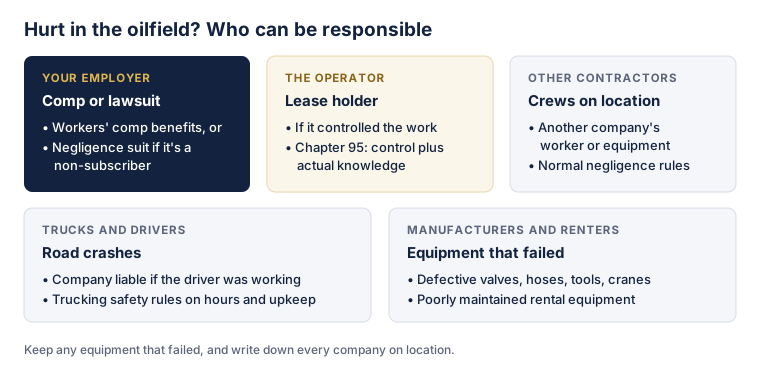
Depending on the facts, claims may involve:
- Your employer, through workers' comp or, if it's a non-subscriber, a negligence lawsuit
- The operator, the company that holds the lease and directs the well, if it controlled the work and knew of the danger
- Other contractors on location whose workers or equipment caused the accident
- Trucking companies and drivers, in crashes on lease roads and highways
- Equipment manufacturers and rental companies, if defective or poorly maintained equipment caused the injury
Your employer: workers' comp or non-subscriber
Most private Texas employers, including many oilfield service companies, may choose whether to carry workers' compensation (Tex. Labor Code § 406.002).
- If your employer has workers' comp, you get medical care and income benefits without proving fault, but you generally can't sue your employer. If a worker dies, the surviving spouse and heirs of the body may still sue the employer for gross negligence and seek punitive damages.
- If your employer is a non-subscriber, you can sue it for negligence, and it can't argue that you were careless, that a coworker caused the injury, or that you assumed the risk.
Some large operators run "wrap-up" insurance programs that provide workers' comp for every contractor's workers on a project. That can make the operator your employer for workers' comp purposes and bar a negligence lawsuit against it. Ask whether such a program covered your job. Our work injury guide and construction injury guide explain these rules in detail.
Claims against the operator
The operator is often the company with the most control over the site, and the most insurance. But operators usually hire independent contractors to do the dangerous work, and Texas law limits when a company is responsible for injuries to a contractor's employees.
- The control test. Generally, a company that hires a contractor is liable for injuries to the contractor's employees only if it controlled, or had the contractual right to control, the specific work that caused the injury. Requiring general safety compliance or setting schedules usually isn't enough.
- Chapter 95. When a contractor's employee is injured by the condition or use of an improvement to real property, Chapter 95 of the Civil Practice and Remedies Code requires proof that the property owner controlled the manner of the work and had actual knowledge of the danger and failed to adequately warn (§ 95.003). Operators frequently argue that wells, tanks and lines are such improvements.
- Company men matter. The operator's on-site representative, often called the company man, may direct how work is done. If they ordered the crew to keep working despite a known hazard, or chose the method that failed, the operator may be responsible.
Other contractors, trucking companies and manufacturers
When your own employer has workers' comp, claims against other companies are often the main path to full compensation.
- Other contractors: if another company's crane operator, truck driver or crew caused the accident, that company can be liable for negligence like anyone else.
- Defective equipment: failed valves, hoses, fittings, wireline equipment, blowout preventers, cranes and tools can support product liability claims against the manufacturer or seller.
- Rental companies: equipment rented with worn parts, missing guards or bad maintenance can make the rental company responsible.
- Trucking companies: oilfield trucks, tankers and sand haulers are commercial vehicles subject to safety rules on hours, maintenance and driver qualifications. See our truck accident guide.
Fatigue and crashes on oilfield roads
Oilfield workers often work 12-hour or longer shifts for days or weeks at a time, then drive long distances to a hotel, man camp or home. Fatigue has been linked to dozens of fatal oilfield crashes in Texas. In one 2014 crash in the Eagle Ford Shale, a van carrying a well service crew that had just finished a 24-hour shift struck a school bus near Three Rivers; the driver had fallen asleep, and three workers died (StateImpact Texas/NPR).
Who is responsible depends heavily on whether the driver was working:
- On the job: if the driver was driving a company truck or crew van as part of the job, the employer is generally responsible for the driver's negligence, and the injured people may have strong claims against the company.
- Off duty: if a worker crashes while driving their own car home after a shift, Texas courts have generally held that the employer isn't responsible, as the case below shows.
A real Texas case: McNeil v. Nabors Drilling
In McNeil v. Nabors Drilling USA, Inc., No. 01-99-00925-CV (Tex. App.—Houston [1st Dist.] Jan. 11, 2001), a Texas appeals court addressed whether a drilling company was responsible for a crash caused by an exhausted rig worker driving home (opinion).
What happened
A Nabors Drilling employee worked a 6 p.m. to 6 a.m. shift on a six-days-on, six-days-off rotation. Over the three days before the crash, he had gotten less than 15 hours of sleep, and he knew he was tired. Almost four hours after going off duty, while driving home on a two-lane highway in Burleson County, he fell asleep at the wheel and crashed head-on into Patricia McNeil's car, injuring her.
The lawsuit
Patricia and Milton McNeil sued the employee and Nabors. They argued Nabors failed to provide a safe work environment that protected people on the road, and that by providing sleeping quarters at the rig, it took on a duty to provide them reasonably so its workers could rest.
What the court decided
The court affirmed summary judgment for Nabors. Following the Texas Supreme Court's decision in Otis Engineering Corp. v. Clark, it held that an employer takes on a duty over an employee's off-duty conduct only when it knows the employee is incapacitated and affirmatively takes control of the employee. Neither was shown, and providing sleeping quarters didn't create a duty to people on the road. In 2009, the Texas Supreme Court applied the same principle in Nabors Drilling, U.S.A., Inc. v. Escoto, holding that the company owed no duty to prevent a fatigue crash after a shift that killed several people, including the employee (case commentary).
What this means for you
- Whether the driver was on the clock is crucial. A crew van or company truck driven as part of the job is very different from a worker's own car after a shift.
- The driver is still responsible. Even when the employer isn't, the tired driver's own auto insurance covers the crash, and your own UM/UIM coverage may help.
- Evidence of control can change the result. If a supervisor knew a worker was exhausted and ordered or directed them to drive, the analysis may be different.
- Get the facts quickly. Time sheets, shift schedules, GPS data and travel arrangements show whether the driver was working.
Master service agreements and indemnity
Oilfield companies usually sign master service agreements (MSAs) that say which company will cover which injuries, often through "knock-for-knock" indemnity, where each company agrees to cover injuries to its own workers no matter who caused them. Texas regulates these agreements through the Oilfield Anti-Indemnity Act in Chapter 127 of the Civil Practice and Remedies Code (Chapter 127).
For an injured worker, MSAs mostly affect which insurance company ends up paying, not whether you can bring a claim. But they matter behind the scenes: they can affect settlement negotiations and who has an incentive to fight your claim. A lawyer will want copies of the MSAs between the companies on location.
Retaliation, rules and offshore work
- Retaliation: Texas Labor Code § 451.001 prohibits firing or discriminating against a worker for filing a workers' comp claim in good faith. Federal law also protects workers who report safety concerns.
- Safety rules: OSHA sets federal workplace safety standards, and the Railroad Commission of Texas regulates oil and gas wells, including rules on hydrogen sulfide. Violations can be strong evidence of negligence, though a citation doesn't automatically win a case.
- Offshore and maritime work: workers on offshore platforms, drilling vessels or barges may be covered by federal laws like the Jones Act, the Longshore and Harbor Workers' Compensation Act or the Outer Continental Shelf Lands Act instead of Texas workers' comp. These have different rules and deadlines.
Deadlines
- Workers' comp: report to your employer within 30 days; file with the Division of Workers' Compensation within one year
- Lawsuits against a non-subscriber employer, operator, contractor or manufacturer: generally two years from the injury
- Wrongful death: generally two years from the date of death; see our wrongful death guide
See our guide to Texas injury claim deadlines.
When to call a lawyer
Oilfield cases often involve several companies, contracts and insurance policies. Talk to a licensed Texas lawyer if:
- You were seriously injured, or a coworker or family member died
- Your employer is a non-subscriber
- Another company's crew or equipment caused the accident
- Equipment failed, or safety gear or procedures were missing
- You were hurt in a crash in a company vehicle or by an oilfield truck
- Your workers' comp claim was denied, or you were fired after reporting
The Office of Injured Employee Counsel offers free help with workers' comp claims at 866-393-6432. For a lawyer referral, contact the State Bar of Texas Lawyer Referral and Information Service at (800) 252-9690, Monday to Friday, 8:30 a.m. to 4:30 p.m., or texasbar.com/LawyerReferral. Our Find a Lawyer page has questions to ask.
Checklist: after an oilfield injury
- Get medical care and tell the doctor it happened at work
- Report the injury to your supervisor, then in writing
- Write down the operator, well name, rig number and every company on location
- Photograph the scene, equipment and any missing safety gear
- Get names of coworkers and other witnesses
- Ask that failed equipment be preserved
- Find out whether your employer, or a wrap-up program, provides workers' comp
- Don't sign statements, waivers or releases without understanding them
- Mark the 30-day, one-year and two-year deadlines
Frequently asked questions
Can I sue my employer for an oilfield injury in Texas?
It depends on whether your employer carries workers' compensation. If it does, you generally receive workers' comp benefits and can't sue your employer for negligence, except for gross negligence claims by the family of a worker who died. If your employer is a non-subscriber, you can sue it for negligence, and it loses key defenses.
Can I sue the oil company or operator for an injury on a well site?
Sometimes. The operator is often not your employer, so a negligence claim may be possible. But operators frequently argue that Chapter 95 of the Civil Practice and Remedies Code protects them, which requires proof that the operator controlled the work and actually knew about the danger. Each case depends on who controlled the work that caused the injury.
What are the most common oilfield accidents in Texas?
Vehicle crashes and being struck by objects are the leading causes of oil and gas worker deaths. Workers are also hurt in fires and explosions, falls, being caught in equipment, and exposure to toxic gases like hydrogen sulfide.
Is my employer responsible if a tired coworker crashed driving home from a shift?
Often not. Texas courts have held that employers generally don't owe a duty to prevent off-duty fatigue crashes unless they knew the employee was impaired and took control of the employee. But if the driver was on the job, such as driving a company crew van, the company can be responsible.
How long do I have to file an oilfield injury claim in Texas?
For workers' comp, report the injury to your employer within 30 days and file with the Division of Workers' Compensation within one year. Lawsuits against a non-subscriber employer, an operator, another contractor or a manufacturer generally must be filed within two years.
Sources
- Texas Tribune: Texas leads the nation in oil and gas worker deaths (CDC study)
- Texas Department of Insurance: 2024 fatal occupational injuries in Texas
- StateImpact Texas/NPR: Fatigue linked to dozens of fatal crashes involving oilfield workers
- McNeil v. Nabors Drilling USA, Inc., No. 01-99-00925-CV (Tex. App.—Houston [1st Dist.] 2001)
- Nabors Drilling, U.S.A., Inc. v. Escoto (Tex. 2009), commentary
- Tex. Civ. Prac. & Rem. Code § 95.003: property owner liability
- Tex. Civ. Prac. & Rem. Code Chapter 127: oilfield indemnity agreements
- Tex. Labor Code § 406.002: workers' comp coverage is elective for most private employers
- Tex. Labor Code § 451.001: protection against retaliation
- State Bar of Texas Lawyer Referral and Information Service (TexasLawHelp.org)
Keep reading
 Work Injuries · Texas
Construction Site Injuries in Texas: Workers' Comp, Lawsuits and Who Is Liable
Construction is one of the deadliest jobs in Texas. If you were hurt on a job site, the companies around you, not just your employer, may be responsible. Here's how Texas law decides who pays.
 Work Injuries · Texas
Hurt at Work in Texas? Workers' Comp, Non-Subscribers and Your Rights
Texas is unusual: most private employers can choose not to carry workers' compensation. Whether yours does changes almost everything about your injury claim. Here's how both systems work and what to do first.
 Divorce & Family · Texas
Child Custody and Child Support in a Texas Divorce: What Parents Should Know
Texas calls custody 'conservatorship' and visitation 'possession and access.' Here's how judges decide, what the standard schedule looks like, how child support is calculated, and how orders can change.