Slip & Fall · Texas
Slipped and Fell in a Store in Texas? What the Law Says and What to Do
A fall in a grocery store or shop can cause real injuries, but Texas law doesn't make a store pay for every fall. Here's what you have to prove, why evidence of how long a spill was there is so important, and the steps to take right away.

The short answer: if you slip and fall in a Texas store, the store isn't automatically responsible. You generally have to show it created the hazard, knew about it, or that the hazard was there long enough that the store should have found it. That last point turns on evidence of how long the spill was there. So the most important things you can do are photograph the hazard before it's cleaned, get witness names, report the fall, and see a doctor.
It happens in a second. One moment you're reaching for a gallon of milk, the next you're on the floor, your hip throbbing, a puddle of something soaking into your jeans. People rush over. Someone in a store vest asks if you're okay. Within minutes the spill is mopped up, and the only evidence of what happened is how much it hurts.
Slip-and-fall injuries can be serious: broken wrists, hip fractures, knee and back injuries, and head injuries. But Texas law sets a specific bar for when a store has to pay. This guide explains what you need to prove, why evidence disappears so quickly in fall cases, what a 2026 Texas Supreme Court decision means for shoppers, and exactly what to do if it happens to you.
What to do right after a fall
In a fall case, the first ten minutes matter more than almost anything else, because the hazard that caused your fall is usually cleaned up right away. Here's what to do, if you're able.
1. Check yourself before you stand up
Falls can cause fractures and head injuries that aren't obvious at first. If you hit your head, feel dizzy, can't put weight on a leg, or have severe pain, stay where you are and ask someone to call 911. Let paramedics help you up.
2. Photograph the hazard before it's gone
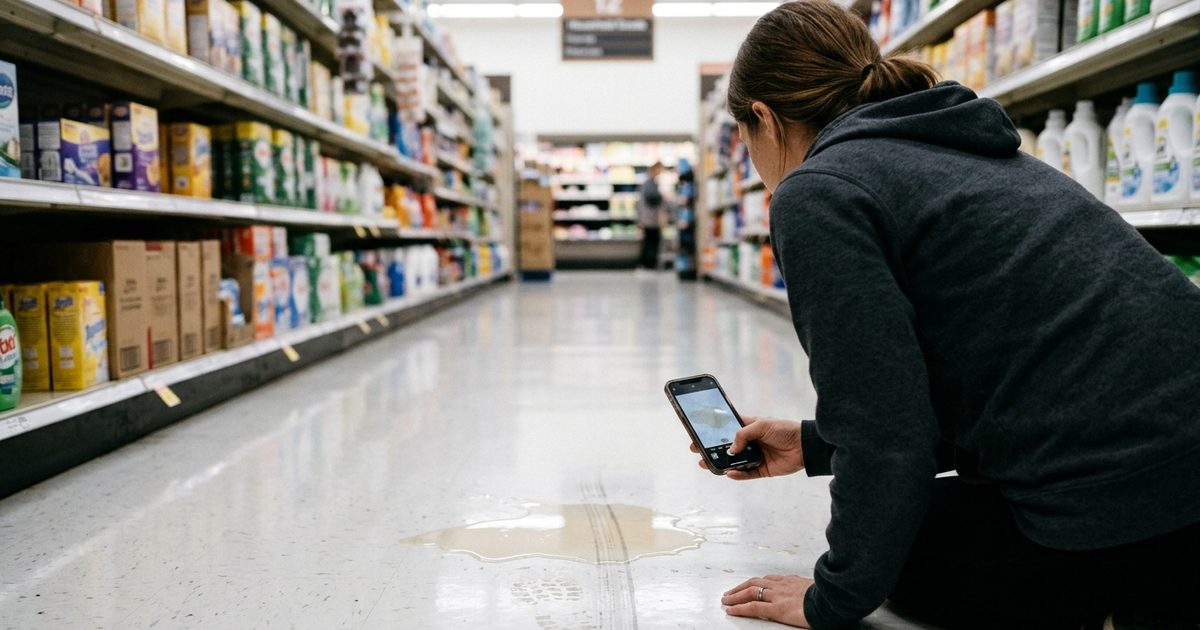
If you can, take photos and video right away, before anyone cleans it up. Get:
- Close-ups of whatever you slipped on: the liquid, food, ice or debris
- Wider shots showing where it was in the aisle
- Any footprints, cart tracks or dirt in the spill, which can suggest it had been there a while
- Anything above it, like a leaking ceiling tile, cooler or display
- Whether there was a wet-floor sign or warning, or not
- The lighting, and anything that blocked your view of the floor
- Your shoes and the clothes that got wet
If you can't move, ask a friend or bystander to take the photos with your phone.
3. Get witness names and phone numbers
Other shoppers and even employees may have seen the spill before you fell, or seen how long it had been there. That kind of information can make or break a case, as you'll see below. Get names and numbers before people leave.
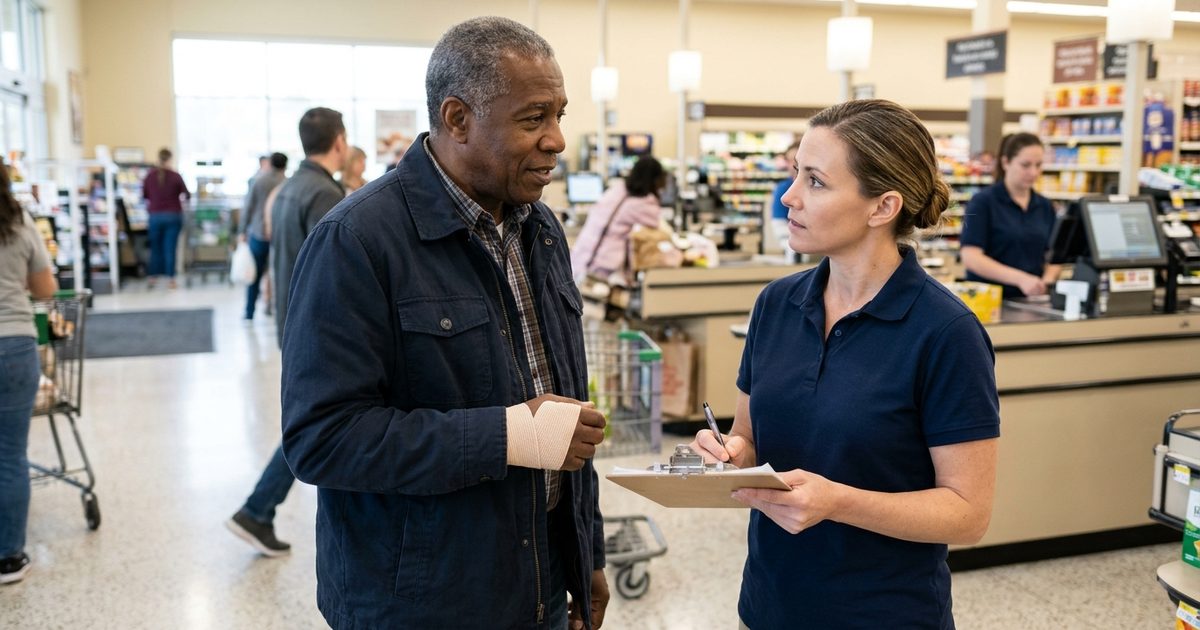
4. Report the fall to a manager
Ask for the manager and report what happened. Most stores will fill out an incident report. Ask for a copy, or at least the report number and the manager's name. Keep your statement short and factual: where you were, what you slipped on, and that you were hurt. Don't guess about how long the spill was there, and don't say "I'm fine" if you're not sure.
5. Ask about video
Many stores have security cameras. Ask the manager to save the video of the aisle, and write down who you asked and when. Store video is often recorded over after a short time, so a lawyer may need to send a formal request to preserve it quickly.
6. See a doctor the same day or the next
Even if you feel okay, get checked. Hip, wrist and back injuries can get worse over the following days, and a prompt medical record ties your injury to the fall. Keep every bill and follow your treatment plan.
What you have to prove
When a customer is hurt by a condition in a store, like a spill, Texas treats it as a "premises liability" claim. Under the Texas Supreme Court's long-standing test from Keetch v. Kroger Co. (1992), a customer generally has to prove four things (as applied in Brookshire Grocery Co. v. Taylor):
- Knowledge: the store actually knew, or should have known, about the condition.
- Unreasonable risk: the condition posed an unreasonable risk of harm.
- No reasonable care: the store didn't take reasonable steps to fix the condition or warn you about it.
- Cause: that failure caused your injury.
Notice what's not on the list: the fact that you fell. Stores aren't required to guarantee that no one ever gets hurt. They're required to act reasonably about hazards they know or should know about. In most store cases, the hardest part is the first element: knowledge.
How a store "knew" about the hazard
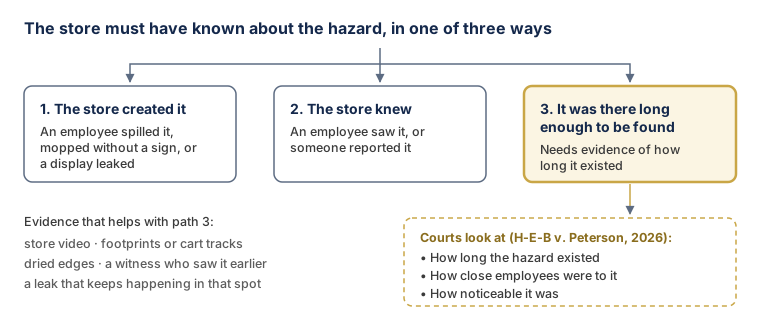
There are generally three ways to show a store is responsible for knowing about a hazard. Texas courts trace this to the Supreme Court of Texas's 2002 decision in Wal-Mart Stores, Inc. v. Reece: the store put the hazard there, the store actually knew about it, or the hazard existed long enough that the store should have discovered it (Brookshire v. Taylor).
1. The store created the hazard
If an employee spilled the liquid, mopped and left the floor wet, or set up a display that dripped or leaked, the store created the condition. These are often the strongest cases.
2. The store actually knew
Evidence that an employee saw the spill, a customer reported it, or someone said "I was just about to clean that up" shows actual knowledge. Witness statements and store records matter here.
3. It was there long enough: the "time-notice rule"
This is the one that trips up most claims. If the store didn't create the hazard and didn't know about it, you have to show it was there long enough that a reasonable store would have found and fixed it. Texas courts call this constructive knowledge, and they require actual evidence of how long the condition existed.
In its 2026 decision in H-E-B v. Peterson, the Supreme Court of Texas explained that constructive knowledge turns on three things: how long the condition existed, how close store employees were to it, and how noticeable it was (opinion). A large, obvious spill right next to a busy checkout may need less time to be noticed than a small clear puddle in a quiet aisle. But without some evidence of time, courts won't assume it.
What can help show how long a hazard was there:
- Store video showing when the spill happened
- Footprints or cart tracks through the spill, or dried edges
- A witness who saw the spill earlier
- An employee who walked past it without cleaning it
- A recurring problem in that exact spot, like a cooler that always leaks
Recurring hazards in the same place
Sometimes the danger isn't one spill but a setup that keeps causing them. In Brookshire Grocery Co. v. Taylor (Texarkana Court of Appeals, 2003), a customer slipped in a deli area near a drink dispenser that regularly dropped ice on the floor, with inadequate mats and no warning signs. Employees testified that ice regularly fell there, and the court upheld a jury award of $103,667.65, even though the customer couldn't say how long that particular ice had been on the floor (opinion). The key was evidence that the store knew about the ongoing danger in that spot.
Common hazards in store falls
Some situations come up again and again in store fall claims. Each raises the same question: did the store create it, know about it, or have enough time to find it?
- Spilled drinks, produce and food in aisles, especially near produce, coolers and checkouts
- Leaks from roofs, freezers, coolers and ice machines
- Rainwater tracked in at entrances, especially without mats or warning signs
- Freshly mopped or waxed floors with no wet-floor sign
- Loose mats, torn flooring and uneven surfaces
- Items left in walkways, like boxes, pallets and stocking carts
Hazards the store creates or that keep recurring in one spot, like a leaking cooler, tend to be easier to prove than a one-time spill made by another customer moments before you fell.
Why your reason for being there matters
Texas law sets different duties depending on why you were on the property (Texas A&M AgriLife Extension):
| Who you were | Examples | What the owner owes you |
|---|---|---|
| Invitee | Shoppers, restaurant customers, delivery workers | Warn about or fix unreasonable risks the owner knew or should have known about |
| Licensee | Social guests at someone's home | Warn about or fix dangers the owner actually knew about and you didn't |
| Trespasser | Someone with no permission to be there | Don't injure them intentionally or through gross negligence |
If you were shopping in a store, you're almost always an invitee, which gives you the strongest protection. Falls at a friend's house or in a place you weren't allowed to be follow different rules.
What the store will do after you fall
Big retailers handle falls all the time and usually have a set process. Knowing what to expect helps you protect yourself.
- An incident report. A manager writes up what happened, often including what you said and what they think caused the fall. Their version may not match yours, so ask for a copy and write down your own account the same day.
- Photos and video. The store may take its own photos and pull video. Ask in writing that it be saved.
- A call from an insurer or claims company. Many large chains use a claims administrator. You can share basic facts, but you don't have to give a recorded statement, and it's wise not to until you understand your injuries.
- An early offer. Some stores offer to pay a small amount or cover an ER bill. Before you sign anything, make sure you know how serious your injury is. A release usually ends your claim for good.
Keep your own records
Start a folder on day one: your photos, the incident report number, witness contacts, medical records and bills, proof of missed work, and a short daily journal of your pain and what you can't do. Also keep the shoes you were wearing, unwashed and unrepaired. The store may argue your footwear caused the fall.
A real Texas case: H-E-B v. Peterson (2026)
On April 10, 2026, the Supreme Court of Texas ruled against a shopper who slipped on a puddle in an H-E-B toy aisle, because there was no evidence of how long the puddle had been there. It's a clear, recent example of how the time-notice rule works.
What happened
Marissa Peterson slipped on a clear liquid in the toy aisle of an H-E-B grocery store, about two hours after it had rained. She didn't know how long the puddle had been there, and H-E-B didn't know about it (Supreme Court of Texas case summaries).
She sued for premises liability. To show H-E-B should have known about the puddle, she pointed to several things:
- Roof leaks in other parts of the store during the previous year, during a remodel
- Water dripping from a ceiling rafter after her fall
- No employee had inspected the toy aisle in the two hours before her fall, even though the store had a stepped-up inspection routine after rain
What the courts decided
The trial court ruled for H-E-B without a trial. The Thirteenth Court of Appeals reversed, finding there was enough evidence to let the case go forward. H-E-B appealed to the Supreme Court of Texas.
In an opinion by Justice Jane Bland, the Supreme Court reversed the court of appeals and reinstated the ruling for H-E-B (opinion). The Court held that the earlier roof leaks didn't show H-E-B knew about this puddle, because they were in other parts of the store and weren't connected in time to her fall. Peterson's expert testimony didn't show how long the puddle had been on the floor either. Without evidence that the puddle existed long enough for a reasonable store to find it, H-E-B couldn't be charged with knowing about it.
What this means for you
- Time is everything. If the store didn't cause the spill or know about it, you need evidence of how long it was there. A store's general problems elsewhere aren't enough.
- Video and witnesses are critical. Footage showing when a spill happened, or a witness who saw it earlier, is often the evidence that fills this gap. Ask for video to be saved right away.
- A missed inspection isn't automatically enough. Even a store that skipped its own safety routine may not be liable without evidence of how long the hazard existed.
- Your photos matter. Signs of age, like footprints, cart tracks or dried edges, can help show a spill had been there a while.
Deadlines and fault
Two years to file
In Texas, you generally have two years from the date of your fall to file a personal injury lawsuit (CPRC § 16.003). Because store video and witness memories fade much faster than that, don't wait to act.
Falls on government property
If you fell in a public building, like a city library, courthouse or state office, the Texas Tort Claims Act applies. You generally must give the government written notice within six months, and some cities require it sooner (CPRC § 101.101).
Shared fault
Stores often argue that the customer should have seen the hazard or was looking at their phone. Under Texas's 51% bar rule, you can still recover if you were 50% or less at fault, but your damages are reduced by your share. If you're found more than 50% responsible, you recover nothing (CPRC § 33.001).
When to call a lawyer
For a minor bump with no lasting injury, you may not need a lawyer. Talk to a licensed Texas personal injury lawyer if:
- You broke a bone, hit your head, needed surgery or ongoing therapy
- You missed work or can't do things you could before
- The store or its insurer denies responsibility or makes a quick, low offer
- You need store video or records preserved before they're deleted
- The fall happened on government property, with its short notice deadline
Because store cases turn on evidence of how long a hazard existed, a lawyer's early request to preserve video and records can be the difference between a strong case and no case.
State Bar of Texas Lawyer Referral and Information Service: (800) 252-9690, Monday to Friday, 8:30 a.m. to 4:30 p.m., or texasbar.com/LawyerReferral. See our Find a Lawyer page for questions to ask at a first meeting.
Checklist: after a fall in a store
- Don't get up too fast; call 911 if you hit your head or can't bear weight
- Photograph the hazard, the aisle, warning signs (or the lack of them) and anything overhead
- Look for signs the spill was old: footprints, cart tracks, dried edges
- Get names and phone numbers of witnesses, including employees
- Report the fall to a manager and get the incident report number
- Ask the store to save the security video, and note who you asked
- See a doctor the same day or the next
- Keep your shoes and clothes as they were
- Don't sign anything or give a recorded statement until you understand your injuries
- Talk to a lawyer quickly if you were seriously hurt
Frequently asked questions
Can I sue a store if I slip and fall in Texas?
You can, but you have to prove more than the fall. As a customer, you generally must show the store knew or should have known about the hazard, the hazard posed an unreasonable risk, the store failed to fix it or warn you, and that failure caused your injury.
What does a store have to know about a spill to be responsible?
Either the store created the hazard, actually knew about it, or it was there long enough that a reasonable store would have found it. Texas courts call the last one constructive knowledge, and it requires evidence of how long the hazard existed.
Why does it matter how long a spill was on the floor?
Under Texas's time-notice rule, a store is only charged with knowing about a hazard it didn't create or see if the hazard was there long enough to be discovered with reasonable care. Without evidence of how long it was there, claims often fail, as in the Texas Supreme Court's 2026 decision in H-E-B v. Peterson.
How long do I have to file a slip and fall claim in Texas?
Generally two years from the date of the injury. If the fall happened on government property, you may need to give written notice within six months or even sooner.
Should I fill out a store incident report?
You can, and you should ask for a copy. Stick to simple facts about what happened and where. Don't guess about the cause or say you're fine if you're not sure.
What if I was partly at fault for my fall?
Texas uses a 51% bar rule. You can still recover if you were 50% or less at fault, but your damages are reduced by your share. If you were more than 50% at fault, you recover nothing.
Sources
- H-E-B, LP v. Peterson, No. 24-0310 (Tex. Apr. 10, 2026): opinion
- Supreme Court of Texas case summaries, April 10, 2026
- Brookshire Grocery Co. v. Taylor, No. 06-02-00122-CV (Tex. App.—Texarkana 2003): discusses Keetch v. Kroger and Wal-Mart v. Reece
- Texas A&M AgriLife: Premises liability, legal status and duty owed
- Tex. Civ. Prac. & Rem. Code § 16.003: two-year limitations period
- Tex. Civ. Prac. & Rem. Code § 101.101: notice to government units
- Tex. Civ. Prac. & Rem. Code § 33.001: proportionate responsibility
- State Bar of Texas Lawyer Referral and Information Service (TexasLawHelp.org)
Keep reading
 Divorce & Family · Texas
Child Custody and Child Support in a Texas Divorce: What Parents Should Know
Texas calls custody 'conservatorship' and visitation 'possession and access.' Here's how judges decide, what the standard schedule looks like, how child support is calculated, and how orders can change.
 Divorce & Family · Texas
How Property Is Divided in a Texas Divorce: Community Property Explained
Texas is a community property state, but that doesn't always mean a 50/50 split. Here's how courts decide who keeps the house, the retirement accounts and the debts, and how to protect what's yours.
 Divorce & Family · Texas
How to File for Divorce in Texas: Steps, Costs and the 60-Day Waiting Period
Thinking about divorce in Texas? Here's the whole process in plain English: who can file and where, what it costs, why you have to wait 60 days, and how agreed and contested divorces end.