Work Injuries · Texas
Hurt at Work in Texas? Workers' Comp, Non-Subscribers and Your Rights
Texas is unusual: most private employers can choose not to carry workers' compensation. Whether yours does changes almost everything about your injury claim. Here's how both systems work and what to do first.

The short answer: if you're hurt at work in Texas, first find out whether your employer carries workers' compensation, because in Texas it's usually optional. If your employer has it, report the injury within 30 days and file a claim within one year. If it doesn't, you may be able to sue your employer for negligence, and the law takes away some of its best defenses. Either way, report the injury right away, in writing if you can, and get medical care.
You lift a box the way you've done a thousand times, and something in your back gives out. Or a forklift clips you in a warehouse aisle, or a ladder slips on a job site. Suddenly you're facing medical bills and lost paychecks, and a question most workers in other states never have to ask: does my employer even have workers' comp?
In most of the country, workers' compensation is mandatory. In Texas, most private employers can choose whether to carry it. That one fact changes how your injury is handled, who pays, and whether you can sue. This guide explains both paths, the deadlines for each, the rules that protect workers whose employers opt out, and a Texas Supreme Court case that shows where those protections stop.
- What to do right after a work injury
- Workers' comp is optional in Texas
- Which path are you on?
- If your employer has workers' comp
- If your employer is a non-subscriber
- Can you be fired for filing a claim?
- Watch out for waivers and company plans
- Claims against someone other than your employer
- A real Texas case: Austin v. Kroger
- When to call a lawyer
- Checklist and FAQ
What to do right after a work injury
These steps protect you whichever system applies.
1. Get medical care
For a serious injury, call 911 or go to the emergency room. For anything else, see a doctor the same day or the next. Tell the doctor you were hurt at work and describe exactly how it happened. Back, shoulder and repetitive-motion injuries often get worse over a few days, so don't wait to see if it goes away.
2. Report the injury to your employer, in writing
Tell your supervisor right away. Then follow up in writing, like a text or email, with the date, time, place and how you got hurt. If your employer has workers' comp, you must report the injury within 30 days (Texas Department of Insurance). Even if it doesn't, a prompt written report is your best proof the injury happened at work.
3. Document everything
- Photos of where you were hurt: the spill, broken equipment, missing guard, or cluttered walkway
- Names and phone numbers of coworkers who saw it or know about the hazard
- Any earlier complaints about the same hazard, like emails, texts or safety reports
- Your medical records, bills and work restrictions
- Your pay stubs, to show your earnings before the injury
4. Find out about your employer's coverage
Texas employers must tell employees whether they carry workers' compensation, when you're hired and with a notice posted at work (Tex. Labor Code § 406.005). Check the posted notice or ask HR directly. You can also call the Texas Division of Workers' Compensation at 800-252-7031.
5. Don't sign anything yet
Some employers ask injured workers to sign forms that give up rights. Read the "waivers" section below before you sign anything beyond a basic injury report.
Workers' comp is optional in Texas
Under Texas Labor Code § 406.002, a private employer may choose whether to obtain workers' compensation insurance. Public employers, like cities and state agencies, are treated differently, and other laws can require coverage in certain situations.
Employers that opt out are called non-subscribers. They're not rare. In 2022, the Texas Department of Insurance estimated that about 25% of Texas private employers were non-subscribers, and about 17% of private-sector employees worked for them (TDI).
Which path are you on?
Your employer's choice puts you on one of two very different paths.
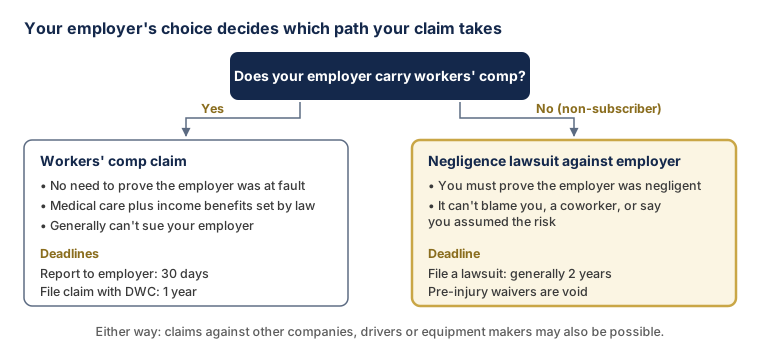
| Employer has workers' comp | Employer is a non-subscriber | |
|---|---|---|
| Do you have to prove the employer was at fault? | No. Benefits are paid for covered work injuries regardless of fault | Yes. You must prove the employer was negligent |
| Can you sue your employer? | Generally no, with a narrow exception for some deaths | Yes, for negligence |
| What can you get? | Medical care and income benefits set by law | Damages a jury awards, which can include pain and suffering |
| Key deadlines | Report within 30 days; file a claim within 1 year | Generally 2 years to file a lawsuit |
If your employer has workers' comp
Workers' compensation is a no-fault system. You don't have to prove your employer did anything wrong, and your own mistake usually doesn't stop your benefits. In exchange, you generally can't sue your employer.
The two deadlines
- 30 days: report your injury to your employer within 30 days of the date of injury.
- 1 year: file your claim with the Texas Division of Workers' Compensation (DWC) within one year of the injury date.
Both come from the Texas Department of Insurance. Missing them can cost you your benefits, so don't rely on your employer to file for you.
What benefits can pay for
Workers' comp pays for medical care for your work injury and replaces part of your lost income. While you can't work, temporary income benefits generally pay 70% of the difference between your average weekly wage and what you can earn after the injury, up to state limits. Workers who earned less than $10 an hour and were hurt on or after September 1, 2015 may get 75% (TDI: temporary income benefits).
There's a waiting period: income benefits start once your injury keeps you out of work for eight days, and the first week is paid only if your disability lasts 14 days or more. Temporary benefits can last up to 104 weeks, and end earlier if you reach maximum medical improvement or can earn your pre-injury wage again.
When a claim is disputed
The insurance carrier can dispute your claim, for example by arguing the injury didn't happen at work or that an exception applies, like intoxication or horseplay. If that happens, you'll need evidence: witness statements, your written injury report and medical records. Free help is available from the state's Office of Injured Employee Counsel at 866-393-6432, which has ombudsmen who help workers without a lawyer.
Can you ever sue a workers' comp employer?
Workers' comp benefits are generally your only remedy against a covered employer. The main exception: when a worker is killed by the employer's intentional act or gross negligence, the surviving spouse and children may seek exemplary (punitive) damages (Tex. Labor Code § 408.001). You may also be able to sue other companies that contributed to your injury, as explained below.
If your employer is a non-subscriber
If your employer opted out of workers' comp, you can sue it for negligence. And the law takes away some of its most powerful defenses. Under Texas Labor Code § 406.033, a non-subscriber can't defend itself by arguing that:
- You were partly at fault for your own injury (contributory negligence)
- You knew the job was risky and accepted the danger (assumption of risk)
- A coworker's carelessness caused the injury
That's a big deal. In most injury cases in Texas, your own share of fault reduces what you can recover. Against a non-subscriber employer, it generally can't be used against you that way.
But you still have to prove negligence
The same law says the injured worker must prove that the employer, or someone acting for it, was negligent. Common examples include:
- Not providing safe equipment, or the right equipment for the job
- Not training workers properly
- Understaffing a two-person job so one worker does it alone
- Ignoring known hazards that workers reported
- Unsafe rules or pressure to work too fast
Defenses a non-subscriber can still use
The employer can still argue you hurt yourself on purpose, or that you were intoxicated. It can also argue it wasn't negligent at all, or that something other than its conduct was the sole cause of your injury. And as the Austin case below shows, it can argue it owed no duty to protect you from a hazard you already knew about.
Your deadline
A lawsuit against a non-subscriber is a personal injury case, so the usual two-year deadline generally applies (CPRC § 16.003). Evidence like witness memories and equipment condition fades much faster, so act sooner.
Can you be fired for filing a claim?
Many injured workers stay quiet because they're afraid of losing their job. Texas law gives workers' comp claimants some protection. Under Texas Labor Code § 451.001, an employer may not fire or otherwise discriminate against an employee because the employee:
- Filed a workers' compensation claim in good faith
- Hired a lawyer to represent them in a claim
- Started a workers' comp proceeding, or had one started, in good faith
- Testified, or is about to testify, in a workers' comp proceeding
This protection is tied to the workers' comp system. Texas is an at-will employment state in general, and an employer can still make job decisions for other legitimate reasons. Retaliation cases often turn on timing and evidence, like a sudden bad review right after you report an injury.
If you think you were fired or punished for reporting an injury or filing a claim, write down what happened and when, save any messages, and talk to an employment lawyer quickly. These claims can have their own deadlines.
Watch out for waivers and company plans
Many non-subscribers offer their own injury benefit plans instead of workers' comp. Some of these plans pay medical bills and part of your wages, which can help. But read carefully before signing anything, because some ask you to give up your right to sue.
Texas law limits these waivers (§ 406.033):
- Before an injury: any agreement to give up your rights before you're hurt is void and unenforceable.
- After an injury: a waiver is valid only if you sign it voluntarily and knowing its effect; at least 10 business days after you first reported the injury; after a medical evaluation by a non-emergency doctor; in writing; and with the waiver language made conspicuous, such as larger type or contrasting colors.
Some company plans also require arbitration instead of a court case. Before you sign any plan document or waiver, it's worth having a lawyer review it.
Claims against someone other than your employer
Whether or not your employer has workers' comp, someone else may share responsibility for your injury. These are often called third-party claims, and they follow regular injury law. Examples:
- A driver from another company crashes into you while you're driving for work
- A defective machine, tool or ladder causes your injury
- A general contractor or another subcontractor on a construction site creates the hazard
- A property owner where you're working fails to fix a dangerous condition
Third-party claims can be important when workers' comp benefits don't cover all your losses, because they can include damages comp doesn't pay, like pain and suffering.

A real Texas case: Austin v. Kroger Texas (2015)
On June 12, 2015, the Supreme Court of Texas ruled that a non-subscribing employer generally has no duty to warn or protect a worker from a hazard that is open and obvious or already known to the worker. The decision shows that even with the special rules for non-subscribers, the worker still has to prove the employer broke a legal duty.
What happened
Randy Austin worked as a floor clean-up person at a Kroger store in Mesquite, Texas. He was told to clean up two oil-like spills, one in the women's restroom and one in the men's. Kroger's safety handbook called for a "Spill Magic" system, an absorbent powder with a broom and dustpan, but it wasn't available that day, so he used a mop (Texas Tech Law Review).
After cleaning the women's restroom and part of the men's spill, he slipped and fell into the remaining liquid. He fractured his femur and dislocated his hip, needed multiple surgeries, and was left with one leg about two inches shorter than the other. Kroger did not carry workers' compensation.
The lawsuit
Austin sued Kroger for negligence, gross negligence and premises liability. The case went to federal court, where Kroger won summary judgment. On appeal, the Fifth Circuit sent the key premises-liability question to the Supreme Court of Texas to answer under Texas law.
What the Supreme Court decided
The Court held that an employer generally has no duty to warn or protect employees from unreasonably dangerous conditions that are open and obvious or known to the employee (case summary). It recognized two exceptions:
- Criminal activity: when the danger comes from foreseeable criminal acts by others
- Necessary use: when the worker must use the dangerous area and can't take adequate precautions, even knowing the danger
Austin's case fit neither exception. The Court also held that the non-subscriber law's removal of defenses doesn't relieve the worker of proving the employer owed a duty in the first place. Austin knew about the spill because cleaning it was his job, so his premises-liability claim failed.
But the Court didn't end his whole case. It left room for a separate claim about Kroger's failure to provide the proper equipment, the Spill Magic system, which went back to the lower court.
What this means for you
- Non-subscriber rules help, but they're not automatic wins. Your employer can't blame you for being careless, but you still have to show it broke a legal duty.
- Known hazards are treated differently. If the danger was obvious or you knew about it, a premises claim may fail unless an exception applies.
- Equipment and training claims matter. An employer's failure to provide the right tools or enough help can be a separate claim. Document what equipment was missing or broken.
- The details are technical. How your claim is framed can decide the outcome, which is a strong reason to talk to a lawyer in a non-subscriber case.
When to call a lawyer
Talk to a licensed Texas lawyer who handles workplace injuries if:
- Your employer is a non-subscriber and you were seriously hurt
- Your workers' comp claim was denied or disputed
- Your employer asks you to sign a waiver, release or plan document
- Another company, driver or equipment maker may share the blame
- A worker died on the job
For workers' comp questions, the state's Office of Injured Employee Counsel offers free help at 866-393-6432. For a lawyer referral, contact the State Bar of Texas Lawyer Referral and Information Service at (800) 252-9690, Monday to Friday, 8:30 a.m. to 4:30 p.m., or texasbar.com/LawyerReferral. See our Find a Lawyer page for questions to ask.
Checklist: hurt at work in Texas
- Get medical care and tell the doctor it happened at work
- Report the injury to your supervisor right away, then in writing
- Photograph the place, equipment or hazard that hurt you
- Get coworker witness names and phone numbers
- Find out whether your employer carries workers' comp
- Workers' comp: report within 30 days and file with DWC within 1 year
- Non-subscriber: keep evidence of missing equipment, training or staffing
- Don't sign a waiver or plan document without reading it, ideally with a lawyer
- Keep pay stubs, medical bills and work restrictions in one folder
Frequently asked questions
Do Texas employers have to carry workers' compensation?
No. Under Texas Labor Code § 406.002, most private employers may choose whether to carry workers' compensation insurance. Public employers and some others are required to by other laws. Employers must tell employees whether they have coverage.
How long do I have to report a work injury in Texas?
If your employer has workers' comp, you must report the injury to your employer within 30 days and file a claim with the Texas Division of Workers' Compensation within one year of the injury date.
Can I sue my employer for a work injury in Texas?
If your employer carries workers' comp, benefits are generally your only remedy against the employer, with an exception for some deaths caused by gross negligence. If your employer is a non-subscriber, you can sue it for negligence, and it can't blame you, a coworker, or say you assumed the risk.
What is a non-subscriber employer in Texas?
A non-subscriber is an employer that has chosen not to carry Texas workers' compensation insurance. In 2022, the Texas Department of Insurance estimated about 25% of private employers were non-subscribers, employing about 17% of private-sector workers.
How much does Texas workers' comp pay while I can't work?
Temporary income benefits generally pay 70% of the difference between your average weekly wage and what you can earn after the injury, up to state limits, for up to 104 weeks. Lower-wage workers may get 75%.
Can my non-subscriber employer make me sign a waiver?
A waiver signed before you're injured is void. A waiver after an injury is valid only if it meets strict rules, including being signed at least 10 business days after you report the injury and after a medical evaluation by a non-emergency doctor.
Sources
- Tex. Labor Code § 406.002: workers' comp coverage is elective for private employers
- Tex. Labor Code § 406.005: employer must notify employees about coverage
- Tex. Labor Code § 406.033: non-subscriber defenses and waivers (text as published)
- Tex. Labor Code § 408.001: exclusive remedy and the death exception
- Tex. Labor Code § 451.001: protection against firing for filing a workers' comp claim
- TDI: Compensability: 30-day and 1-year deadlines, OIEC
- TDI: Temporary income benefits
- TDI: Employer participation in the Texas workers' compensation system, 2022 estimates
- Tex. Civ. Prac. & Rem. Code § 16.003: two-year limitations period
- Texas Tech Law Review: Austin v. Kroger Texas, L.P., No. 14-0216
- Case summary of Austin v. Kroger Texas (Tex. June 12, 2015)
- State Bar of Texas Lawyer Referral and Information Service (TexasLawHelp.org)
Keep reading
 Work Injuries · Texas
Oilfield Accidents in Texas: Injury Claims, Workers' Comp and Who Is Liable
Texas leads the nation in oil and gas worker deaths. If you were hurt on a rig, at a well site or on the road to one, several companies may share responsibility. Here's how Texas law sorts it out.
 Work Injuries · Texas
Construction Site Injuries in Texas: Workers' Comp, Lawsuits and Who Is Liable
Construction is one of the deadliest jobs in Texas. If you were hurt on a job site, the companies around you, not just your employer, may be responsible. Here's how Texas law decides who pays.
 Divorce & Family · Texas
Child Custody and Child Support in a Texas Divorce: What Parents Should Know
Texas calls custody 'conservatorship' and visitation 'possession and access.' Here's how judges decide, what the standard schedule looks like, how child support is calculated, and how orders can change.