Work Injuries · Texas
Construction Site Injuries in Texas: Workers' Comp, Lawsuits and Who Is Liable
Construction is one of the deadliest jobs in Texas. If you were hurt on a job site, the companies around you, not just your employer, may be responsible. Here's how Texas law decides who pays.

The short answer: if you were hurt on a Texas construction site, your options depend on who employs you, whether your employer carries workers' comp, and which other companies were involved. You may have a workers' comp claim, a negligence lawsuit against a non-subscriber employer, and claims against other companies, like the general contractor, another subcontractor, an equipment maker or, in limited cases, the property owner. Texas law sets specific tests for general contractors and owners, so the details of who controlled the work matter a lot.
Construction sites are crowded with risk: open edges and ladders, heavy equipment, power lines, trenches and loads swinging overhead. On a single project, workers from a dozen different companies may be working side by side, each under a different boss, all under a general contractor, on land owned by someone else. When someone gets hurt, that web of companies is exactly what makes the legal questions complicated.
This guide explains how Texas handles construction injuries: workers' comp and non-subscribers, when you can sue a general contractor or property owner, the most common causes of construction deaths, a Texas Supreme Court case about a worker who fell ten stories, and what to do after an accident. For the basics of any Texas work injury, see our work injury guide.
- How dangerous construction work is in Texas
- The Fatal Four
- What to do after a construction injury
- Who can be responsible
- Your employer: workers' comp or non-subscriber
- Suing the general contractor
- A real Texas case: Lee Lewis Construction v. Harrison
- Suing the property owner: Chapter 95
- Equipment makers and other subcontractors
- How OSHA rules fit in
- Retaliation and immigration fears
- Deadlines and when to call a lawyer
- Checklist and FAQ
How dangerous construction work is in Texas
In 2023, 564 people died from work injuries in Texas, and the construction industry accounted for 124 of them, more than one in five, according to the U.S. Bureau of Labor Statistics (BLS, Fatal Occupational Injuries in Texas, 2023). Statewide, falls, slips and trips caused 92 work deaths that year, second only to transportation incidents.
Thousands more construction workers are injured each year with broken bones, back and head injuries, burns, amputations and electrical injuries that can end a career.
The Fatal Four
The federal Occupational Safety and Health Administration identifies four hazards that cause most construction deaths, known as the "Fatal Four" (Texas Department of Insurance):
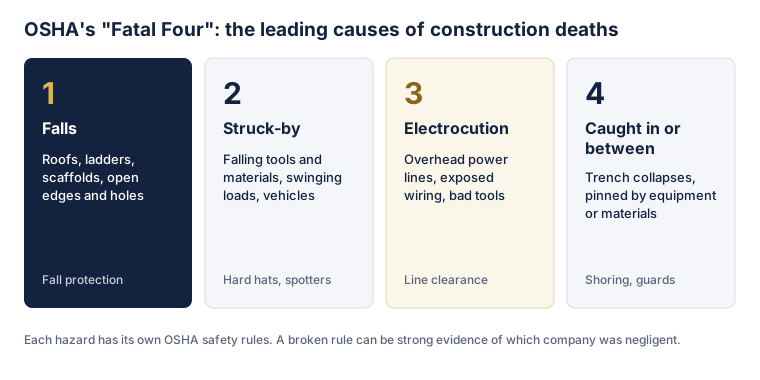
- Falls from roofs, scaffolds, ladders, open floor edges and holes
- Struck-by accidents: falling tools and materials, swinging loads, and vehicles or equipment on site
- Electrocution from overhead power lines, exposed wiring and faulty tools
- Caught-in or between: trench collapses and being pinned by equipment or materials
Each of these has specific safety rules, like fall protection for work at height, trench shoring, and keeping equipment away from power lines. When a company ignored those rules, it can be strong evidence in a claim.
What to do after a construction injury
1. Get medical care and report the injury
Get emergency care for anything serious. Tell your supervisor right away and follow up in writing. If your employer carries workers' comp, you must report the injury within 30 days. Tell the doctor exactly how you were hurt on the job.
2. Find out who's who on the site
Write down the name of your employer, the general contractor, any other subcontractors working near you, and the property owner or project name. Construction sites usually post signs with the general contractor's name and permit information.
3. Document the scene
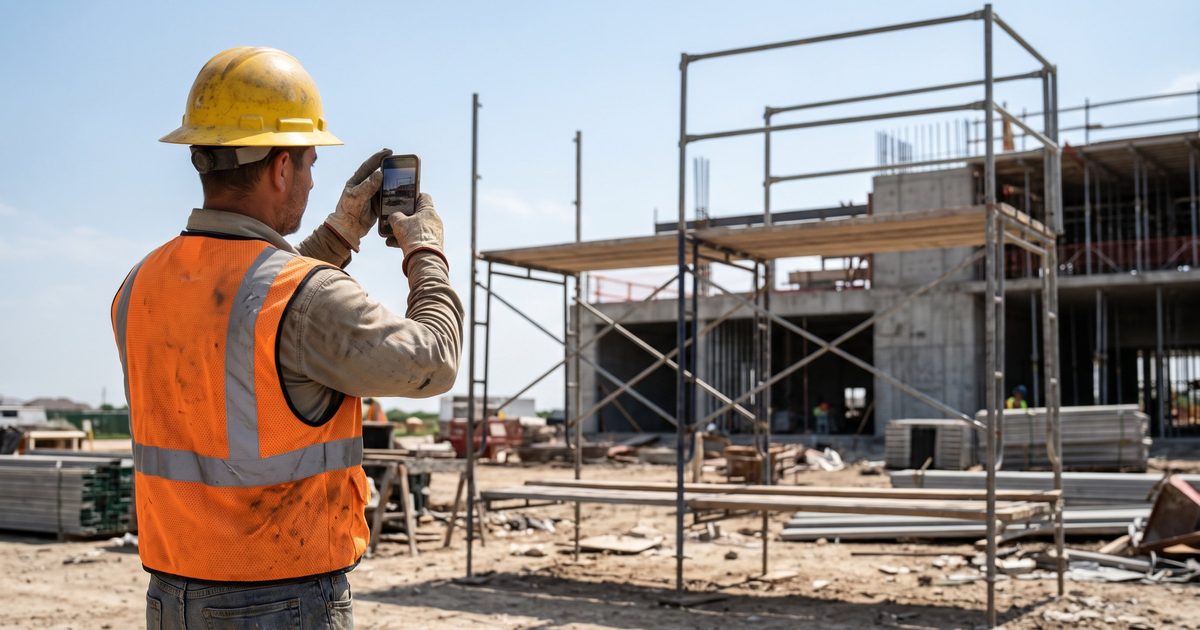
- Photos of where you were hurt: the ladder, scaffold, edge, trench, equipment or wiring
- Missing guardrails, harnesses, tie-off points, shoring or warning signs
- Names and phone numbers of coworkers and workers from other companies who saw it
- Any safety meeting notes, text messages or instructions from supervisors
4. Find out about workers' comp coverage
Ask your employer whether it carries workers' comp. Texas employers must tell workers about their coverage, and the site may post notices. You can also call the Texas Division of Workers' Compensation at 800-252-7031.
5. Don't sign anything you don't understand
Some companies ask injured workers to sign statements, waivers or plan documents. Don't sign anything beyond a basic injury report without understanding it, ideally with a lawyer's help.
Who can be responsible
Construction injuries often involve several companies at once. Depending on the facts, claims may involve:
- Your employer, through workers' comp or, if it's a non-subscriber, a negligence lawsuit
- The general contractor, if it controlled the work that hurt you
- Other subcontractors whose workers or equipment caused the accident
- The property owner, only under the strict test in Chapter 95
- Equipment and tool manufacturers, if a defect caused the injury
- Equipment rental companies, if they supplied poorly maintained equipment
- Drivers, if you were hit by a vehicle in a work zone
Your employer: workers' comp or non-subscriber
Texas is unusual: most private employers may choose whether to carry workers' compensation. That applies to many construction companies, though contractors on government construction projects must provide coverage for their workers.
- If your employer has workers' comp, you can get medical care and income benefits without proving fault, but you generally can't sue your employer. You must report the injury within 30 days and file a claim with the Division of Workers' Compensation within one year.
- If your employer is a non-subscriber, you can sue it for negligence, and it loses key defenses: it can't argue that you were careless, that a coworker caused it, or that you assumed the risk.
Our work injury guide explains both paths in detail, including the Texas Supreme Court's Austin v. Kroger decision.
The general contractor as your "employer"
There's a twist that's common on Texas construction sites. A general contractor can agree in writing to provide workers' comp coverage for its subcontractors and their employees, often through a project-wide insurance program. When that happens, Texas Labor Code § 406.123 can make the general contractor your "employer" for workers' comp purposes. That can bar you from suing the general contractor for negligence, even though you work for a subcontractor. Ask whether a project-wide program covered your site.
Suing the general contractor
Generally, a company that hires an independent contractor isn't responsible for making sure the contractor's employees do their work safely. But Texas recognizes an important exception: a general contractor can owe a duty to a subcontractor's employee if it controls the work.
The Texas Supreme Court has said that control must relate to the specific activity that caused the injury. It can come from:
- Actual control: the general contractor actually directed how the dangerous work was done, for example by telling workers which safety method to use or ordering them to keep working despite a known hazard; or
- Contractual control: the contract gave the general contractor the right to control the means, methods or details of that work
General supervision isn't enough. In JLB Builders v. Hernandez (Tex. May 7, 2021), a concrete subcontractor's employee was hurt when a rebar tower he was standing on fell at a Dallas high-rise. The Court held the general contractor owed him no duty: its general safety inspections, requiring safety harnesses and controlling the work schedule weren't control over how the tower was secured (opinion). The case below shows the other side.
A real Texas case: Lee Lewis Construction v. Harrison
In Lee Lewis Construction, Inc. v. Harrison, 70 S.W.3d 778, the Supreme Court of Texas upheld a large verdict against a general contractor for a subcontractor employee's fatal fall (case commentary; ConstructionRisk summary).
What happened
Jimmy Harrison worked for a subcontractor on a building project managed by Lee Lewis Construction, the general contractor. He fell from the tenth story and died. The evidence showed the general contractor had taken charge of fall protection on the project, and knowingly allowed a fall-protection system it knew was ineffective to be used.
The verdict
Harrison's family sued. The jury found the general contractor negligent and grossly negligent. The trial court entered judgment for about $7.9 million in actual damages and $5 million in punitive damages. The court of appeals affirmed, with a reduction for part of the pain and suffering damages that wasn't proven.
What the Supreme Court decided
The Supreme Court affirmed. Because the general contractor retained control over fall protection, it owed Harrison a duty of care, even though he worked for a different company. And because it knowingly allowed an inadequate system to be used, the jury could find gross negligence.
What this means for you
- Find out who controlled the safety measure that failed. If the general contractor chose or approved the fall protection, scaffolding or trench method, it may be responsible.
- Documents and testimony decide control. Contracts, safety plans, meeting notes and what supervisors actually said on site are key evidence.
- General safety programs alone aren't enough. As JLB Builders shows, inspecting the site and requiring harnesses doesn't by itself make a general contractor liable.
- Gross negligence can lead to punitive damages. Knowingly allowing a dangerous practice is treated very differently from an honest mistake.
Suing the property owner: Chapter 95
Property owners have even more protection. Chapter 95 of the Texas Civil Practice and Remedies Code applies when a contractor's or subcontractor's employee is injured from the condition or use of an improvement to real property that the contractor is building, repairing, renovating or modifying. In those cases, the property owner is liable only if both of these are true (§ 95.003):
- the owner exercised or retained some control over the manner in which the work was performed, beyond the right to start or stop the work, inspect progress or receive reports; and
- the owner had actual knowledge of the danger or condition that caused the injury and failed to adequately warn
The Texas Supreme Court has applied Chapter 95 broadly to hazards connected to the work. In Los Compadres Pescadores v. Valdez (Tex. March 26, 2021), workers building pilings for a condominium were shocked when a roughly 20-foot piece of rebar touched an overhead power line. The Court held Chapter 95 applied, because the danger arose from the improvement the workers were building (Bracewell summary).
Because the test is so demanding, claims against owners succeed only when the owner was actually directing the work and knew about the specific danger.
Equipment makers and other subcontractors
Claims against other companies on the site are often the strongest path, especially when your employer has workers' comp:
- Other subcontractors: if another company's worker dropped materials, left a hole uncovered or operated equipment carelessly, that company can be liable for negligence like anyone else.
- Defective equipment: scaffolds, ladders, lifts, nail guns, saws and cranes with design or manufacturing defects can support product liability claims against the manufacturer or seller.
- Rental companies: equipment rented with worn brakes, missing guards or no instructions can make the rental company responsible.
Keep the tool or equipment if you can, or ask a lawyer to make sure it's preserved. Don't let it be repaired or thrown away.
How OSHA rules fit in
OSHA sets federal safety standards for construction, like fall protection at certain heights, scaffold and ladder rules, trench protection and electrical safety. OSHA can inspect a site and issue citations and fines after a serious accident.
An OSHA citation doesn't automatically win an injury case, and OSHA itself doesn't pay injured workers. But violations of safety rules, and a company's safety records, are often important evidence of negligence. You can also file a confidential safety complaint with OSHA if you see a dangerous condition.
Retaliation and immigration fears
Many construction workers worry that reporting an injury will cost them their job. Texas Labor Code § 451.001 prohibits firing or discriminating against a worker for filing a workers' comp claim in good faith. Federal law also protects workers who raise safety concerns.
Workers sometimes also worry about their immigration status. In general, the right to safe working conditions and to seek compensation for injuries does not depend on immigration status, though some issues, like future lost wages, can be affected. A lawyer can advise you confidentially.
Deadlines
- Workers' comp: report to your employer within 30 days; file with the Division of Workers' Compensation within one year
- Lawsuits against a non-subscriber employer, general contractor, subcontractor, owner or manufacturer: generally two years from the injury
- Wrongful death: generally two years from the date of death; see our wrongful death guide
See our guide to Texas injury claim deadlines for exceptions.
When to call a lawyer
Construction cases are among the most complex injury cases because of the number of companies, contracts and insurance policies involved. Talk to a licensed Texas lawyer if:
- You were seriously injured, or a coworker or family member died
- Your employer is a non-subscriber
- Another company's workers or equipment caused the accident
- Safety equipment was missing or a supervisor ordered unsafe work
- Your workers' comp claim was denied or you were fired after reporting
The state's Office of Injured Employee Counsel offers free help with workers' comp claims at 866-393-6432. For a lawyer referral, contact the State Bar of Texas Lawyer Referral and Information Service at (800) 252-9690, Monday to Friday, 8:30 a.m. to 4:30 p.m., or texasbar.com/LawyerReferral. Our Find a Lawyer page has more questions to ask.
Checklist: after a construction site injury
- Get medical care and tell the doctor it happened at work
- Report the injury to your supervisor, then in writing
- Write down your employer, the general contractor and other companies on site
- Photograph the scene, equipment and missing safety gear
- Get names of coworkers and other witnesses
- Find out whether your employer, or a project-wide program, provides workers' comp
- Keep or preserve any tool or equipment involved
- Don't sign waivers or statements without understanding them
- Mark the 30-day, one-year and two-year deadlines
Frequently asked questions
Can I sue the general contractor if I was hurt working for a subcontractor in Texas?
Sometimes. A general contractor can owe a duty to a subcontractor's employee if it actually controlled, or had a contractual right to control, the specific work that caused the injury. General safety oversight and scheduling aren't enough. But if the general contractor provided workers' comp coverage for subcontractors' workers under a written agreement, it may be treated as your employer, which can bar a lawsuit.
Can I sue the property owner for a construction injury in Texas?
Only in limited cases. Under Texas Civil Practice and Remedies Code Chapter 95, a property owner is liable for injuries to a contractor's employee from the condition or use of an improvement being built or repaired only if the owner controlled the manner of the work and had actual knowledge of the danger and failed to adequately warn.
What are the most common causes of construction deaths?
OSHA identifies four leading causes, known as the Fatal Four: falls, being struck by an object, electrocution, and being caught in or between objects.
Do Texas construction companies have to carry workers' comp?
Most private employers in Texas, including many construction companies, may choose whether to carry workers' compensation. However, contractors on government construction projects must provide coverage for their workers. If your employer is a non-subscriber, you may be able to sue it for negligence.
How long do I have to file a construction injury claim in Texas?
If your employer has workers' comp, report the injury within 30 days and file with the Division of Workers' Compensation within one year. Lawsuits against a non-subscriber employer, a general contractor, a property owner or an equipment maker generally must be filed within two years.
Sources
- U.S. Bureau of Labor Statistics: Fatal Occupational Injuries in Texas, 2023
- Texas Department of Insurance: OSHA's Fatal Four
- Lee Lewis Construction, Inc. v. Harrison, 70 S.W.3d 778 (Tex. 2001), commentary
- ConstructionRisk: general contractor liable for injury to independent contractor's employee
- JLB Builders, L.L.C. v. Hernandez, No. 20-0368 (Tex. May 7, 2021)
- Tex. Civ. Prac. & Rem. Code § 95.003: property owner liability
- Bracewell: Los Compadres Pescadores v. Valdez (Tex. 2021)
- Tex. Labor Code § 406.002: workers' comp coverage is elective for most private employers
- Tex. Labor Code § 451.001: protection against retaliation
- State Bar of Texas Lawyer Referral and Information Service (TexasLawHelp.org)
Keep reading
 Work Injuries · Texas
Oilfield Accidents in Texas: Injury Claims, Workers' Comp and Who Is Liable
Texas leads the nation in oil and gas worker deaths. If you were hurt on a rig, at a well site or on the road to one, several companies may share responsibility. Here's how Texas law sorts it out.
 Work Injuries · Texas
Hurt at Work in Texas? Workers' Comp, Non-Subscribers and Your Rights
Texas is unusual: most private employers can choose not to carry workers' compensation. Whether yours does changes almost everything about your injury claim. Here's how both systems work and what to do first.
 Divorce & Family · Texas
Child Custody and Child Support in a Texas Divorce: What Parents Should Know
Texas calls custody 'conservatorship' and visitation 'possession and access.' Here's how judges decide, what the standard schedule looks like, how child support is calculated, and how orders can change.