Car Accidents · Texas
What to Do After a Car Accident in Texas: The First 72 Hours
The steps you take in the first three days — at the scene, at the doctor, and on the phone with insurers — shape everything that follows. Here's what Texas law expects and how to protect yourself.

The short answer: after a car accident in Texas, your first 72 hours come down to four jobs: stay safe and report the crash, see a doctor, get your official crash report, and be careful what you tell insurance companies. Do those well and you protect your health, your claim and your options. Skip them and you can lose money you are owed.
Nobody plans for this part. One second you're driving to work on I-35 or heading home from the grocery store, and the next you're standing on the shoulder with your hands shaking, trying to remember whose insurance card you're supposed to photograph. Your phone is buzzing. Someone behind you is honking. And nobody hands you a manual.
This guide is that manual. It walks you through what to do at the scene, in the first day, and in the first three days, in plain English. It also covers how fault works in Texas, the deadlines that can quietly end a claim, and a real Texas Supreme Court case that shows why your medical bills matter more than you'd think.
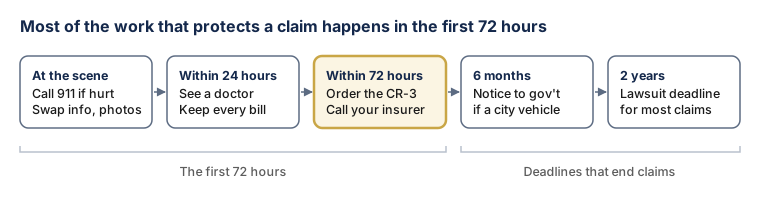
- At the scene: the first hour
- The first 24 hours: get checked by a doctor
- Within 72 hours: your crash report and the insurance calls
- How fault works in Texas
- The deadlines you can't miss
- A real Texas case: what one driver's medical bills teach us
- When to call a lawyer, and how to find one
- Your printable checklist and FAQ
At the scene: the first hour
Texas law gives you specific duties the moment a crash happens: stop, help anyone who's hurt, exchange information, and report it to police when someone is injured or a car can't be driven. Here's how that plays out in real life.
1. Stop, breathe, and get safe
First, stop. Leaving the scene of a crash is a crime in Texas, even a minor one. If damage is under $200, failing to stop is a Class C misdemeanor; at $200 or more it's a Class B misdemeanor (Tex. Transp. Code § 550.022).
Turn on your hazard lights. If you're on a freeway in a big city and both cars can still be driven safely, Texas law actually requires you to move them off the main lanes to a frontage road, cross street or other safe spot as soon as you can. Standing in a live lane of I-45 to argue about a dented bumper is how a fender-bender turns into a tragedy.
If a car can't move, or anyone is hurt, stay put, stay buckled if traffic is flying past, and call for help.
2. Call 911 if anyone is hurt or a car can't be driven
Under Tex. Transp. Code § 550.026, you must notify police right away by the fastest means available when a crash injures or kills someone, or damages a vehicle so badly it can't be driven normally and safely. Inside city limits, that's the local police department. Out in the county, it's the sheriff's office or the nearest Department of Public Safety office. In practice, calling 911 covers it.
Texas law also says you must give reasonable help to anyone injured, including getting them to a doctor or hospital if they need it or ask for it (§ 550.023). Don't move someone with a possible neck or back injury unless they're in immediate danger, like a fire. Let paramedics do that.
3. Exchange the information the law requires
Every driver in the crash must give the others their name, address, vehicle registration number and insurance company, and show their driver's license if asked (§ 550.023). Get the same from them.
The easiest way: take a clear photo of the other driver's license, insurance card and license plate. The Texas Department of Insurance recommends exactly this, plus getting names and phone numbers from any witnesses.
4. Photograph everything, then photograph it again
Your phone is the best evidence tool you'll ever own. Before the cars are towed, take:
- Wide shots showing where each car ended up
- Close-ups of damage to every vehicle, including yours
- Skid marks, broken glass and debris on the road
- Traffic lights, stop signs and anything blocking the view
- Road and weather conditions (rain, glare, construction)
- Any visible injuries, and again over the next few days as bruises develop
Also jot down the time, the exact location and the responding officer's name and badge number. Ask the officer how to get the report later.
5. Don't argue about fault, and don't apologize
It's human to say "I'm so sorry" after a crash. But in Texas, how much each driver is to blame directly affects how much money anyone recovers. A casual apology can later be described as an admission. Be polite, check on the other driver, and stick to facts. Let the investigation sort out who caused it.
The first 24 hours: get checked by a doctor
See a doctor within a day of the crash, even if you feel fine. It's the single most important thing you can do for your health, and it's also the foundation of any injury claim.
Why "I feel fine" isn't good enough
Right after a crash, your body floods with adrenaline. Plenty of people walk away feeling shaken but okay, then wake up the next morning unable to turn their head. Neck and back strains, concussions and some internal injuries don't always announce themselves right away.
An ER, an urgent care clinic or your regular doctor all work. Tell them you were in a car accident and describe every symptom, even small ones: a headache, a stiff shoulder, trouble sleeping, feeling foggy.
Why it matters for your claim
Insurance adjusters look closely at the gap between the crash and your first doctor visit. If you wait two weeks, they'll argue you were hurt doing something else, or not really hurt at all. A same-day or next-day visit creates a record that ties your injuries to the crash.
After that first visit:
- Follow the treatment plan. Skipped physical therapy sessions look like you weren't really hurt.
- Keep every bill and receipt, including prescriptions, mileage to appointments and co-pays.
- Keep a simple pain journal. A few lines a day about pain levels and what you couldn't do (work, lift your kids, sleep through the night) is powerful evidence later.
Your own insurance may pay first
Every Texas auto policy includes Personal Injury Protection (PIP) unless you turned it down in writing, according to the Texas Department of Insurance. PIP helps pay medical bills and lost wages for you and your passengers. Check your policy or call your agent to see if you have it. Many people don't realize they're carrying it.
As you'll see in the real case later in this guide, Texas courts look closely at what your medical bills actually were, not just what was printed on the invoice. Keep everything.
Within 72 hours: your crash report and the insurance calls
By day three, you should have requested your crash report, notified your own insurance company, and avoided giving a recorded statement to the other driver's insurer. These three moves set up everything that comes next.
Get your Texas crash report (the CR-3)
If police came to the scene, the officer filled out a Texas Peace Officer's Crash Report, known as the CR-3. It's the official record of what happened: where, when, who was involved, the officer's notes, and often a diagram and the officer's opinion on contributing factors.
You can buy it online through TxDOT's Crash Report Online Purchase System. According to TxDOT, a regular copy costs $6 and a certified copy costs $8, plus a small online surcharge. Get the certified copy if a lawyer or court may need it. The report is emailed to you after purchase. Reports often take a little while to be uploaded after the crash, so if yours isn't there yet, check back.
People directly involved in the crash, their representatives, vehicle owners and certain insurers can get the full report. Anyone else gets a redacted copy.
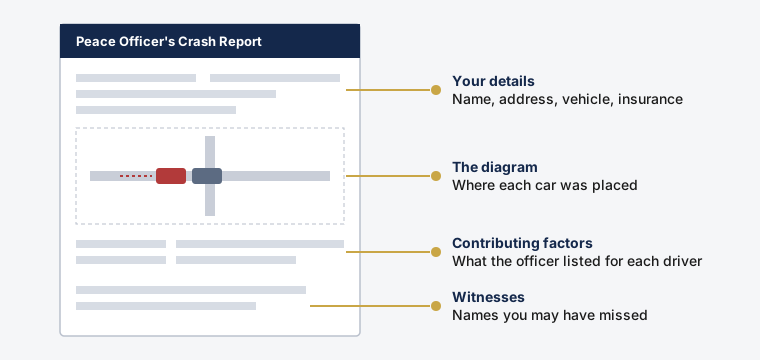
When it arrives, read it carefully. Check:
- Your name, address, vehicle and insurance details
- Where the officer placed each car in the diagram
- The contributing factors listed for each driver
- Witness names you may not have gotten at the scene
If something is factually wrong, like the wrong street or a mixed-up license plate, contact the police department that wrote the report and ask how to request a correction.
No officer came? Texas used a driver's report form called the CR-2, but TxDOT says it no longer keeps those forms and will destroy any sent to it. If police didn't respond, write up your own detailed account, keep it with your photos, and keep a copy of anything the local police department gives you.
Tell your own insurance company
Report the crash to your own insurer as soon as possible, even if you think the other driver was at fault. Most policies require prompt notice, and the Texas Department of Insurance advises sending a copy of the police report once you have it, plus medical reports and bills if you're hurt.
Texas has prompt-payment rules for your own insurer. It must acknowledge your claim within 15 days, accept or deny it within 15 business days of getting everything it needs (up to 45 days if it explains the delay), and pay within five business days of agreeing to pay. Those rules don't apply when the other driver's insurer is the one paying.
Be careful with the other driver's insurance company
Within a day or two, you'll probably get a friendly call from the other driver's insurance adjuster. They'll ask how you're doing, then ask if you'd mind giving a quick recorded statement.
You don't have to. That adjuster works for the other driver's insurance company, and their job is to pay as little as possible. A recorded statement given while you're in pain, on medication or still sorting out what happened can be used to argue you were partly at fault, or that you weren't really hurt.
It's fine to give your name, contact information and your insurance company's details. For anything more, it's reasonable to say: "I'm not ready to give a recorded statement. Please send any questions in writing."
Also hold off on:
- Signing anything, especially a release or a medical records authorization with no limits
- Accepting a quick settlement check. Once you sign a release, you usually can't reopen the claim, even if your injuries turn out to be worse
- Posting about the crash on social media. Adjusters look, and a photo of you at a barbecue can be twisted into "not really hurt"
How fault works in Texas
Texas uses a "51% bar" rule: you can recover money if you were 50% or less at fault, but your award shrinks by your share of the blame. Once you're found more than 50% responsible, you recover nothing.
The rule comes from two short sections of Texas law. Section 33.001 of the Civil Practice and Remedies Code bars a person from recovering if their share of responsibility is greater than 50 percent. Section 33.012 says that if you can recover, your damages are reduced by your own percentage of fault.
What that looks like with real numbers
Say a jury decides your total damages are $50,000. Here's how your share of the blame changes what you take home:
| Your share of fault | What happens | You recover |
|---|---|---|
| 0% | No reduction | $50,000 |
| 20% | Reduced by 20% | $40,000 |
| 50% | Reduced by 50% | $25,000 |
| 51% | Barred from recovery | $0 |
That jump from 50% to 51% is why fault matters so much, and why insurance adjusters work so hard to nudge your percentage up. Every point they shift onto you is money off your claim, and crossing that line wipes it out.
How fault gets decided
In most crashes, fault is pieced together from:
- The CR-3 crash report, including the officer's diagram and contributing factors
- Traffic laws, like following too closely, failing to yield or running a red light
- Your photos and the damage pattern. A crumpled rear bumper tells its own story
- Witness statements
- Video from dashcams, doorbell cameras or nearby businesses. Ask for it quickly, because many systems record over footage within days
The officer's opinion on the report isn't the final word. Insurers and courts make their own decisions. But a clear, accurate report, good photos and solid witnesses make it much harder for anyone to shift blame onto you.
A common example: rear-end crashes
If you're hit from behind while stopped at a light, the driver behind you is usually blamed, because drivers are expected to keep a safe distance. But not always. If your brake lights were out, or you cut in and slammed on your brakes, part of the fault can shift to you. That's exactly why you shouldn't guess or apologize at the scene.
The deadlines you can't miss
In Texas, you generally have two years from the crash to file an injury lawsuit. If a city, county or state vehicle was involved, you may need to send written notice within six months, or even sooner. Miss these and your claim can be gone for good, no matter how strong it was.
The two-year rule
Texas Civil Practice and Remedies Code § 16.003 says a personal injury lawsuit must be filed no later than two years after the day the claim arises. For a car accident, that's usually the day of the crash.
Two years sounds like plenty of time. It isn't. Treatment can take months. Insurance negotiations drag on. Adjusters sometimes keep talking right up to the deadline, then stop returning calls once it passes. A lawyer also needs time to gather records and evidence before filing. If you're thinking about getting help, don't wait until month 23.
When the other driver works for the government
If you were hit by a city bus, a county truck, a police car or another government vehicle, a separate law kicks in. Under the Texas Tort Claims Act, § 101.101, you must give the government written notice within six months of the crash. The notice has to describe your injury or damage, when and where the crash happened, and what happened.
The catch: cities can set their own shorter notice deadlines in their charters or ordinances, and the law allows it. So if a government vehicle was involved, find out the exact deadline for that city or agency right away. The six-month rule doesn't apply if the government already had actual notice of the injury, but don't count on that. Send the notice.
Special rule for kids
If the injured person is under 18, the two-year clock generally doesn't start running until they turn 18, under § 16.001. That's a protection for the child, not a reason for parents to wait. Medical bills a parent pays may have different timing, and evidence fades fast. Talk to a lawyer early.
Deadlines at a glance
| Deadline | What it's for | Source |
|---|---|---|
| Immediately | Report the crash to police if someone is hurt or a car can't be driven | Transp. Code § 550.026 |
| As soon as possible | Notify your own insurance company | Your policy; TDI guidance |
| 6 months (sometimes less) | Written notice to a government agency involved in the crash | CPRC § 101.101 |
| 2 years | File a personal injury lawsuit | CPRC § 16.003 |
A real Texas case: what one driver's medical bills teach us
In Haygood v. De Escabedo, decided July 1, 2011, the Supreme Court of Texas ruled that injured people can recover only the medical expenses that were actually paid or are still owed, not the full amount printed on the bill. That one rule still shapes nearly every Texas car accident claim.
What happened
Aaron Glenn Haygood was driving when a minivan pulling out of a grocery store parking lot collided with his car. The minivan's driver was Margarita Garza De Escabedo. Haygood hurt his neck and shoulder, needed surgery on both, and was left with some lasting impairment (opinion via FindLaw).
His twelve health care providers billed a total of $110,069.12. But Haygood had Medicare Part B, and under Medicare's rules the providers wrote off $82,329.69 of those charges. That left $27,739.43 that was actually owed: $13,257.41 already paid by trial and $14,482.02 still due.
What the jury did
At trial, a jury found De Escabedo negligent and awarded Haygood:
| Category | Jury award |
|---|---|
| Past medical expenses | $110,069.12 |
| Future medical expenses | $7,000 |
| Past pain and mental anguish | $24,500 |
| Future pain and mental anguish | $3,000 |
Notice the first line. The jury awarded the full billed amount, including more than $82,000 that no one would ever pay.
What the Supreme Court decided
The defense appealed. The Tyler Court of Appeals reversed and sent the case back for a new trial, and the Supreme Court of Texas agreed with that result.
The Court relied on a Texas statute, Civil Practice and Remedies Code § 41.0105, which limits medical expense recovery to amounts actually paid or incurred by or for the injured person. It held that the written-off portion of a bill doesn't count, because the provider never had a right to collect it. It also held that juries should hear evidence only of the medical expenses that can actually be recovered, not the inflated sticker price. Justice Lehrmann dissented, arguing the statute limits what can be recovered but shouldn't limit what evidence the jury hears.
What this means for you
- The number on your hospital bill isn't automatically what your claim is worth. What matters is what was paid, and what you still legally owe.
- Keep every bill, explanation of benefits and payment record, not just the first invoice. Your lawyer or adjuster will need the real numbers.
- Health insurance, Medicare and Medicaid change the math. Write-offs by your insurer can shrink the medical portion of your claim.
- Pain and suffering is a separate category. In Haygood's case, the jury awarded it separately from his bills. Your pain journal and treatment records are how that part of your story gets told.
This is one reason it pays to get organized early. The paperwork you gather in the first 72 hours, and keep gathering after, becomes the evidence of what your injuries actually cost.
When to call a lawyer, and how to find one
If you were hurt, if fault is disputed, or if a government vehicle or a commercial truck was involved, talk to a licensed Texas personal injury lawyer early. A minor fender-bender with no injuries is usually something you can handle with your insurance company yourself.
Signs it's time to get legal help
- You or a passenger needed medical treatment, especially surgery, an ER visit or ongoing therapy
- You missed work or can't do your job the way you used to
- The other driver's insurer is blaming you, or the crash report gets the facts wrong
- The other driver had no insurance, too little insurance, or drove off
- A commercial truck, delivery van, rideshare or company vehicle was involved
- A city, county or state vehicle was involved (remember that short notice deadline)
- The insurance company is pushing a quick settlement or asking you to sign a release
- Someone died in the crash
Most personal injury lawyers offer a free first consultation and work on a contingency fee, which means they're paid a percentage of what they recover for you, and nothing if they don't recover anything. Always ask about the percentage, who pays case costs, and get the agreement in writing before you sign.
How to find a Texas lawyer you can trust
State Bar of Texas Lawyer Referral and Information Service. This is the official referral service run by the State Bar, based in Austin, and it covers the whole state (details via TexasLawHelp.org).
- Phone: (800) 252-9690, Monday to Friday, 8:30 a.m. to 4:30 p.m.
- Online: texasbar.com/LawyerReferral
- Cost: Referred lawyers typically charge $20 for a 30-minute first consultation. Confirm with the service when you call, since injury lawyers often waive this anyway.
Check any lawyer's license. Before hiring anyone, including a lawyer you saw on a billboard, look them up on the State Bar of Texas website to confirm they're licensed and in good standing. Our Find a Lawyer page has more help.
Questions to ask at your first meeting:
- How many Texas car accident cases have you handled?
- Will you personally handle my case, or someone else at the firm?
- What's your fee percentage, and does it change if the case goes to trial?
- Who pays for case costs like medical records and expert reports if we lose?
- How often will I hear from you, and how?
Your printable checklist
Screenshot this or print it and keep a copy in your glovebox.
At the scene
- Stop, turn on hazards, move off the freeway main lanes if both cars can drive safely
- Call 911 if anyone is hurt or a car can't be driven
- Help anyone injured without moving them unless they're in danger
- Photograph the other driver's license, insurance card and plate
- Get witness names and phone numbers
- Photograph the cars, the road, signs, signals and weather
- Note the officer's name and badge number
- Don't argue about fault or apologize
Within 24 hours
- See a doctor, even if you feel fine
- Start a folder for bills, receipts and notes
- Start a short daily pain journal
Within 72 hours
- Report the crash to your own insurance company
- Order your CR-3 crash report from TxDOT and check it for errors
- Decline a recorded statement to the other driver's insurer
- Don't sign releases or accept a quick check
- Stay off social media about the crash
- If a government vehicle was involved, check the notice deadline now
- Decide whether to talk to a lawyer
Frequently asked questions
Do I have to report a minor car accident in Texas?
You must notify police right away if the crash injured or killed someone, or if a vehicle can't be driven normally and safely. Even for minor crashes, you still have to stop and exchange your name, address, registration and insurance information with the other driver.
How long do I have to file a car accident claim in Texas?
Generally two years from the date of the crash to file a personal injury lawsuit. If a government vehicle was involved, you may need to send written notice within six months, and some cities require it sooner.
How do I get my Texas accident report?
Buy your CR-3 crash report online from TxDOT's Crash Report Online Purchase System. A regular copy is $6 and a certified copy is $8, plus a small online fee.
Can I still get money if the accident was partly my fault?
Yes, as long as you were 50% or less at fault. Your recovery is reduced by your percentage of fault. If you're found more than 50% at fault, you can't recover damages from the other driver.
Should I talk to the other driver's insurance company?
You can give basic contact and insurance information. You don't have to give a recorded statement, and it's often wise not to until you understand your injuries and your options.
Does Texas require Personal Injury Protection (PIP)?
Every Texas auto policy includes PIP unless the policyholder rejected it in writing. It helps pay medical bills and lost wages for you and your passengers, so check your policy before assuming you don't have it.
What is the minimum car insurance in Texas?
Texas requires at least 30/60/25 liability coverage: $30,000 per injured person, $60,000 per accident for injuries, and $25,000 for property damage, according to the Texas Department of Insurance.
Sources
- Tex. Transp. Code § 550.022: duties when a crash damages a vehicle; moving cars off freeway lanes
- Tex. Transp. Code § 550.023: information drivers must exchange; duty to help the injured
- Tex. Transp. Code § 550.026: duty to report crashes to police
- TxDOT: Crash reports and records: how to buy a CR-3; CR-2 retention
- Texas Department of Insurance: Auto insurance guide: minimum coverage, PIP, claim deadlines
- Tex. Civ. Prac. & Rem. Code § 33.001 and § 33.012: proportionate responsibility
- Tex. Civ. Prac. & Rem. Code § 16.003: two-year limitations period
- Tex. Civ. Prac. & Rem. Code § 16.001: minors and limitations
- Tex. Civ. Prac. & Rem. Code § 101.101: notice to government units
- Haygood v. De Escabedo, No. 09-0377 (Tex. July 1, 2011)
- State Bar of Texas Lawyer Referral and Information Service (TexasLawHelp.org)
Keep reading
 Car Accidents · Texas
Rear-End Collisions and Whiplash in Texas: Who Is at Fault and What Your Claim Is Worth
Rear-end crashes are among the most common in Texas, and whiplash is the injury insurers doubt most. Here's how fault works, what can change it, and how to prove a neck or back injury.
 Car Accidents · Texas
Brain Injury After a Car Accident in Texas: Symptoms, Proving Your Claim and Compensation
A brain injury can hide behind a normal CT scan and a 'you're fine' at the scene. Here's how to spot the warning signs after a Texas crash, prove the injury and protect your claim.
 Car Accidents · Texas
Hit by a City Bus, Police Car or Government Vehicle in Texas? Your Rights Under the Tort Claims Act
Crashes with city buses, police cars, garbage trucks and other public vehicles follow special rules in Texas. Miss a notice deadline that can be as short as 90 days and your claim may be gone.