Car Accidents · Texas
Hit by a City Bus, Police Car or Government Vehicle in Texas? Your Rights Under the Tort Claims Act
Crashes with city buses, police cars, garbage trucks and other public vehicles follow special rules in Texas. Miss a notice deadline that can be as short as 90 days and your claim may be gone.

The short answer: if a city bus, police car, garbage truck, school bus or other government vehicle hit you in Texas, you can usually bring a claim, but under different rules than a normal crash. The Texas Tort Claims Act requires written notice within six months, and many cities require it within as little as 90 days. Damages are capped, punitive damages aren't allowed, and police and ambulances responding to emergencies get extra protection.
Government vehicles are everywhere in Texas: city buses and light rail, police cruisers, fire trucks, ambulances, garbage and recycling trucks, school buses, TxDOT maintenance trucks and county work crews. When one of them causes a crash, most people assume they'll file a claim the same way they would against any other driver. That assumption costs people their claims every year.
The reason is governmental immunity, an old rule that says you generally can't sue the government unless the government has agreed to be sued. In Texas, the Tort Claims Act is where the government agrees, but only on its own terms. This guide explains those terms in plain English: who qualifies, the deadlines, the damage caps, the emergency exception, a recent Texas Supreme Court case about a police chase, and what to do right away. For the general steps after any crash, see our guide on what to do after a car accident in Texas.
- Why government crashes are different
- Which vehicles and drivers count
- When the government is liable
- The notice deadline: 90 days to six months
- How much you can recover
- Police chases and the emergency exception
- A real Texas case: City of Austin v. Powell (2024)
- Suing the driver vs. the government
- Federal vehicles and the mail truck
- What to do after the crash
- Deadlines and when to call a lawyer
- Checklist and FAQ
Why government crashes are different
When a private driver hits you, you deal with that driver's insurance company, and if it won't pay fairly, you can file a lawsuit within two years. When a government driver hits you, four things change:
- You need permission to sue. The government is immune unless a statute waives that immunity. For vehicle crashes, the waiver is in the Texas Tort Claims Act, Chapter 101 of the Civil Practice and Remedies Code.
- You have to give formal notice, fast. The government must receive written notice of your claim within six months, and a city's charter can make that window shorter.
- Damages are capped. Even with catastrophic injuries, the most you can recover from a governmental unit is limited by law.
- There are special exceptions. Emergency responses, and certain decisions about how to run government programs, are protected.
None of this makes a claim impossible. It means the clock and the paperwork matter more than usual.
Which vehicles and drivers count
The Tort Claims Act covers "governmental units," which include the State of Texas and its agencies, cities, counties, school districts, junior college districts, and many other political subdivisions and special districts. Common examples:
- City buses and transit vehicles
- Police cars, fire trucks and city or county ambulances
- Garbage, recycling and street maintenance trucks
- School buses operated by an independent school district
- TxDOT trucks, state agency cars and university vehicles
- County sheriff's vehicles and road crews
Be careful with vehicles that look public but aren't. Some cities and school districts hire private contractors to run buses or collect trash. A private company doesn't get governmental immunity, so a claim against it follows the normal rules, with the normal two-year deadline. The police report, the vehicle's markings and the driver's employer will tell you which situation you're in. If you're not sure, assume the shorter government deadline applies until a lawyer tells you otherwise.
Federal vehicles, like U.S. Postal Service trucks and military vehicles, are a different system entirely. We cover them below.
When the government is liable
Under § 101.021 of the Tort Claims Act, a governmental unit is liable for personal injury, death and property damage caused by the wrongful act or negligence of an employee acting within the scope of employment, if the damage arises from the operation or use of a motor-driven vehicle and the employee would be personally liable under Texas law (§ 101.021).
In plain English, you generally need to show:
- A government employee was driving or using the vehicle. Volunteers and independent contractors usually don't count.
- They were on the job. A city employee driving a city truck on a work route is covered. The same employee driving their own car on the weekend is not; that's a normal claim against their personal insurance.
- They were negligent. Running a red light, rear-ending you, an unsafe lane change, backing into you: the same kinds of carelessness that make any driver liable.
- The vehicle's operation or use caused your injury. The vehicle has to be more than just the setting. A bus driver pulling away before a passenger is seated may qualify; something that merely happened on a parked bus may not.
Texas uses the same 51% fault rule against the government as against anyone else. If you were partly at fault, your damages are reduced by your percentage, and if you were more than 50% at fault you recover nothing.
The notice deadline: 90 days to six months
This is the rule that trips up the most people. Section 101.101 says a governmental unit is entitled to receive notice of a claim no later than six months after the incident. The notice must reasonably describe the damage or injury, the time and place of the incident, and the incident itself (§ 101.101).
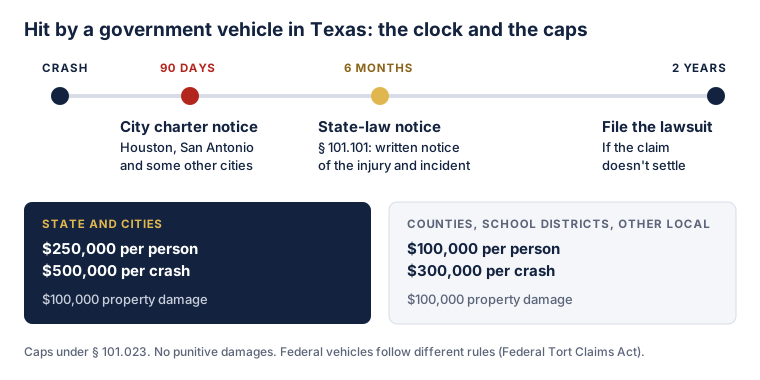
The same section approves city charter provisions that set their own notice periods, and many large Texas cities use shorter ones:
- Houston: written, notarized notice within 90 days of the injury, sent to the City Secretary (City of Houston claim instructions)
- San Antonio: written notice within 90 days under City Charter Section 150, sent to the City Manager or City Clerk (City of San Antonio notice of claim)
- Other cities, counties and agencies: check the entity's own claim instructions, usually on its website under "risk management," "claims" or the city secretary's page
Houston's form, for example, asks for when, where and how the injury happened, the extent of the injury, the amount of damages, the amount you'd accept to settle, your address, and witnesses. Fill in what you can. You don't need to know your final medical bills to give timely notice.
Does it matter if they already know?
Under § 101.101(c), the formal notice requirement doesn't apply if the government had actual notice that someone died, was injured or had property damaged. But Texas courts read "actual notice" narrowly: generally, the government must have known it was at least partly at fault, not just that a crash happened. A police report alone often isn't enough. Don't rely on actual notice. Send written notice anyway, and keep proof that it was received, like a certified mail receipt.
What notice is not
Notice is not a lawsuit. It simply tells the government you have a claim. After notice, many cities and agencies will open a claim file and an adjuster will contact you, much like an insurance company. If the claim doesn't settle, you still have to file a lawsuit within the general two-year limitations period.
How much you can recover
The Tort Claims Act limits what you can recover (§ 101.023):
| Who caused the crash | Bodily injury or death, per person | Bodily injury or death, per occurrence | Property damage, per occurrence |
|---|---|---|---|
| State of Texas and its agencies (like TxDOT) | $250,000 | $500,000 | $100,000 |
| Cities (municipalities) | $250,000 | $500,000 | $100,000 |
| Other local units (counties, school districts and others) | $100,000 | $300,000 | $100,000 |
Two more limits matter:
- No punitive damages. The act doesn't allow exemplary damages against the government (§ 101.024).
- The per-occurrence cap is shared. If a city bus crash injures ten passengers, they all share the $500,000 per-occurrence limit, however serious their injuries.
For serious injuries, the caps make your own insurance especially important. Your personal injury protection (PIP) and underinsured motorist (UIM) coverage can help. PIP pays your medical bills and lost wages no matter who was at fault. Uninsured and underinsured motorist coverage is less certain: many auto policies exclude government-owned vehicles from it, so read your policy or ask your agent. See our guide to uninsured and underinsured driver claims and our guide to what an injury case is worth.
Police chases and the emergency exception
The Tort Claims Act doesn't apply to claims arising from an employee's action while responding to an emergency call or reacting to an emergency situation, if the action complied with the laws and ordinances applicable to emergency action, or, without such a law or ordinance, if the action was not taken with conscious indifference or reckless disregard for the safety of others (§ 101.055(2)).
This is the main defense in crashes involving police cars, fire trucks and ambulances. In practice:
- Was it an emergency? A patrol car on routine patrol, or an ambulance returning to the station, may not be responding to an emergency. If there was no emergency, the exception doesn't apply and ordinary negligence is enough.
- If it was an emergency, ordinary carelessness usually isn't enough. You generally have to show the driver broke a law that specifically governs emergency driving or acted recklessly, meaning they knew of the risk and didn't care.
- Lights and sirens matter. Whether they were on, and whether the driver slowed at red lights and intersections, often decides these cases.
A real Texas case: City of Austin v. Powell (2024)
On December 31, 2024, the Supreme Court of Texas decided City of Austin v. Powell, No. 22-0662, which shows how hard the emergency exception is to overcome (opinion; KERA News coverage).
What happened
In 2018, Austin police chased a fleeing suspect. Officer Brandon Bender joined the pursuit, and Officer Michael Bullock followed close behind him. When Bender slowed and turned to try to cut the suspect off, Bullock braked but couldn't stop in time. He hit Bender's car, and his patrol car then hit Noel Powell's minivan, which was stopped at a stop sign. Powell had done nothing wrong. The impact spun his van around.
The lawsuit
Powell sued the City of Austin. The city argued the emergency exception applied. The trial court and the court of appeals let the case go forward, finding that Bullock's failure to keep a safe distance, inattention and failure to control his speed raised a fact question about recklessness.
What the Supreme Court decided
The Supreme Court reversed and dismissed Powell's case. It held:
- The general rule against following too closely isn't a law "applicable to emergency action," so breaking it doesn't defeat the exception.
- Violations of the police department's own policies aren't "laws and ordinances" under the statute.
- Speeding, following too closely and inattention were, at most, negligence, not recklessness. The severity of the crash didn't prove recklessness, and the officers' use of lights and sirens pointed the other way.
The same day, in City of Houston v. Rodriguez, the Court also dismissed a lawsuit by a man whose truck was hit by a Houston officer during a chase, on a related doctrine called official immunity.
What this means for you
- Innocent drivers can lose. Powell was stopped at a stop sign and still couldn't recover from the city. That's why your own insurance matters so much.
- Evidence of recklessness is the key. Dash camera and body camera video, radio traffic, speeds and whether the officer slowed at intersections can make the difference.
- Request records quickly. A lawyer can use the Texas Public Information Act and preservation letters to get video and data before it's routinely deleted.
- Non-emergency crashes are different. If the officer wasn't responding to an emergency, the ordinary negligence rules apply.
Suing the driver vs. the government
You might think you could avoid the caps by suing the bus driver or officer personally. Texas law makes that difficult. Under the act's election-of-remedies provision, suing the governmental unit generally bars a suit against the employee over the same incident, and if you sue an employee for something they did on the job, the court can dismiss the employee and substitute the governmental unit (§ 101.106). In most vehicle cases, the claim is against the government itself. A lawyer should choose the defendant carefully from the start, because a wrong choice can't always be undone.
Federal vehicles and the mail truck
Crashes with U.S. Postal Service trucks, military vehicles, and other federal vehicles fall under the Federal Tort Claims Act, not Texas law. The basics:
- You must first file a written administrative claim with the federal agency, usually on Standard Form 95, within two years of the crash, stating a specific dollar amount.
- The agency has six months to respond. You can sue in federal court only after it denies the claim or doesn't respond in that time.
- There's no jury, and punitive damages aren't allowed.
Contractors who deliver for the Postal Service, and many delivery companies, are private and follow the normal Texas rules.
What to do after the crash
1. Call 911 and get medical care
Report the crash and get checked even if you feel okay. Tell medical providers exactly how the crash happened.
2. Identify the government entity
Write down the vehicle number, any agency name or logo, the driver's name, and the bus route or unit number. Ask the responding officer which agency owns the vehicle. The police report (Texas Peace Officer's Crash Report) will usually list it.
3. Document everything
- Photos of all vehicles, the intersection, traffic signals and any skid marks
- Names and phone numbers of witnesses, including bus passengers
- Whether lights and sirens were on, and whether the vehicle slowed down
- Nearby businesses with cameras, and the bus's own cameras
4. Find and calendar the notice deadline
Look up the entity's notice rules the same week. Count 90 days from the crash as your working deadline unless you confirm a longer one.

5. Send written notice and keep proof
Use the entity's claim form if it has one, sign it (and notarize it if required), keep a copy, and send it by certified mail with a return receipt, or hand-deliver it and get a date-stamped copy. Include the date, time and place, a description of what happened, your injuries and property damage, and a settlement amount if the form requires one.
6. Use your own insurance too
Report the crash to your insurer and file a PIP claim for medical bills and lost wages. Your own coverage doesn't depend on the government's immunity.
Deadlines
- City charter notice: as short as 90 days in some cities, including Houston and San Antonio
- State-law notice: within six months of the incident
- Lawsuit: generally within two years of the crash
- Federal vehicles: administrative claim within two years, then a lawsuit within six months after the agency's final denial
When to call a lawyer
Government claims are full of procedural traps, and mistakes are often permanent. Talk to a licensed Texas lawyer quickly if:
- You were seriously injured or a family member died
- A police car, fire truck or ambulance was involved
- You're not sure which agency, or whether a private contractor, owns the vehicle
- You're close to a 90-day or six-month deadline
- The government's adjuster has denied your claim or blamed you
For a lawyer referral, contact the State Bar of Texas Lawyer Referral and Information Service at (800) 252-9690, Monday to Friday, 8:30 a.m. to 4:30 p.m., or texasbar.com/LawyerReferral. Our Find a Lawyer page has questions to ask.
Checklist: after a crash with a government vehicle
- Call 911 and get medical care
- Write down the vehicle number, agency and driver's name
- Photograph the scene and get witness contact information
- Note whether lights and sirens were on
- Get the police crash report
- Look up the entity's notice deadline the same week
- Send written notice by certified mail and keep the receipt
- File a PIP claim with your own insurer
- Mark the two-year lawsuit deadline
Frequently asked questions
Can I sue the city if a city vehicle hit me in Texas?
Often, yes. The Texas Tort Claims Act waives immunity for injuries caused by a government employee's negligent operation or use of a motor vehicle while on the job, if the employee would be personally liable under Texas law. But special notice deadlines, damage caps and exceptions apply.
How long do I have to file a claim against a government entity in Texas?
State law requires written notice within six months of the incident, but many city charters require notice sooner. Houston and San Antonio, for example, require notice within 90 days. The general two-year deadline still applies to filing a lawsuit. If you miss the notice deadline, the claim can be barred unless the government had actual notice of the injury.
How much can I recover from a Texas city or the state?
The Tort Claims Act caps damages. For the state and for cities, the limit is $250,000 per person and $500,000 per occurrence for bodily injury or death, and $100,000 for property damage. Other local units, like counties, have lower caps of $100,000 per person and $300,000 per occurrence. Punitive damages are not available.
Can I sue if a police car hit me during a chase?
Sometimes, but it's hard. The Tort Claims Act's emergency exception protects the government when an officer responding to an emergency follows the laws for emergency action, or, if none apply, does not act with conscious indifference or reckless disregard. Ordinary carelessness, like following too closely, is usually not enough.
What if a federal vehicle, like a postal truck, hit me?
Claims against the federal government go under the Federal Tort Claims Act, not the Texas law. You generally must file a written administrative claim with the agency, often on Standard Form 95, within two years, and wait for the agency to respond before suing.
Sources
- Tex. Civ. Prac. & Rem. Code § 101.021: government liability for motor vehicle use
- Tex. Civ. Prac. & Rem. Code § 101.023: limits on liability
- Tex. Civ. Prac. & Rem. Code § 101.024: no exemplary damages
- Tex. Civ. Prac. & Rem. Code § 101.055: emergency exception
- Tex. Civ. Prac. & Rem. Code § 101.101: notice
- Tex. Civ. Prac. & Rem. Code § 101.106: election of remedies
- City of Austin v. Powell, No. 22-0662 (Tex. Dec. 31, 2024)
- KERA News: Texas Supreme Court rules on Austin and Houston police chase crashes
- City of Houston: instructions for filing a claim
- City of San Antonio: notice of claim
- State Bar of Texas Lawyer Referral and Information Service (TexasLawHelp.org)
Keep reading
 Car Accidents · Texas
Rear-End Collisions and Whiplash in Texas: Who Is at Fault and What Your Claim Is Worth
Rear-end crashes are among the most common in Texas, and whiplash is the injury insurers doubt most. Here's how fault works, what can change it, and how to prove a neck or back injury.
 Car Accidents · Texas
Brain Injury After a Car Accident in Texas: Symptoms, Proving Your Claim and Compensation
A brain injury can hide behind a normal CT scan and a 'you're fine' at the scene. Here's how to spot the warning signs after a Texas crash, prove the injury and protect your claim.
 Car Accidents · Texas
Hit by a Drunk Driver in Texas? How to Get Compensated, Including From the Bar That Served Them
More than 1,000 people died in alcohol-related crashes in Texas in 2024. If a drunk driver hurt you or someone you love, you may have claims against the driver, a bar that kept serving them, and the state's crime victims fund.