Car Accidents · Texas
Brain Injury After a Car Accident in Texas: Symptoms, Proving Your Claim and Compensation
A brain injury can hide behind a normal CT scan and a 'you're fine' at the scene. Here's how to spot the warning signs after a Texas crash, prove the injury and protect your claim.

The short answer: if you hit your head, or were jolted hard, in a Texas car accident, get checked even if you feel fine, and tell every provider about the head impact. Brain injuries can be serious even when a CT scan is normal, and symptoms often show up later. To recover compensation, you'll generally need medical expert evidence linking the injury to the crash, and you must file within two years.
Most people picture a brain injury as something dramatic: a person unconscious at the scene, rushed into surgery. Some are. But many brain injuries from car accidents are quieter. You climb out of the car, tell the officer you're okay, and go home. A few days later you notice that you can't follow a conversation, you've lost your keys three times, the light from your phone hurts, and you snapped at your kids for no reason.
That kind of injury is real, and it can change a person's work, relationships and future. It's also the kind of injury insurance companies are most likely to question, because it doesn't show up on an X-ray. This guide explains the warning signs, how brain injuries are diagnosed, how Texas law requires you to prove them, what compensation can cover, and a Texas Supreme Court case about why medical evidence matters.
- How common brain injuries are
- How a crash injures the brain
- Symptoms and warning signs
- What to do after the crash
- How brain injuries are diagnosed
- Proving a brain injury claim in Texas
- A real Texas case: Guevara v. Ferrer
- What compensation can cover
- How insurers push back
- Help for survivors and families
- Deadlines and when to call a lawyer
- Checklist and FAQ
How common brain injuries are
The Centers for Disease Control and Prevention counted 69,473 deaths related to traumatic brain injury (TBI) in the United States in 2021, and more than 587 TBI-related hospitalizations a day in 2020. Motor vehicle crashes are one of the leading causes of moderate and severe brain injuries (USAFacts, using CDC data).
Those numbers leave out the large number of people with concussions who are treated in an emergency room and sent home, see their own doctor, or never get treated at all. Those are often the people whose injuries are missed, and whose claims are hardest to prove later.
How a crash injures the brain
Your brain floats inside your skull. In a crash, your body stops or changes direction suddenly, and the brain can strike the inside of the skull or twist. That can bruise brain tissue, stretch and tear nerve fibers, or cause bleeding.
- You don't have to hit your head. The violent back-and-forth motion of a rear-end or side-impact crash can injure the brain without any blow to the head.
- Airbags and seat belts help, but don't prevent every brain injury. They reduce the impact; they can't stop the brain from moving inside the skull.
- "Mild" doesn't mean minor. Doctors call a concussion a mild TBI because it isn't immediately life-threatening, not because its effects are always small. Most people recover from a concussion in weeks or months, but some have symptoms that last much longer.
Doctors usually grade brain injuries as mild, moderate or severe, based on things like loss of consciousness, how long confusion or memory loss lasted, and imaging findings.
Symptoms and warning signs
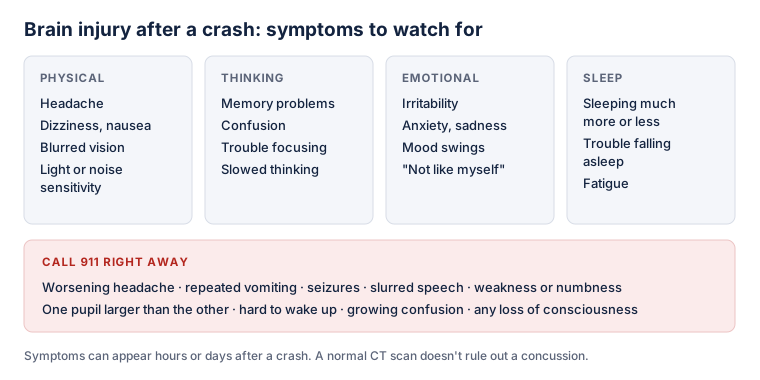
Brain injury symptoms tend to fall into four groups:
- Physical: headaches, dizziness, nausea, blurred vision, ringing in the ears, sensitivity to light or noise, balance problems, fatigue
- Thinking: confusion, trouble concentrating, memory problems, slowed thinking, difficulty finding words
- Emotional: irritability, anxiety, depression, mood swings, feeling "not like myself"
- Sleep: sleeping much more or much less than usual, or trouble falling asleep
Family members often notice changes before the injured person does. If someone close to you says you seem different, take it seriously.
Get emergency care right away for
- A headache that gets worse and doesn't go away
- Repeated vomiting, seizures, or slurred speech
- Weakness, numbness or loss of coordination
- One pupil larger than the other
- Unusual drowsiness, or being hard to wake up
- Growing confusion, restlessness or agitation
- Any loss of consciousness, even briefly
These can be signs of bleeding or swelling in the brain, which can be life-threatening. Call 911.
What to do after the crash
1. Get checked, and mention your head
Let paramedics examine you at the scene. If you don't go to the hospital, see a doctor within a day or two. Tell every provider if you hit your head, felt dazed, blacked out or can't remember part of the crash. If it isn't in the records, insurers will later say it didn't happen.
2. Don't drive or return to hard work too soon
Follow your doctor's instructions about rest, screens, driving and work. Pushing through symptoms can make them worse and longer-lasting.
3. Keep a symptom journal
Write down each day how you feel: headaches, forgotten appointments, trouble at work, mood changes, sleep. Ask a family member to add what they notice. A journal is powerful evidence, because brain injuries change everyday life in ways that are hard to remember later.
4. Follow up and follow through
Go to follow-up visits and any referrals to a neurologist, concussion clinic, therapist or rehabilitation program. Gaps in treatment are one of the main ways insurers argue an injury isn't serious.
5. Protect the claim
Get the crash report, photos of the vehicles, and witness information. Report the claim, but be careful what you say to the other driver's insurer. See our guide to talking to insurance adjusters.
How brain injuries are diagnosed
There isn't one simple test for a brain injury. Doctors may use:
- A clinical exam: questions about what happened, memory, attention, balance and coordination
- CT scans: used in the emergency room to look for bleeding and skull fractures. A normal CT doesn't rule out a concussion.
- MRI: can show some injuries that a CT misses, and may be ordered when symptoms continue
- Neuropsychological testing: detailed tests of memory, attention, processing speed and other thinking skills, often used when symptoms last
- Specialist evaluation: neurologists, neuropsychologists, and vision, hearing or balance specialists, depending on symptoms
Because mild brain injuries often don't appear on imaging, the medical record, from the first visit on, carries much of the weight. Consistent reports of symptoms, a clear history of the crash, and a specialist's diagnosis tie it together.
Proving a brain injury claim in Texas
To recover money from the at-fault driver, you have to prove two things: that the other driver was negligent, and that the crash caused your injuries and losses.
Fault in a brain injury case works like any other car accident case. Texas's 51% rule applies: you can recover if you were 50% or less at fault, reduced by your share. See our guide on what to do after a car accident in Texas.
Causation is where brain injury cases are won or lost. The defense may argue that your symptoms come from stress, depression, an earlier concussion, aging or something else. You'll generally need:
- Medical records showing symptoms beginning after the crash and continuing
- Testimony from treating doctors or retained experts, such as a neurologist or neuropsychologist, explaining the diagnosis and why the crash caused it
- "Before and after" witnesses: family, friends, coworkers and supervisors who can describe how you've changed
- Work records showing missed time, lost promotions or performance problems
A real Texas case: Guevara v. Ferrer
The Supreme Court of Texas explained when you need a medical expert to prove an accident caused an injury in Guevara v. Ferrer, 247 S.W.3d 662 (Tex. 2007) (case summary).
What happened
On October 17, 2002, 86-year-old Arturo Labao was riding in a car driven by his son-in-law when another car turned in front of them and the cars collided. Both men were taken to the emergency room by ambulance. Over the following months, Mr. Labao went through abdominal surgeries, a long stay in intensive care, a tracheotomy and many other treatments. He died in May 2003.
The trial
His family sued. His medical bills topped $1 million, but the only medical records offered were brief admission and consultation notes, and no medical expert testified about what the crash had caused. The jury awarded more than $1.1 million in medical expenses and $125,000 for pain and mental anguish.
What the Supreme Court decided
The Court held that expert medical evidence is generally required to prove that an accident caused a medical condition. Lay testimony is enough only when the condition, its connection to the accident and the need for treatment are within ordinary experience, like the emergency care someone gets right after a crash. Lay testimony couldn't prove that the crash caused all of Mr. Labao's later conditions and treatment. The Court also said that the timing of a condition, coming soon after an accident, may raise suspicion but isn't enough on its own.
What this means for you
- Brain injuries almost always need an expert. How a crash affected memory, mood and thinking is not "ordinary experience," so a qualified medical witness will usually be needed.
- "It started after the crash" isn't enough. Timing helps, but a doctor has to connect the dots.
- Detailed records matter. Short notes that don't mention a head impact or symptoms make a doctor's job much harder later.
- Emergency care is easier to prove. The ambulance ride and ER visit right after a crash are within ordinary experience. Months of later treatment need more.
What compensation can cover
A brain injury can affect a person for years, so damages often focus on the future as much as the past. In Texas, you may recover:
- Medical expenses, past and future, including rehabilitation, therapy, medication and specialist care. Under Texas law, recovery is limited to amounts actually paid or incurred; see our guide on what an injury case is worth.
- Lost wages and lost earning capacity, if the injury keeps you from returning to your job or limits your career
- Pain, suffering and mental anguish
- Physical impairment, including lost ability to do things you used to do
- Care and household help, if you need supervision, transportation or help at home
- Loss of consortium for a spouse, and in some serious cases for children, when the relationship is seriously affected
In serious cases, lawyers often use a life care plan, prepared by medical and rehabilitation experts, to estimate future care costs, and an economist to estimate lost future earnings. There's no general cap on these damages in a car accident case against a private driver, though Texas caps punitive damages and limits claims against government vehicles; see our guide to government vehicle accidents.

How insurers push back
- "The CT was normal." True for many real brain injuries. A specialist's explanation answers this.
- "You didn't hit your head." The forces in a crash can injure the brain without a blow.
- "You said you were fine at the scene." Adrenaline and confusion are common after a crash. Your later records show the full picture.
- "It's depression or stress." Mood changes are a common brain injury symptom. A neuropsychologist can help separate the causes.
- "You had an earlier injury." If the crash made an earlier condition worse, you can still recover for the worsening.
- Surveillance and social media. A smiling photo doesn't show headaches or memory loss, but it will be used. Be careful what you post.
Help for survivors and families
Texas Health and Human Services runs the Comprehensive Rehabilitation Services (CRS) program, which helps Texans with a traumatic brain injury or spinal cord injury regain independence through inpatient and outpatient rehabilitation and post-acute brain injury services (Texas HHS). HHS also lists other brain injury resources for survivors and families (find help through HHS).
If a brain injury leaves someone unable to manage their own affairs, a family member may need a guardianship or power of attorney to handle the claim and finances. A lawyer can explain the options.
Deadlines
- Two years from the crash for most injury lawsuits
- Children: the deadline generally doesn't start running until the child turns 18
- People of unsound mind: the deadline can be paused while a person is legally of unsound mind, which may include some severe brain injuries. Don't rely on this without legal advice.
- Government vehicles: notice can be required in as little as 90 days
See our guide to Texas injury claim deadlines.
When to call a lawyer
Brain injury claims usually need medical experts, and the value of a case can depend on future losses that are hard to estimate. Talk to a licensed Texas lawyer if:
- You were diagnosed with a concussion or brain injury
- Symptoms have lasted more than a few weeks
- You can't return to work, or your work has suffered
- The insurer says your injury is minor or unrelated
- A family member needs help managing the claim
For a referral, contact the State Bar of Texas Lawyer Referral and Information Service at (800) 252-9690, Monday to Friday, 8:30 a.m. to 4:30 p.m., or texasbar.com/LawyerReferral. Our Find a Lawyer page has questions to ask.
Checklist: brain injury after a car accident
- Get checked, even if you feel fine
- Tell every provider about any head impact, daze or memory gap
- Call 911 for emergency warning signs
- Keep a daily symptom journal, with notes from family
- Go to every follow-up and specialist referral
- Follow rest, driving and work instructions
- Get the crash report and witness information
- Be careful with insurers and social media
- Mark the two-year deadline
Frequently asked questions
Can you get a brain injury in a car accident without hitting your head?
Yes. The sudden speeding up and stopping in a crash can move the brain inside the skull and injure it even if your head never strikes anything. That's why concussion symptoms can appear after a rear-end or side-impact crash where you didn't hit your head.
How long after a car accident can brain injury symptoms appear?
Some symptoms show up right away, but others, like headaches, memory problems, mood changes and trouble sleeping, may appear or worsen over the following hours, days or weeks. See a doctor promptly, and go back if new symptoms appear.
What if my CT scan was normal?
A normal CT scan doesn't rule out a concussion or mild traumatic brain injury. CT scans look for bleeding and fractures, and many brain injuries don't show up on them. Diagnosis often depends on your symptoms, a clinical exam and, sometimes, neuropsychological testing.
Do I need a medical expert to prove a brain injury claim in Texas?
Usually, yes. In Guevara v. Ferrer (2007), the Texas Supreme Court held that expert medical evidence is generally required to prove that an accident caused a medical condition, unless the injury and its cause are within ordinary experience. Brain injuries almost always need expert proof.
How long do I have to file a brain injury lawsuit in Texas?
Generally two years from the date of the accident. The deadline is paused for children under 18 and for people of unsound mind, which can include some people with severe brain injuries, but don't rely on that without a lawyer's advice.
Sources
- USAFacts: How common are traumatic brain injuries in the US? (CDC data)
- Guevara v. Ferrer, 247 S.W.3d 662 (Tex. 2007), summary
- Texas HHS: resources for Texans with brain injury
- Texas HHS: find help for acquired brain injury
- Tex. Civ. Prac. & Rem. Code § 16.001: deadlines paused for minors and people of unsound mind
- Tex. Civ. Prac. & Rem. Code § 16.003: two-year deadline for personal injury
- State Bar of Texas Lawyer Referral and Information Service (TexasLawHelp.org)
Keep reading
 Car Accidents · Texas
Rear-End Collisions and Whiplash in Texas: Who Is at Fault and What Your Claim Is Worth
Rear-end crashes are among the most common in Texas, and whiplash is the injury insurers doubt most. Here's how fault works, what can change it, and how to prove a neck or back injury.
 Car Accidents · Texas
Hit by a City Bus, Police Car or Government Vehicle in Texas? Your Rights Under the Tort Claims Act
Crashes with city buses, police cars, garbage trucks and other public vehicles follow special rules in Texas. Miss a notice deadline that can be as short as 90 days and your claim may be gone.
 Car Accidents · Texas
Hit by a Drunk Driver in Texas? How to Get Compensated, Including From the Bar That Served Them
More than 1,000 people died in alcohol-related crashes in Texas in 2024. If a drunk driver hurt you or someone you love, you may have claims against the driver, a bar that kept serving them, and the state's crime victims fund.