Truck Accidents · Texas
Hit by an 18-Wheeler in Texas? Who's Responsible and What to Do Next
A crash with a semi-truck isn't just a bigger car accident. More people can be responsible, federal safety rules come into play, and key evidence can vanish within months. Here's how it works in Texas.

The short answer: after a crash with an 18-wheeler in Texas, the driver may not be the only one responsible. The trucking company, the people who loaded or maintained the truck, and others can share the blame, and federal safety rules often show who broke the rules. But the evidence that proves it, like driver logs and the truck's electronic data, can be lost within months. Get medical care, document everything, and talk to a lawyer quickly.
There's no fair fight between a pickup and a fully loaded semi. One moment you're cruising down I-20 or I-10, and the next there's a wall of steel in your mirror or across your lane. Even a "minor" truck crash can total a car and send people to the hospital.
What happens afterward is different too. A car accident usually involves two drivers and two insurance companies. A truck accident can involve a driver, a trucking company, a cargo company, a mechanic shop and several insurers, all with lawyers who start working the day of the crash. This guide explains who can be responsible, the federal rules that matter, the evidence you need to protect, and how Texas truck cases work in court today.
- Why truck crashes are different
- What to do at the scene of a truck crash
- Who can be responsible
- The federal rules that can prove fault
- Evidence that disappears fast
- Dealing with the trucking company's insurance
- How Texas truck cases work in court
- A real Texas case: Werner v. Blake
- When to call a lawyer
- Checklist and FAQ
Why truck crashes are different
Truck crashes follow the same basic Texas rules as car crashes: you have a two-year deadline, and fault is shared under the 51% rule. But four things make them more complicated.
- The injuries are often worse. A loaded tractor-trailer can weigh many times more than a passenger car. That weight turns ordinary crashes into life-changing ones.
- More than one party can be responsible. The driver works for a company. The cargo may have been loaded by someone else. The brakes may have been serviced by a third company.
- Federal safety rules apply. Interstate trucking companies and their drivers must follow the Federal Motor Carrier Safety Regulations, which cover everything from how long drivers can work to how trucks are inspected.
- There's usually more insurance. Federal rules require for-hire trucking companies to carry far more liability coverage than the 30/60/25 minimum for Texas drivers.
What to do at the scene of a truck crash
Everything in our guide to the first 72 hours after a Texas car accident applies here: stop, call 911 if anyone is hurt or a vehicle can't be driven, exchange information, and see a doctor within 24 hours. Truck crashes add a few extra steps.
1. Stay away from the truck if it's leaking or smoking
Big rigs carry large fuel tanks, and some carry hazardous cargo. If you see leaking fluid, smoke or a hazard placard on the trailer, get yourself and your passengers well away from the vehicles and tell the 911 dispatcher.
2. Photograph the truck's identifying details
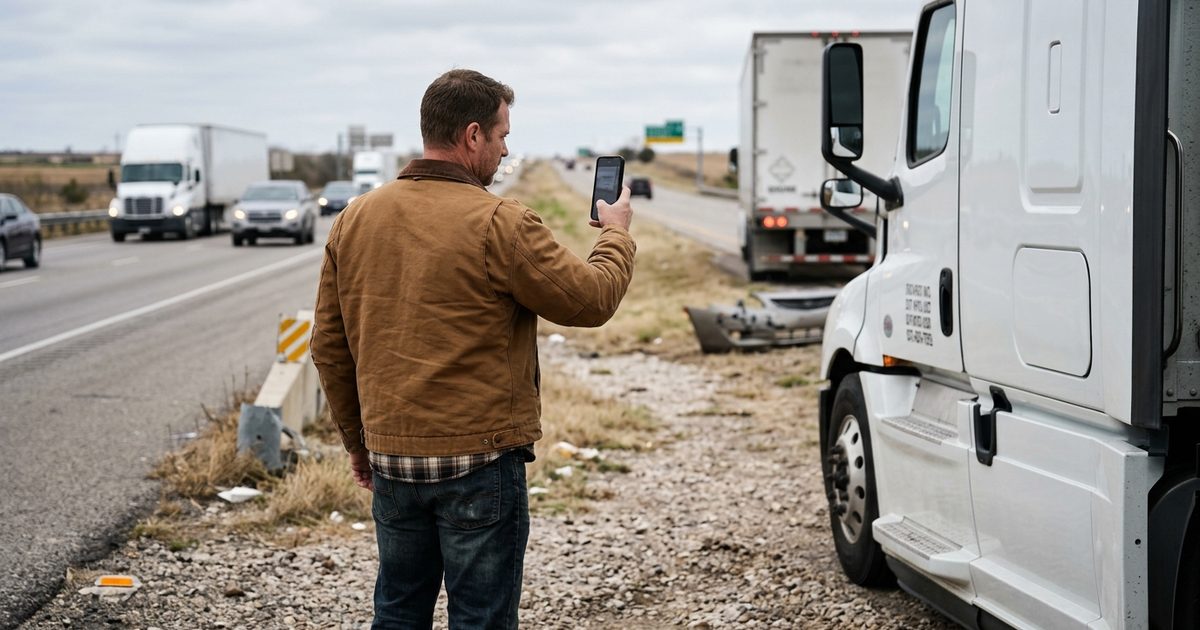
Commercial trucks display a company name and a USDOT number on the cab door. That number lets anyone look up the company in the federal government's SAFER Company Snapshot, which shows its inspection results, crash counts and safety rating. Photograph:
- The company name and USDOT number on the cab
- The truck's and trailer's license plates and trailer number
- Any cargo that spilled or shifted, and how the trailer is loaded if you can see it
- The truck's tires, lights and any visible damage
- Skid marks, the final positions of every vehicle, and the road conditions
3. Get the driver's information, then stop talking
Get the truck driver's name, license, insurance information and the name of the company they drive for. Be polite, but don't argue about what happened, and don't apologize. Truck drivers are trained to report crashes to their company right away, and the company's insurer may have someone working on the case within hours.
4. Find the witnesses
Other drivers who saw the crash are extremely valuable in truck cases, because the truck company will have its own version of events. Get names and phone numbers before people drive away.
Who can be responsible for a truck crash
In a truck crash, responsibility often falls on more than just the driver. Who is actually responsible depends on what caused the crash, and that takes investigation. Here are the usual suspects.
The truck driver
Drivers can be at fault for the same reasons anyone can: speeding, following too closely, unsafe lane changes, distraction or impairment. Truck drivers also have extra legal duties, such as staying within their hours-of-service limits and inspecting their vehicles.
The trucking company
In general, an employer is responsible for an employee's negligence on the job. A trucking company can also be responsible for its own mistakes, such as:
- Hiring a driver with a bad record or without proper qualifications
- Failing to train or supervise drivers
- Pushing schedules that are impossible to meet within the federal hours limits
- Skipping required inspections, repairs or drug and alcohol testing
The company that loaded the cargo
Overloaded or badly secured cargo can shift, making a truck hard to steer or stop, or causing a rollover. If a separate shipper or loading company packed the trailer, it may share responsibility.
The maintenance company
Brake failures and tire blowouts are sometimes traced to poor maintenance. If an outside shop serviced the truck, its work may be part of the case.
A parts manufacturer
When a defective part, like a brake component or tire, causes a crash, the manufacturer can be responsible under product liability law.
And sometimes, someone else entirely
A truck being involved doesn't automatically make the trucking company responsible. Another driver, road conditions or a sudden emergency may be the real cause. The Texas Supreme Court case below shows exactly how that question gets decided.
The federal rules that can prove fault
Federal safety rules set the minimum standards for interstate truck drivers and companies. When a driver or company breaks those rules, it can be strong evidence of negligence. These are the rules that come up most often.
Hours of service: how long a trucker can drive
Fatigue is a serious danger in trucking, so federal law limits how long drivers can work. Under 49 CFR § 395.3, a driver carrying property:
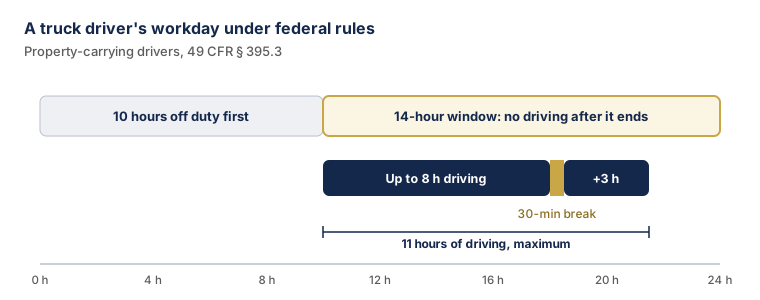
- Must have 10 consecutive hours off duty before starting to drive
- May drive a maximum of 11 hours after that break
- May not drive after the 14th hour since coming on duty
- Must take a 30-minute break after 8 hours of driving
- May not drive after 60 hours on duty in 7 days, or 70 hours in 8 days if the company operates every day; a 34-hour break resets that count
Most trucks track these hours electronically. If the logs show a driver was over the limit when the crash happened, that matters.
Driver qualifications, testing and phone use
Trucking companies must check a driver's license, driving record and medical certification, and test drivers for drugs and alcohol. Texas law specifically lists these kinds of records, along with hours-of-service violations and texting or handheld phone use, as evidence that can be used in commercial truck cases (Tex. Civ. Prac. & Rem. Code § 72.054).
Insurance minimums
Under 49 CFR § 387.9, for-hire trucks carrying ordinary freight across state lines must carry at least $750,000 in liability coverage. Trucks hauling oil and certain hazardous materials need at least $1 million, and some bulk hazardous loads need $5 million. These are minimums; many companies carry more.
Evidence that disappears fast
The most important evidence in a truck case is often in the trucking company's hands, and some of it doesn't last. That's the single biggest reason to act quickly.
| Evidence | Why it matters | How long it's kept |
|---|---|---|
| Driver's hours-of-service records | Show whether the driver was over the legal limits | At least 6 months under federal rules (49 CFR § 395.8) |
| Company accident register | Lists the company's past crashes, injuries and deaths | 3 years after each accident (49 CFR § 390.15) |
| Truck's electronic data, dashcam video | Can show speed, braking and what the driver saw | Varies; can be overwritten if not saved |
| Maintenance and inspection records | Show whether brakes and tires were properly kept up | Varies by record type |
| Nearby business and traffic cameras | An independent view of the crash | Often only days or weeks |
Lawyers handle this by quickly sending the trucking company a letter demanding that it preserve all evidence related to the crash. Once a company is on notice, destroying evidence can have serious consequences for it in court. You can't easily do this yourself, which is one reason truck crash victims tend to need a lawyer sooner than people in minor car accidents.
Dealing with the trucking company's insurance
Expect to hear from the trucking company's insurer quickly, sometimes within a day or two. Be polite, give your contact information, and don't agree to a recorded statement or sign anything until you understand your injuries and your options.
Why the first offer is rarely the real number
Early settlement offers in truck cases often arrive before anyone knows how serious the injuries are. A back injury that seems like a strain in week one can need surgery in month four. Once you sign a release, the claim is usually over for good, even if your medical bills keep growing.
What a truck crash claim can include
Every case is different, but injured people in Texas generally seek compensation for:
- Medical expenses, past and future, based on what was actually paid or is still owed (see our explanation of the Haygood case)
- Lost wages and any loss of future earning ability
- Pain and mental anguish
- Physical impairment and disfigurement
- Property damage, including your vehicle
When a crash causes a death, certain family members may bring a wrongful death claim, which has its own rules. That's a situation where talking to a lawyer quickly matters even more.
Keep your own records
Start a folder on day one: the CR-3 report, photos, medical bills, pay stubs showing missed work, receipts and a short daily journal of how your injuries affect you. Truck companies have teams keeping records. You should too.
How Texas truck cases work in court
Texas changed the rules for commercial vehicle lawsuits in 2021 with a law known as House Bill 19. If you're considering a claim, it helps to know how it works.
Trials can be split into two phases
Under § 72.052, a trucking company or driver being sued can ask the court to split the trial in two, and the court must agree if the request is made on time. In the first phase, the jury decides who is liable and how much compensation is owed. Only in the second phase does it consider punitive damages (called "exemplary damages" in Texas).
Some evidence about the company is limited in phase one
If the trucking company admits the driver was its employee acting within the scope of the job, claims against the company that depend on proving the driver was negligent, like negligent entrustment (trusting an unsafe driver with the truck), generally wait for phase two (§ 72.054). Certain safety records, like hours-of-service violations, drug test results and phone use, can still come in. Claims that don't depend on the driver's negligence, such as poor maintenance, remain available.
The usual Texas rules still apply
- Two years to sue: the standard personal injury deadline (§ 16.003)
- The 51% bar: you can recover if you were 50% or less at fault, reduced by your share (§ 33.001)
- Government vehicles: written notice within six months, sometimes less
A real Texas case: Werner Enterprises v. Blake
In June 2025, the Supreme Court of Texas threw out a jury verdict reported at about $100 million against a trucking company, ruling that the truck driver's conduct was not a legal cause of a tragic crash. The case shows that when a truck is involved, the key question is still what actually caused the collision.
What happened
In 2014, during icy winter weather near Odessa, a pickup traveling on Interstate 20 lost control, crossed a wide median and collided with an 18-wheeler owned by Werner Enterprises headed the other way. A mother and her three children were passengers in the pickup. A 7-year-old boy was killed; his 12-year-old sister was left permanently paralyzed; and his mother and 14-year-old brother suffered traumatic brain injuries (FreightWaves).
The family sued Werner and its driver, a driver in training. They argued he was driving too fast for the icy conditions, and that the company itself was also negligent.
What the jury decided
In 2018, a Houston jury found Werner and its driver responsible. It assigned 70% of the responsibility to Werner employees other than the driver, 14% to the driver, and 16% to the pickup's driver. The damages included $16.5 million for the mother, $5 million for her son, and about $68.2 million for her daughter (Akerman). Werner appealed, and the Fourteenth Court of Appeals, sitting as a full court, upheld the verdict in a 5–4 decision.
What the Supreme Court decided
On June 27, 2025, the Supreme Court of Texas reversed and ruled for Werner and its driver. In the majority opinion written by Chief Justice Blacklock, the Court held that even if the truck driver was going too fast, his speed was not a substantial factor in causing the crash. The sole legal cause was the pickup losing control and suddenly crossing into oncoming traffic. Because the driver's conduct wasn't a legal cause, the claims against the company failed too.
The decision wasn't unanimous. Justice Bland wrote an opinion dissenting in part, joined by Justices Boyd and Huddle. Justice Lehrmann did not participate (Supreme Court of Texas orders, June 27, 2025; opinion).
What this means for you
- Being hit by a truck isn't enough on its own. You have to show that something the driver or company did actually caused the crash, not just that the truck was there.
- Cause is decided by evidence. Speed data, video, logs, witness accounts and expert reconstruction are what answer that question. That's why preserving evidence early is so important.
- Big verdicts can be overturned. Trucking companies have the resources to appeal for years. This case took more than a decade from crash to final decision.
- Other drivers' insurance matters. When another driver is the real cause, their insurance coverage may be much smaller than a trucking company's. Your own uninsured/underinsured motorist coverage can make a big difference.
When to call a lawyer after a truck crash
If anyone was hurt in a crash with a commercial truck, talk to a licensed Texas personal injury lawyer as soon as you can, ideally within days, not months. Truck cases move fast on the trucking company's side, and evidence like driver logs may only be kept for six months.

Look for a lawyer who has handled commercial truck cases specifically and who knows the federal safety rules. Ask how they will preserve evidence and whether they work with accident reconstruction experts.
State Bar of Texas Lawyer Referral and Information Service: (800) 252-9690, Monday to Friday, 8:30 a.m. to 4:30 p.m., or texasbar.com/LawyerReferral. Always check that any lawyer is licensed and in good standing with the State Bar. See our Find a Lawyer page for questions to ask at your first meeting.
Truck crash checklist
At the scene
- Call 911 and get away from any leaking fluid, smoke or hazmat placards
- Photograph the company name and USDOT number on the truck's cab
- Photograph the truck and trailer plates, trailer number and any spilled cargo
- Get the driver's name, license, insurance and employer
- Get witness names and phone numbers
- Don't argue about fault or apologize
In the first few days
- See a doctor, even if you feel okay
- Order your CR-3 crash report from TxDOT
- Look up the trucking company on the SAFER Company Snapshot
- Don't give a recorded statement to the trucking company's insurer
- Talk to a lawyer about sending an evidence preservation letter
Frequently asked questions
Who can be held responsible for an 18-wheeler accident in Texas?
Depending on what caused the crash, responsibility can fall on the truck driver, the trucking company that employs the driver, a company that loaded the cargo, a company that maintained the truck, or a parts manufacturer. Often more than one party shares the blame.
How long does a trucking company have to keep driver logs?
Federal rules require motor carriers to keep drivers' records of duty status and supporting documents for at least six months. That's why it's important to have a lawyer send a letter asking the company to preserve evidence as soon as possible.
How many hours can a truck driver legally drive?
Under federal hours-of-service rules for property-carrying drivers, a driver may drive up to 11 hours after 10 consecutive hours off duty, may not drive beyond the 14th hour after coming on duty, and must take a 30-minute break after 8 hours of driving.
How much insurance do trucking companies have to carry?
For-hire trucks carrying ordinary freight across state lines must carry at least $750,000 in liability coverage under federal rules. Higher minimums of $1 million or $5 million apply to certain hazardous materials.
How long do I have to file a truck accident lawsuit in Texas?
Generally two years from the date of the crash. Claims involving government vehicles can require written notice within six months or less.
Can I still recover if I was partly at fault for a truck accident?
Yes, if you were 50% or less responsible. Your damages are reduced by your percentage of fault. If you're found more than 50% responsible, you can't recover.
Sources
- 49 CFR Part 395: hours of service (§ 395.3) and record retention (§ 395.8)
- 49 CFR § 387.9: minimum financial responsibility for motor carriers
- 49 CFR § 390.15: accident register requirements
- FMCSA SAFER: Company Snapshot help
- Tex. Civ. Prac. & Rem. Code § 72.052: bifurcated trials in commercial vehicle cases
- Tex. Civ. Prac. & Rem. Code § 72.054: employer stipulations and evidence (H.B. 19, 2021)
- Tex. Civ. Prac. & Rem. Code § 16.003: two-year limitations period
- Tex. Civ. Prac. & Rem. Code § 33.001: proportionate responsibility
- Werner Enterprises, Inc. v. Blake, No. 23-0493 (Tex. June 27, 2025) and the Court's order list
- Akerman: case summary of Werner v. Blake
- FreightWaves: Court reverses $100 million verdict
- State Bar of Texas Lawyer Referral and Information Service (TexasLawHelp.org)
Keep reading
 Truck Accidents · Texas
Jackknife and Underride Truck Crashes in Texas: Why They Happen and Who Is Liable
When an 18-wheeler jackknifes across a highway, or a car slides under a trailer, the results are often fatal. Here's why these crashes happen, which federal rules apply, and how Texas courts decide who pays.
 Divorce & Family · Texas
Child Custody and Child Support in a Texas Divorce: What Parents Should Know
Texas calls custody 'conservatorship' and visitation 'possession and access.' Here's how judges decide, what the standard schedule looks like, how child support is calculated, and how orders can change.
 Divorce & Family · Texas
How Property Is Divided in a Texas Divorce: Community Property Explained
Texas is a community property state, but that doesn't always mean a 50/50 split. Here's how courts decide who keeps the house, the retirement accounts and the debts, and how to protect what's yours.