Truck Accidents · Texas
Jackknife and Underride Truck Crashes in Texas: Why They Happen and Who Is Liable
When an 18-wheeler jackknifes across a highway, or a car slides under a trailer, the results are often fatal. Here's why these crashes happen, which federal rules apply, and how Texas courts decide who pays.

The short answer: jackknife and underride crashes are two of the deadliest kinds of 18-wheeler wrecks. A jackknife happens when the trailer swings out and the truck folds, often blocking a highway. An underride happens when a car slides under the back or side of a trailer. In Texas, the truck driver and trucking company can be liable for unsafe speed, braking, maintenance or failing to warn drivers, and a trailer maker may be liable for a defective guard. Other drivers can share the blame. Families generally have two years to file a lawsuit, but evidence in truck cases disappears fast.
Most truck crashes are serious because of size alone: a loaded 18-wheeler can weigh up to 80,000 pounds, 20 or more times as much as a car. But two kinds of crashes are especially dangerous because of the shape of the truck itself. In a jackknife, a 53-foot trailer can swing across every lane of a highway in seconds. In an underride, a car's crumple zones and airbags never get a chance to work, because the trailer bed rides over the hood and strikes the windshield.
This guide explains why these crashes happen, the federal safety rules that apply to trucks and trailers, who can be held responsible under Texas law, and a Texas Supreme Court case about a jackknifed 18-wheeler on Interstate 40 that set off a deadly pileup. For the basics of truck crash claims, see our guide to who is responsible in a Texas truck accident.
- What a jackknife is and why it happens
- What an underride crash is
- Federal underride guard rules
- What a driver must do when a truck stops on the road
- Who can be liable
- A real Texas case: Gregory v. Chohan (2023)
- What trucking companies are expected to do
- Evidence that disappears fast
- What to do after a crash
- What you can recover
- Deadlines and when to call a lawyer
- Checklist and FAQ
What a jackknife is and why it happens
A tractor-trailer has a pivot point where the trailer connects to the tractor. In a jackknife, the trailer swings out to the side and the tractor and trailer fold toward each other, like a pocketknife closing. The trailer can end up sideways across the road, or the whole rig can slide across lanes.
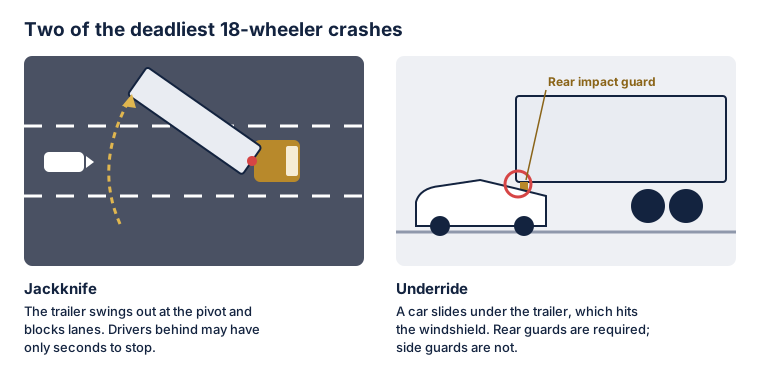
Common causes include:
- Speed too fast for conditions. Ice, rain and wet roads give a heavy truck far less grip. Texas's rare icy days are especially dangerous because drivers aren't used to them.
- Hard or sudden braking, especially when the truck comes up on stopped traffic too fast, or braking while turning
- Empty or lightly loaded trailers, which have less weight on the trailer wheels and lose traction more easily
- Improperly loaded or shifting cargo
- Brake problems, like poorly adjusted or worn brakes that grab unevenly
- Driver fatigue or distraction, which delays reaction and leads to panic braking. Our truck accident guide covers federal hours-of-service limits.
A jackknifed truck becomes a wall across the highway. Drivers behind it, especially at night or in bad weather, may have only seconds to react, and multi-vehicle pileups are common.
What an underride crash is
In an underride crash, a passenger vehicle slides partly or completely under a truck's trailer. Because a trailer bed usually sits higher than a car's hood, the first thing the car hits can be its own windshield pillars and roof. The car's bumper, crumple zones and airbags, which are designed to absorb crash energy, may never engage.
There are two main types:
- Rear underride: a car hits the back of a trailer, often one that's stopped, slow or hard to see at night. A strong rear impact guard is designed to stop the car before it goes under.
- Side underride: a car hits the side of a trailer, often when a truck is turning, crossing an intersection, pulling out of a driveway or jackknifed across lanes. Most trailers have no side guards at all.
Underride crashes are often fatal or cause catastrophic head and neck injuries, even at moderate speeds.
Federal underride guard rules
Rear impact guards
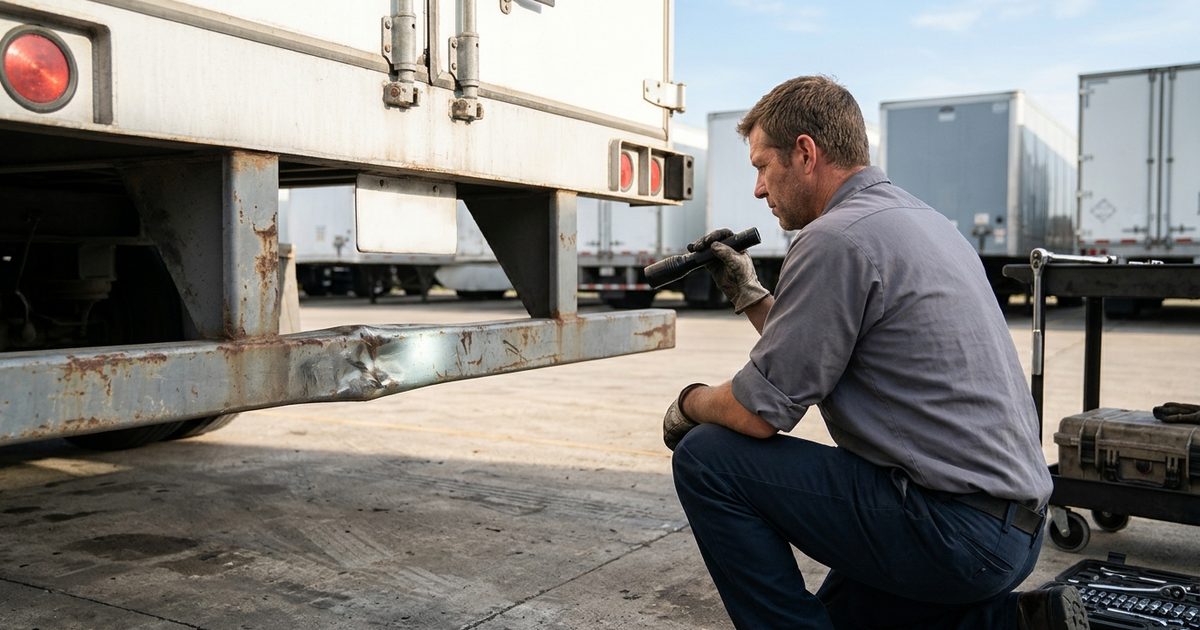
Federal law requires most trailers to have rear impact guards, the steel bars hanging below the back of the trailer. In July 2022, the National Highway Traffic Safety Administration strengthened those standards (FMVSS No. 223 and No. 224). Under the updated rule, a rear guard must be strong enough to prevent passenger compartment intrusion when a car hits the back of the trailer at 35 mph, both head-on to the center and with a 50% overlap. Compliance was required from July 15, 2024 (Federal Register, July 15, 2022; NHTSA).
The rule does not require protection in a 30% overlap crash, where only the edge of a car hits the corner of the trailer. NHTSA said that wasn't practicable yet and continues to research it.
Annual inspection of rear guards
A strong guard does no good if it's bent, rusted or missing. Since December 9, 2021, the Federal Motor Carrier Safety Administration has required rear impact guards to be included in trucks' annual inspections. Before that, a trailer could pass its annual inspection with a damaged or missing guard (FreightWaves). Federal rules on rear guards for trucks in operation are in 49 C.F.R. § 393.86.
Side guards: not required
There is no federal requirement for side underride guards. In 2022, NHTSA said a federal advisory committee would research their effectiveness and costs, and that it planned an advance notice of proposed rulemaking, as required by the 2021 Bipartisan Infrastructure Law (NHTSA). Some companies install side guards voluntarily.
What this means for a claim
- A damaged or missing rear guard may point to the trucking company's maintenance and inspection failures.
- A guard that failed despite being intact may point to a design or manufacturing defect, and a claim against the trailer maker.
- The trailer's build date matters. The 2024 standard applies to trailers made after the compliance date; older trailers were built under older standards.
Product claims over side guards are hard to win. In one widely reported 2018 case outside Texas, a federal appeals court upheld judgment for a trailer maker after a young woman suffered a severe brain injury in a side underride crash, because the side guard design her experts proposed had never been built or tested (Land Line). These cases depend heavily on engineering evidence.
What a driver must do when a truck stops on the road
Many jackknife and rear underride crashes happen after a truck has already stopped, when drivers behind it don't see it in time. Federal rules address this. Under 49 C.F.R. § 392.22, when a commercial truck is stopped on a traveled lane or shoulder, the driver must:
- turn on the hazard warning flashers immediately, and
- place warning devices, like reflective triangles, as soon as possible and in any event within 10 minutes, at set distances behind the truck
Failing to warn other drivers can be strong evidence of negligence when a stopped or jackknifed truck causes a second crash. So can parking illegally on a shoulder, or stopping without lights at night.
Who can be liable
These crashes often involve several responsible parties, and Texas divides responsibility among them by percentage (§ 33.001).
- The truck driver: speed for conditions, following too closely, unsafe braking, fatigue, distraction or failing to warn other drivers after stopping
- The trucking company: responsible for its driver's negligence on the job, and for its own failures in hiring, training, scheduling, maintenance and inspections
- The cargo loader: if bad loading caused the trailer to shift or lose traction
- The trailer or guard maker: if a defectively designed or built guard failed
- A maintenance shop: if brake or guard work was done badly
- Other drivers: whose speed or actions contributed to the crash or a pileup
- A government agency: in rare cases, for a dangerous road condition, with special notice rules and caps
Texas courts also look closely at causation. In Werner Enterprises v. Blake (2025), the Texas Supreme Court reversed an $89 million verdict against a trucking company, holding that a pickup that crossed an icy median was the sole cause of a deadly crash. Our truck accident guide explains that case. The case below shows the other side: how a jackknifed truck and the drivers around it can all share responsibility.
A real Texas case: Gregory v. Chohan (2023)
The Supreme Court of Texas decided Gregory v. Chohan, No. 21-0017, on June 16, 2023 (opinion). Much of the attention went to its ruling on damages, which we cover in our case value guide. But the facts are a textbook jackknife case, and the Court's ruling on fault matters just as much.
What happened
Around midnight on November 23, 2013, Sarah Gregory was driving a New Prime 18-wheeler east on Interstate 40 near Amarillo. The road was icy and unlit. She was going about 58 mph. When she braked for traffic backed up about half a mile ahead, her truck slid and jackknifed, blocking the left lane and part of the right. She gave no warning to drivers behind her.
Two trucks, including one driven by Bhupinder Deol, got past on the right. Then a third truck, belonging to ATG Transportation, veered right, lost control and rolled onto its side, blocking most of the remaining space. A chain of collisions followed. Deol was killed when, according to the evidence, a van was pushed over him in the later collisions. Four people died in the pileup.
The trial
Deol's family sued Gregory and New Prime. The trial court refused to let the jury consider whether the ATG truck driver was also responsible. The jury's total verdict was about $38.8 million, including about $15 million in noneconomic damages for Deol's family.
What the Supreme Court decided
The Court reversed and ordered a new trial. On fault, it held that the evidence raised a real question about the ATG driver's responsibility, either for driving too fast for the icy conditions or for overcorrecting. The ATG truck's blockage made the deadly collisions more likely. The fact that Gregory's jackknife started the chain of events didn't rule out that another driver was also a substantial cause. Leaving ATG off the verdict form was harmful error. The Court also found the damages award wasn't rationally connected to the evidence.
What this means for you
- Jackknife cases often have more than one responsible party. In a pileup, every driver's speed and choices will be examined.
- Defendants will point to others. Expect a trucking company to name other drivers as responsible third parties to reduce its share.
- Warning and speed evidence matters. Whether the trucker was driving too fast for ice, and whether anyone warned the drivers behind, are central questions.
- Reconstruction is essential. Sorting out who hit whom, and in what order, requires experts, scene data and the trucks' electronic records.
What trucking companies are expected to do
Jackknife and underride crashes are not just bad luck. Trucking companies have tools and duties that reduce the risk, and whether they used them often becomes part of a case:
- Training for winter and wet roads, including when to slow down, increase following distance or park the truck
- Realistic schedules that don't push drivers to keep going through ice storms or drive tired
- Brake maintenance and inspections, with records showing brakes were adjusted and working
- Rear guard inspections and repairs, now part of the required annual inspection
- Proper loading, so cargo is balanced and secured
- Safety technology, like electronic stability control and collision warning systems, and in some fleets, voluntary side guards and reflective tape that makes trailers easier to see at night
When a company skipped these steps, it can be responsible for its own negligence, in addition to its driver's. Records of training, maintenance and dispatch are often the key evidence.
Evidence that disappears fast
Truck cases are won with evidence that the trucking company controls, and much of it can be lost within days or weeks:
- Electronic data: engine control module data showing speed, braking and throttle in the seconds before the crash, and electronic logging device records of hours driven
- Dashcam and forward-facing camera video, which many fleets use
- Inspection and maintenance records for brakes and the rear guard
- The trailer and guard itself, which may be repaired, scrapped or put back into service
- Driver qualification files, drug and alcohol test results and dispatch records
- Load and bill of lading documents
A lawyer can send the trucking company a preservation (spoliation) letter demanding that this evidence be kept. Sending it quickly is one of the most important steps in a truck case.
What to do after a crash
- Call 911 and get medical care. Underride and pileup injuries are often severe and not always obvious at first.
- Photograph the scene if you can safely: the truck's position, the trailer's rear guard, skid marks, warning triangles (or their absence) and weather
- Get the truck's information: the company name and USDOT number on the cab door, the trailer number and the driver's name
- Get witness names, including other truck drivers
- Don't talk to the trucking company's insurer or investigators without advice; they often arrive at the scene within hours
- Call a lawyer quickly so preservation letters can go out
Our car accident guide covers the general steps after any crash.
What you can recover
Injured people can claim medical expenses, lost income and earning capacity, pain and suffering, mental anguish, physical impairment, disfigurement and property damage. Trucking companies are generally required to carry far more insurance than ordinary drivers, which can matter a great deal in catastrophic cases. If the trucking company or driver was grossly negligent, punitive damages may be possible. See our guide to what an injury case is worth in Texas.
When a crash is fatal, the surviving spouse, children and parents can bring a wrongful death claim, and the estate can bring a survival claim. Our Texas wrongful death guide explains who can sue and what families can recover.
Deadlines
You generally have two years from the crash to file an injury lawsuit in Texas, and two years from the date of death for a wrongful death claim (§ 16.003). A claim against a trailer maker can also be limited by Texas's 15-year product liability limit. See our guide to Texas injury claim deadlines. In practice, the evidence deadline is much shorter than the legal one.
When to call a lawyer
Almost every jackknife or underride crash involving serious injury or death calls for a lawyer with trucking experience, and early. Ask:
- Have you handled jackknife, underride or pileup cases?
- Will you send preservation letters right away, and to whom?
- Do you work with accident reconstruction and trailer engineering experts?
- How will you handle multiple trucking companies and insurers?
For a referral, contact the State Bar of Texas Lawyer Referral and Information Service at (800) 252-9690, Monday to Friday, 8:30 a.m. to 4:30 p.m., or texasbar.com/LawyerReferral. See our Find a Lawyer page for more questions to ask.
Checklist: after a jackknife or underride crash
- Call 911 and get medical care
- Photograph the truck, trailer, rear guard, skid marks and warning devices
- Write down the company name, USDOT number and trailer number
- Get names of witnesses and other drivers
- Don't give statements to the trucking company's insurer
- Ask a lawyer to send preservation letters within days
- Keep all medical records and bills
- In a fatal crash, identify the spouse, children and parents
- Mark the two-year deadline
Frequently asked questions
What is a jackknife truck accident?
A jackknife happens when a tractor-trailer's trailer swings out to the side so the cab and trailer fold toward each other like a pocketknife. The trailer can block several lanes, and other vehicles may crash into it or under it.
What is an underride crash?
An underride crash happens when a car slides under the back or side of a trailer. Because the trailer bed sits above the car's hood, the trailer can strike the windshield and passenger compartment, which makes these crashes especially deadly.
Are trucks required to have underride guards?
Trailers are required to have rear impact guards. In 2022, NHTSA strengthened the rear guard standards, with compliance required from July 15, 2024. Since December 2021, rear guards must also be checked in annual inspections. There is no federal requirement for side underride guards; NHTSA has been studying them.
Who is liable for a jackknife or underride crash in Texas?
It depends on the facts. The truck driver and trucking company may be liable for speeding, unsafe braking, poor maintenance or failing to warn other drivers. A trailer maker may be liable for a defective guard. Other drivers who contributed can share responsibility, and Texas divides fault by percentage.
What must a truck driver do after the truck stops on the highway?
Federal rules require a driver whose truck is stopped on a traveled lane or shoulder to turn on the hazard warning flashers immediately and to place warning devices, like reflective triangles, as soon as possible and within 10 minutes.
Sources
- Federal Register, July 15, 2022: Rear Impact Guards, Rear Impact Protection (FMVSS 223 and 224)
- NHTSA: Underride protection for truck trailers
- FreightWaves: FMCSA will require annual inspections of rear impact guards
- FMCSA: rear impact guard enforcement guidance
- 49 C.F.R. § 392.22: emergency signals for stopped vehicles
- Gregory v. Chohan, No. 21-0017 (Tex. June 16, 2023)
- Werner Enterprises, Inc. v. Blake, No. 23-0493 (Tex. June 27, 2025)
- Land Line: Appellate court rules trailer manufacturer not liable for side underride crash
- Tex. Civ. Prac. & Rem. Code § 33.001: proportionate responsibility
- State Bar of Texas Lawyer Referral and Information Service (TexasLawHelp.org)
Keep reading
 Truck Accidents · Texas
Hit by an 18-Wheeler in Texas? Who's Responsible and What to Do Next
A crash with a semi-truck isn't just a bigger car accident. More people can be responsible, federal safety rules come into play, and key evidence can vanish within months. Here's how it works in Texas.
 Divorce & Family · Texas
Child Custody and Child Support in a Texas Divorce: What Parents Should Know
Texas calls custody 'conservatorship' and visitation 'possession and access.' Here's how judges decide, what the standard schedule looks like, how child support is calculated, and how orders can change.
 Divorce & Family · Texas
How Property Is Divided in a Texas Divorce: Community Property Explained
Texas is a community property state, but that doesn't always mean a 50/50 split. Here's how courts decide who keeps the house, the retirement accounts and the debts, and how to protect what's yours.