Car Accidents · Florida
What to Do After a Car Accident in Florida: The 14-Day Rule and Your First Steps
Florida's car accident rules are different from almost every other state. Miss the 14-day medical deadline and you can lose your PIP benefits. Here's what to do at the scene, in the first two weeks and beyond.

The short answer: after a Florida car accident, call 911, get the other driver's information, and see a doctor, chiropractor or other qualified provider within 14 days. Florida is a no-fault state, so your own personal injury protection (PIP) insurance pays first, but only if you get care within that window. You generally have two years to sue, and if you're found more than 50% at fault, you recover nothing.
A car accident in Florida plays out differently than in most of the country. In Texas, Georgia or California, the at-fault driver's insurance pays for your injuries. In Florida, your own insurance pays first, no matter who caused the crash. That system comes with its own rules and deadlines, and the most important one starts the moment the crash happens.
This guide walks you through what to do at the scene, in the first 14 days, and in the months after a Florida crash: how the 14-day rule works, crash reports, when you can step outside the no-fault system and sue, Florida's newer 51% fault rule, a Florida Supreme Court case that changed how fault is shared, and the deadlines that matter. For a full explanation of PIP, see our guide to Florida no-fault insurance.
How common crashes are in Florida
In 2023, Florida recorded 395,175 traffic crashes, with 3,375 people killed and 252,285 injured, according to the Florida Department of Highway Safety and Motor Vehicles (FLHSMV Traffic Crash Facts 2023). More than 105,000 of those crashes were hit-and-runs.
Florida's busy highways, heavy tourist traffic and large numbers of older and out-of-state drivers all add to the risk. If you're driving in Florida, a crash is a real possibility, and knowing the rules in advance can protect thousands of dollars in benefits.
At the scene
1. Check for injuries and call 911
Move to a safe place if you can and turn on your hazard lights. Call 911 if anyone is hurt, a car can't be driven, or you suspect the other driver is impaired. Florida law requires drivers involved in a crash to stop, give their information, and help anyone who is injured. Leaving the scene of a crash with injuries is a crime.
2. Exchange information
- Names, phone numbers and addresses of all drivers
- Driver's license numbers and license plates
- Insurance companies and policy numbers
- The owner of each vehicle, if different from the driver
- Names and contact details of passengers and witnesses
3. Take photos and video
Photograph every vehicle from several angles, the road, skid marks, traffic signals and signs, weather, and any visible injuries. A short video walking around the scene is quick and often shows details you'd miss in photos.
4. Be careful what you say
Stay calm and polite, but don't apologize or guess about fault. Stick to the facts with the officer. Statements at the scene can be used later to argue you were partly to blame.
5. Accept medical help, or plan to get it soon
If paramedics offer to check you, let them. Emergency medical services count as qualifying initial care under Florida's PIP law. If you feel fine, plan to see a doctor anyway, because of the 14-day rule below.
The 14-day rule
Florida's PIP law only pays medical benefits if you receive initial medical services within 14 days of the crash (Fla. Stat. § 627.736(1)(a)). Initial care can come from a medical doctor, osteopathic physician, chiropractor, dentist, a hospital, or licensed emergency medical services. If you wait until day 15, your own insurer can deny your PIP medical claim, even if your injuries are real.
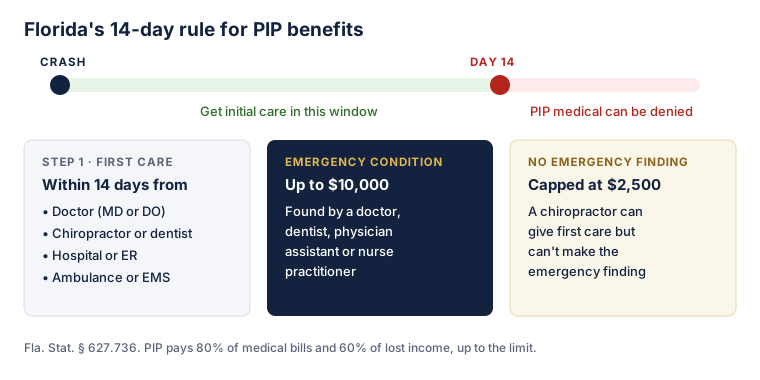
There's a second step that matters just as much. PIP pays up to $10,000, but only if a medical doctor, osteopathic physician, dentist, physician assistant or advanced practice nurse determines you had an emergency medical condition. Without that finding, medical benefits are capped at $2,500. A chiropractor can provide your initial care, but can't make the emergency medical condition finding.
What this means in practice:
- See a qualified provider within 14 days, even if you only feel stiff or sore.
- Describe every symptom, including headaches, numbness, back pain and dizziness.
- Ask whether your provider has evaluated you for an emergency medical condition, and make sure it's in your records if it applies.
- Keep copies of every bill and record.
Crash reports
Law enforcement must file a crash report for crashes involving injury, death, a hit-and-run, DUI, a vehicle that needs a wrecker, a commercial motor vehicle, or apparent damage of at least $500 (FLHSMV: Traffic Crash Reports). For a minor crash that doesn't meet those criteria, you can file a Driver Report of a Traffic Crash online or by mail.
- Getting a copy: reports are available through the Florida Crash Portal, usually within 10 days. The fee is $10 per report plus a $2 convenience fee.
- Privacy: Florida crash reports are confidential for 60 days after they're filed, except for the people involved, their lawyers and insurers, and certain others. That protects you from solicitation by strangers.
- Accuracy: read the report carefully. If it gets facts wrong, contact the investigating agency to ask about adding a correction or supplement.
How Florida's no-fault system works
Florida requires most drivers to carry at least $10,000 in PIP and $10,000 in property damage liability. Notably, Florida doesn't require most drivers to carry bodily injury liability coverage, which pays for injuries you cause to others. Repeal bills have been proposed in recent years, but as of 2026 the no-fault system remains in place (Viles & Beckman, 2026).
After a crash, you claim PIP from your own insurer, regardless of fault. PIP generally pays:
- 80% of reasonable and necessary medical expenses
- 60% of lost income
- Replacement services, like help with household chores you can't do
- A $5,000 death benefit, in addition to the medical and disability benefits
PIP doesn't pay for pain and suffering, and it doesn't fix your car. Vehicle damage is claimed from the at-fault driver's property damage coverage or your own collision coverage. For the full details, see our guide to Florida no-fault and PIP.
When you can sue the other driver
No-fault doesn't mean you can never sue. Under Fla. Stat. § 627.737, you can recover damages for pain, suffering, mental anguish and inconvenience from the at-fault driver only if your injury includes (§ 627.737(2)):
- Significant and permanent loss of an important bodily function
- Permanent injury within a reasonable degree of medical probability, other than scarring or disfigurement
- Significant and permanent scarring or disfigurement
- Death
You can also pursue economic losses that PIP didn't cover, like the 20% of medical bills and 40% of lost wages PIP leaves unpaid, and bills above the $10,000 limit. Because many Florida drivers carry little or no bodily injury coverage, your own uninsured/underinsured motorist (UM) coverage is often the most important source of compensation for a serious injury.
Florida's 51% fault rule
When you do bring a claim against the other driver, fault matters. Since a major 2023 law change, Florida uses modified comparative negligence: a party found greater than 50% at fault for their own harm can't recover any damages. If you're 50% or less at fault, your damages are reduced by your percentage (Fla. Stat. § 768.81(6)). The rule applies to negligence cases filed on or after March 24, 2023, though not to medical malpractice cases (Jimerson Birr: HB 837 comparative negligence).
| Your share of fault | Damages of $100,000 become |
|---|---|
| 0% | $100,000 |
| 20% | $80,000 |
| 50% | $50,000 |
| 51% | $0 |
Before 2023, Florida used a "pure" comparative fault rule that let injured people recover something even if they were mostly at fault. That rule came from the case below.
A real Florida case: Hoffman v. Jones
In Hoffman v. Jones, 280 So. 2d 431 (Fla. 1973), the Florida Supreme Court changed how fault is shared in Florida injury cases, and influenced courts across the country (overview; case commentary).
What happened
William Harrison Jones Jr. was killed in a collision with a truck owned by the Pav-A-Way Corporation and driven by Philip Hoffman Jr. His widow, Hazel Jones, sued as administrator of his estate.
The old rule
At the time, Florida followed contributory negligence, a rule nearly 150 years old: if the injured person was even slightly at fault, they recovered nothing at all. That harsh rule could leave a family with no compensation over a tiny share of blame.
What the Supreme Court decided
In a 6–1 decision, the Court abandoned contributory negligence and adopted pure comparative negligence: an injured person's recovery is reduced by their share of fault, but not eliminated. It was the first time a state supreme court abandoned contributory negligence by court decision, and other courts, including the California Supreme Court, later relied on it.
What this means for you today
- Fault is shared, not all-or-nothing, unless you're more than 50% at fault.
- The 2023 law added a cutoff. Under § 768.81(6), crossing 50% now means recovering nothing, so every percentage point matters.
- Evidence of the other driver's mistakes is key. Photos, witnesses, video and the crash report can keep your share of blame down.
- Insurers know the rule. Expect the other side to argue you were partly at fault.

Dealing with insurance companies
- Report the crash to your own insurer right away and open a PIP claim. Your policy requires prompt notice.
- Cooperate with your own insurer. Florida's PIP law lets insurers require an examination under oath and medical exams in some cases.
- Be careful with the other driver's insurer. You don't have to give them a recorded statement. Stick to basic facts.
- Don't sign a release until you know the full extent of your injuries.
- Keep records of every call, bill, receipt and missed workday.
Deadlines
- 14 days: get initial medical care to keep PIP medical benefits
- Promptly: report the crash to your insurer
- Two years: file a negligence lawsuit for crashes after March 24, 2023 (it used to be four years) (Fla. Stat. § 95.11)
- Two years: wrongful death claims
- Shorter notice rules can apply to claims against government vehicles
When to call a lawyer
You may not need a lawyer for a minor crash with no injuries. Talk to a licensed Florida lawyer if:
- You were hurt badly enough to need more than a quick checkup
- Your injury may be permanent, or you have scarring
- Your PIP claim was denied or cut off
- The other driver had no insurance or very little
- The other side says you were at fault
- A truck, rideshare or company vehicle was involved
- Someone died
For a referral, contact The Florida Bar Lawyer Referral Service at (800) 342-8011, Monday to Friday, 8:00 a.m. to 5:30 p.m., or online at floridabar.org/public/lrs (Florida Bar LRS FAQ). Our Find a Lawyer page has questions to ask.
Checklist: after a car accident in Florida
- Move to safety and call 911
- Exchange driver, vehicle and insurance information
- Photograph the vehicles, the scene and your injuries
- Get witness names and phone numbers
- See a qualified medical provider within 14 days
- Ask about an emergency medical condition finding
- Report the crash to your insurer and open a PIP claim
- Get the crash report from the Florida Crash Portal
- Keep bills, receipts and a record of missed work
- Mark the two-year lawsuit deadline
Frequently asked questions
What is the 14-day rule after a car accident in Florida?
To get personal injury protection (PIP) medical benefits under Florida's no-fault law, you must receive initial medical care within 14 days of the crash from a qualified provider, such as a physician, chiropractor, dentist, hospital or emergency medical services. If you wait longer, your PIP medical benefits can be denied.
Do I have to report a car accident in Florida?
Law enforcement must file a crash report when a crash involves injury, death, a hit-and-run, DUI, a vehicle that needs a tow, a commercial vehicle, or apparent damage of at least $500. Call 911 from the scene. For minor crashes that don't meet those criteria, drivers can file a Driver Report of a Traffic Crash with the state.
How long do I have to sue after a car accident in Florida?
For negligence claims arising after March 24, 2023, Florida generally gives you two years from the date of the crash to file a lawsuit. The deadline used to be four years. Wrongful death claims also generally have a two-year deadline.
What if I was partly at fault for the accident in Florida?
Florida uses modified comparative negligence. Your damages are reduced by your percentage of fault, and if you are found more than 50% at fault for your own injuries, you recover nothing. This rule applies to negligence cases filed on or after March 24, 2023.
Can I sue the other driver after a car accident in Florida?
You can sue for losses PIP doesn't cover, but to recover for pain and suffering you must meet Florida's serious injury threshold, such as a permanent injury within a reasonable degree of medical probability, significant and permanent scarring or disfigurement, significant and permanent loss of an important bodily function, or death.
Sources
- Florida Department of Highway Safety and Motor Vehicles: Traffic Crash Facts 2023
- FLHSMV: Traffic Crash Reports
- Fla. Stat. § 627.736: personal injury protection benefits
- Fla. Stat. § 627.737: tort exemption and serious injury threshold
- Fla. Stat. § 768.81: comparative fault
- Fla. Stat. § 95.11: limitations periods
- Jimerson Birr: Florida HB 837 and comparative negligence
- Viles & Beckman: Did Florida repeal no-fault insurance? (2026)
- Hoffman v. Jones, 280 So. 2d 431 (Fla. 1973)
- CaseMine: adoption of comparative negligence in Florida
- The Florida Bar: Lawyer Referral Service FAQ
Keep reading
 Car Accidents · Texas
Rear-End Collisions and Whiplash in Texas: Who Is at Fault and What Your Claim Is Worth
Rear-end crashes are among the most common in Texas, and whiplash is the injury insurers doubt most. Here's how fault works, what can change it, and how to prove a neck or back injury.
 Car Accidents · Texas
Brain Injury After a Car Accident in Texas: Symptoms, Proving Your Claim and Compensation
A brain injury can hide behind a normal CT scan and a 'you're fine' at the scene. Here's how to spot the warning signs after a Texas crash, prove the injury and protect your claim.
 Car Accidents · Texas
Hit by a City Bus, Police Car or Government Vehicle in Texas? Your Rights Under the Tort Claims Act
Crashes with city buses, police cars, garbage trucks and other public vehicles follow special rules in Texas. Miss a notice deadline that can be as short as 90 days and your claim may be gone.