Claim Basics · Florida
Florida No-Fault Insurance Explained: PIP, the $10,000 Limit and When You Can Sue
In Florida, your own insurance pays first after a crash, no matter who caused it. Here's what personal injury protection covers, what it doesn't, and when you can step outside no-fault and sue.

The short answer: Florida is a no-fault state. After a crash, your own personal injury protection (PIP) pays your medical bills and part of your lost income, up to $10,000, no matter who caused the accident. But you must get medical care within 14 days, and without an "emergency medical condition" finding, benefits are capped at $2,500. To sue the other driver for pain and suffering, your injury must meet Florida's serious injury threshold.
Most states handle car accident injuries the same way: the driver who caused the crash, through their insurance, pays for the other person's injuries. Florida, like a handful of other states, does it differently. It created a no-fault system meant to get medical bills paid quickly without fighting over who was to blame.
In practice, the system is full of limits, percentages and deadlines that surprise people at the worst possible time. This guide explains what PIP pays and what it doesn't, the 14-day rule, the emergency medical condition requirement, who's covered, how claims work, a Florida Supreme Court case about what insurers can require, and when you can step outside no-fault and sue. For the steps to take right after a crash, see our guide to what to do after a car accident in Florida.
- What no-fault means in Florida
- What coverage Florida requires
- What PIP pays
- What PIP doesn't pay
- The 14-day rule and the $2,500 cap
- Who is covered
- How a PIP claim works
- A real Florida case: Nunez v. GEICO
- When you can sue: the serious injury threshold
- Filling the gaps: UM, MedPay and the at-fault driver
- Is no-fault being repealed?
- When to call a lawyer, checklist and FAQ
What no-fault means in Florida
"No-fault" doesn't mean nobody is at fault. It means that, for injuries, you first turn to your own insurance, whoever caused the crash. Florida's Motor Vehicle No-Fault Law requires most vehicle owners to carry PIP, and in exchange it limits lawsuits over minor injuries (Fla. Stat. § 627.736; § 627.737).
Fault still matters for vehicle damage, for injuries serious enough to meet the threshold, and for losses PIP doesn't cover.
What coverage Florida requires
Owners of vehicles registered in Florida must generally carry at least:
- $10,000 in personal injury protection (PIP)
- $10,000 in property damage liability (PDL), which pays for damage you cause to other people's property
Florida does not require most drivers to carry bodily injury liability coverage, which pays for injuries you cause to others. That's why many at-fault drivers in Florida have little or no coverage for the people they hurt, and why uninsured motorist coverage matters so much here (Viles & Beckman, 2026).
What PIP pays
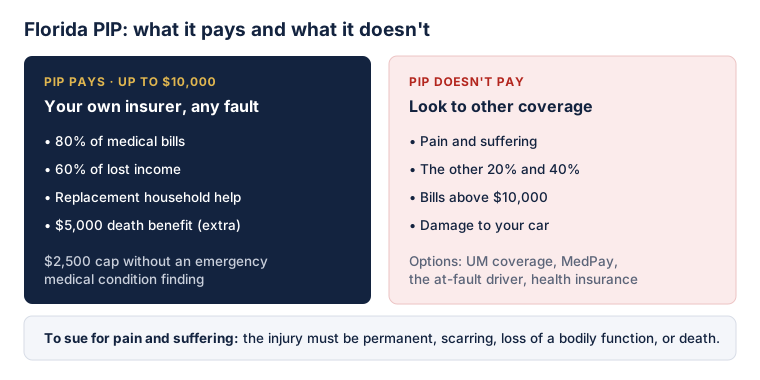
Florida PIP generally pays, up to the $10,000 limit:
- Medical benefits: 80% of reasonable and necessary medical, surgical, rehabilitative and similar expenses
- Disability benefits: 60% of lost gross income and earning capacity
- Replacement services: reasonable expenses for help with things you can't do because of your injury, like household chores
- Death benefit: $5,000, paid in addition to the $10,000 limit
Medical bills are also subject to fee schedules, so PIP may pay less than a provider's full charge.
What PIP doesn't pay
- Pain and suffering, mental anguish or inconvenience
- The remaining 20% of medical bills and 40% of lost income
- Anything above $10,000
- Damage to your car, which goes through the at-fault driver's property damage coverage or your own collision coverage
For a serious injury, $10,000 can disappear in a single emergency room visit. That's why the other sources below matter.
The 14-day rule and the $2,500 cap
Two rules control how much PIP you can get:
1. Initial care within 14 days
PIP medical benefits are available only if you receive initial services and care within 14 days of the crash from a qualified provider, such as a medical doctor, osteopathic physician, chiropractor, dentist, hospital or licensed emergency medical services (PIP study guide summary of § 627.736(1)(a)). Miss it, and PIP can deny your medical benefits.
2. Emergency medical condition
To unlock the full $10,000, a medical doctor, osteopathic physician, dentist, physician assistant or advanced practice nurse must determine that you had an emergency medical condition: acute symptoms severe enough that, without immediate medical attention, you could reasonably be expected to suffer serious jeopardy to your health, serious impairment of bodily functions, or serious dysfunction of an organ or body part. Without that finding, medical and disability benefits are limited to $2,500.
A chiropractor can provide your initial care within 14 days, but can't make the emergency medical condition finding. If you start with a chiropractor, make sure you're also evaluated by one of the providers who can.
Who is covered
Your PIP policy generally covers:
- You, in your own car, in someone else's car, or as a pedestrian or cyclist struck by a car
- Relatives who live with you, if they don't own a car with their own PIP
- Passengers in your car who don't have PIP of their own
- In some cases, Florida residents struck as pedestrians or cyclists by your car who don't have their own PIP
PIP doesn't cover injuries on a motorcycle; motorcyclists need other coverage. Who pays when several policies could apply follows a priority order, so tell every insurer about every policy in your household.

How a PIP claim works
- Report the crash to your insurer promptly and ask for a PIP claim number.
- Get care within 14 days and give each provider your claim number so they can bill PIP directly.
- Fill out the PIP application your insurer sends, including your wage information for lost income.
- Cooperate with reasonable requests. Since a 2013 change to the law, your policy can require you to give a recorded statement or an examination under oath, and insurers can request a medical exam.
- Track payments. Ask your insurer for a PIP payout ledger so you know how much of your $10,000 is left.
Insurers generally must pay PIP benefits within 30 days after receiving written notice of the claim and the amount, unless they have reasonable proof they aren't responsible. If a PIP claim is denied or cut off, a lawyer can send a formal pre-suit demand, which Florida requires before suing a PIP insurer.
A real Florida case: Nunez v. GEICO
In Nunez v. GEICO General Insurance Co., No. SC12-650 (Fla. June 27, 2013), the Florida Supreme Court decided whether an insurer could deny PIP benefits for a reason the PIP statute didn't allow (opinion).
What happened
Merly Nunez was in a car accident on September 17, 2008. Her GEICO policy included PIP coverage and a condition requiring policyholders to submit to an examination under oath (EUO), a formal, recorded question-and-answer session. GEICO denied her PIP claim because she hadn't satisfied that condition. Nunez filed a class action, the case moved to federal court, and the U.S. Court of Appeals for the Eleventh Circuit asked the Florida Supreme Court to answer the key question.
What the Supreme Court decided
In a 5–2 decision written by Justice James Perry, the Court held that, under the 2008 version of the PIP statute, an insurer could not make an examination under oath a condition for paying PIP benefits. The Court explained that PIP is meant to provide "swift and virtually automatic" payment, and an EUO requirement could delay or deny that. The Court also noted that the Legislature had amended the law, effective January 1, 2013, to require insureds to comply with policy terms including EUOs, and treated that as a new rule that didn't apply to Nunez's earlier claim.
What this means for you
- PIP is supposed to be fast. Florida courts have repeatedly described the goal as prompt, near-automatic payment of benefits.
- Insurers must follow the statute. Policy conditions that conflict with the PIP law can be challenged.
- The rules have changed since. For claims today, your policy can require an EUO, so take any request seriously and consider having a lawyer attend.
- Ask for the reason in writing. If PIP is denied or reduced, get the specific reason and the policy language it relies on.
When you can sue: the serious injury threshold
Florida's no-fault law generally protects at-fault drivers from injury lawsuits to the extent PIP pays. But you can recover damages for pain, suffering, mental anguish and inconvenience if your injury consists, in whole or in part, of (§ 627.737(2)):
- Significant and permanent loss of an important bodily function
- Permanent injury within a reasonable degree of medical probability, other than scarring or disfigurement
- Significant and permanent scarring or disfigurement
- Death
"Permanent injury" is usually proven by a doctor's opinion that you won't fully recover, for example from a herniated disc, a fracture with lasting effects, or a brain injury. Even if you don't meet the threshold, you can still pursue economic losses PIP didn't pay, like unpaid medical bills and wages.
If you do sue, Florida's newer rules apply: you generally have two years from the crash to file, and you recover nothing if you're found more than 50% at fault. See our Florida car accident guide.
Filling the gaps: UM, MedPay and the at-fault driver
- Uninsured/underinsured motorist (UM) coverage: because Florida doesn't require bodily injury liability coverage, many at-fault drivers can't pay for a serious injury. Your own UM coverage can step in. Florida insurers must offer it, and you have to reject it in writing.
- Medical payments coverage (MedPay): optional coverage that can help pay the 20% PIP doesn't, and medical bills above the PIP limit.
- The at-fault driver's bodily injury coverage, if they have it, for injuries meeting the threshold.
- Health insurance for bills after PIP runs out.
Check your policy's declarations page today. Knowing what you carry before a crash is much better than finding out afterward.
Is no-fault being repealed?
Florida lawmakers have filed bills in several recent sessions to repeal no-fault and replace PIP with required bodily injury liability coverage, typically $25,000 per person and $50,000 per crash, plus $5,000 in medical payments coverage. A version passed in 2021 but was vetoed. In the 2026 session, the repeal bills died in committee, so as of now PIP is still required (Viles & Beckman, 2026). We'll update this guide if the law changes.
When to call a lawyer
Talk to a licensed Florida lawyer if:
- Your PIP claim was denied, reduced to $2,500, or cut off
- Your insurer wants an examination under oath
- Your medical bills are above $10,000
- Your doctor says your injury may be permanent
- The at-fault driver had little or no insurance
- You were hurt as a pedestrian, cyclist or motorcyclist
For a referral, contact The Florida Bar Lawyer Referral Service at (800) 342-8011, Monday to Friday, 8:00 a.m. to 5:30 p.m., or online at floridabar.org/public/lrs. Our Find a Lawyer page has questions to ask.
Checklist: making the most of Florida PIP
- Check your policy for PIP, UM and MedPay before you need them
- Report any crash to your insurer promptly
- Get initial care within 14 days
- Be evaluated by a doctor, PA or nurse practitioner for an emergency medical condition
- Give every provider your PIP claim number
- Track how much of your $10,000 has been used
- Take EUO and medical exam requests seriously
- Get any denial in writing
- Ask a doctor whether your injury is permanent
- Mark the two-year lawsuit deadline
Frequently asked questions
What does PIP cover in Florida?
Personal injury protection generally pays 80% of reasonable and necessary medical expenses, 60% of lost income, and replacement services, up to $10,000, plus a $5,000 death benefit. PIP doesn't pay for pain and suffering or damage to your car.
Why did my PIP only pay $2,500?
Florida limits PIP medical and disability benefits to $2,500 unless a medical doctor, osteopathic physician, dentist, physician assistant or advanced practice nurse determines that you had an emergency medical condition. A chiropractor can provide initial care but can't make that determination.
Is Florida still a no-fault state in 2026?
Yes. Bills to repeal no-fault and replace PIP with required bodily injury liability coverage have been introduced in recent years, but as of the end of the 2026 legislative session, PIP is still required in Florida.
Can I sue the other driver in a no-fault state like Florida?
Yes, in some cases. You can seek pain and suffering damages from the at-fault driver if your injury meets Florida's threshold: significant and permanent loss of an important bodily function, a permanent injury within a reasonable degree of medical probability, significant and permanent scarring or disfigurement, or death. You can also pursue economic losses PIP didn't pay.
Does PIP cover me if I'm hit as a pedestrian or on a bicycle in Florida?
Often, yes. If you have PIP, it can cover you when you're struck by a car as a pedestrian or cyclist. If you don't have your own PIP, you may be covered under the PIP of a relative you live with, or the PIP on the vehicle that hit you, depending on the circumstances.
Sources
- Fla. Stat. § 627.736: personal injury protection benefits
- Fla. Stat. § 627.737: tort exemption and serious injury threshold
- Florida PIP study guide: the 14-day rule, emergency medical conditions and benefits
- Nunez v. GEICO General Insurance Co., No. SC12-650 (Fla. June 27, 2013)
- Viles & Beckman: Did Florida repeal no-fault insurance? (2026)
- The Florida Bar: Lawyer Referral Service FAQ
Keep reading
 Claim Basics · Texas
Talking to the Insurance Adjuster After a Texas Accident: What to Say, What Not to Say and Your Rights
The adjuster who calls after a crash sounds friendly, but their job is to pay as little as possible. Here's how to handle the first call, recorded statements, medical releases and settlement offers in Texas.
 Claim Basics · Texas
Wrongful Death Claims in Texas: Who Can Sue, the Deadline and What Families Can Recover
Texas law decides exactly which family members can bring a wrongful death claim, and it's narrower than most people expect. Here's who can sue, when, and what the law allows a family to recover.
 Claim Basics · Texas
How Much Is My Injury Case Worth in Texas? What Really Decides the Number
There's no formula and no calculator that can value your case. But Texas law decides what counts, what gets cut and what you keep. Here's how the number really gets built.