Claim Basics · Texas
Talking to the Insurance Adjuster After a Texas Accident: What to Say, What Not to Say and Your Rights
The adjuster who calls after a crash sounds friendly, but their job is to pay as little as possible. Here's how to handle the first call, recorded statements, medical releases and settlement offers in Texas.

The short answer: be polite, stick to basic facts, and don't rush. With the other driver's insurer, you don't have to give a recorded statement, sign a broad medical release, or accept the first offer. With your own insurer, you have to cooperate, but Texas law gives you deadlines it must meet. Don't sign any release until you know how badly you were hurt, because a settlement is final.
Within a day or two of a crash, the phone usually rings. The caller is friendly, sympathetic and in a hurry to "get this taken care of for you." They ask how you're feeling, whether they can record the conversation, and whether you'd sign a form so they can get your medical records. Some will mention a check they can send this week.
That caller is an insurance adjuster, and they may be perfectly nice. But they work for a company whose business depends on paying out less than it takes in. Everything you say can be used to argue that the crash was partly your fault, or that your injuries are minor or came from something else. This guide explains how Texas insurance claims work, what to say and not say, how to handle recorded statements, medical releases and quick offers, and the rights you have under Texas law.
- Your adjuster vs. the other driver's adjuster
- The first call: what to say and not say
- Recorded statements
- Medical authorizations
- Common adjuster tactics
- Quick offers and releases
- Claims with your own insurer
- A real Texas case: Allstate v. Watson
- Demand letters and the Stowers doctrine
- When an insurer treats you unfairly
- Deadlines and when to call a lawyer
- Checklist and FAQ
Your adjuster vs. the other driver's adjuster
After a Texas crash, you may deal with two kinds of claims, and two kinds of adjusters:
- A third-party claim against the at-fault driver's insurance. That company's duty is to its own customer, the driver who hit you. Its adjuster's job is to evaluate your claim against their driver, and to protect their driver and the company.
- A first-party claim under your own policy, for example personal injury protection (PIP), medical payments, collision, or uninsured/underinsured motorist coverage. Here you're the customer, and you have a contract with the company.
The difference matters. You owe the other driver's insurer nothing beyond basic information. You owe your own insurer cooperation under your policy, and in return it owes you prompt handling and fair dealing under Texas law.
Texas is an at-fault state: the driver who caused the crash, through their liability insurance, pays for the other person's injuries and damage. Texas drivers must carry at least $30,000 per person and $60,000 per crash for injuries, and $25,000 for property damage. That's often far less than a serious injury is worth, which is one reason adjusters push back hard.
The first call: what to say and not say
You don't need to avoid the adjuster. Reporting the claim gets things moving. Just keep the first conversation short.
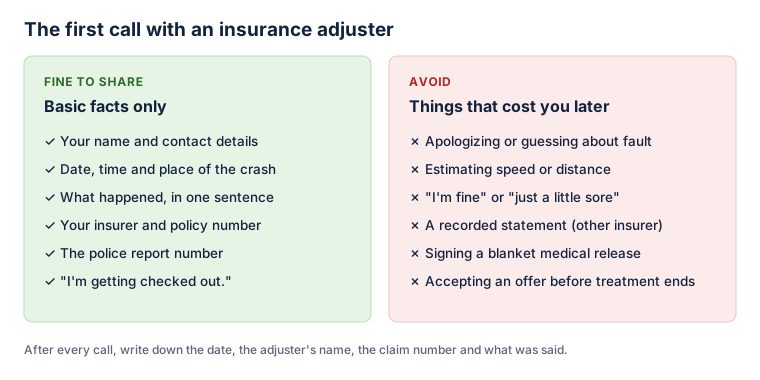
Fine to share
- Your name, phone number and address
- The date, time and location of the crash
- The vehicles involved and the basic facts ("I was stopped at the light and was hit from behind")
- Your insurance company and policy number
- The police report number, if you have it
- That you're getting medical care and will share information when it's appropriate
Avoid
- Apologizing or guessing about fault. "I'm sorry" or "maybe I could have braked sooner" can turn up later as an admission.
- Estimating speeds, distances or times. Guesses that turn out to be wrong can hurt your credibility.
- Saying you're fine. Many injuries, like whiplash, concussions and back injuries, take hours or days to show up. Say "I'm getting checked out."
- Describing your injuries in detail before a doctor has. Let the medical records speak.
- Agreeing to anything: a recorded statement, a medical release, or a settlement amount.
After every call, write down the date, the adjuster's name and company, the claim number and what was said. If they make a promise, ask them to put it in an email.
Recorded statements
The other driver's adjuster will often ask, "Do you mind if I record this so I get it right?" You can say no. Texas law doesn't require you to give the other driver's insurer a recorded statement.
Recorded statements are carefully structured. Questions like "You didn't see the other car until the last second, right?" or "So other than being sore, you're doing okay?" are designed to produce answers that limit what the company pays. Months later, small differences between your recorded statement and your later testimony can be used to suggest you aren't reliable.
A good response: "I'm not comfortable giving a recorded statement. I'm happy to give you the basic facts in writing." If you have a lawyer, tell the adjuster to contact your lawyer instead.
Your own insurer is different. Most auto policies have a cooperation clause that requires you to help with the investigation, which can include a recorded statement. Refusing can put your coverage at risk. If you're worried about the questions, it's reasonable to ask for them in advance or to have a lawyer present.
Medical authorizations
Adjusters often send a form authorizing them to get "any and all" of your medical records. Be careful. A blanket authorization can give them years of your medical history, which they can search for old injuries or conditions to blame instead of the crash.
- Don't sign a blanket authorization for the other driver's insurer.
- When it's time to prove your claim, provide the records and bills related to the crash yourself, or sign a limited authorization covering only the providers who treated you for the crash, starting on the crash date.
- With your own insurer, a PIP claim may require medical records for the treatment you're claiming. Read what you're signing.
Common adjuster tactics
Not every adjuster plays games, but these moves are common enough to watch for:
- Shifting blame. Texas's 51% fault rule reduces your recovery by your share of the blame, and bars it entirely above 50%. Every point an adjuster can move onto you saves the company money.
- Pointing to gaps in treatment. If you wait two weeks to see a doctor or skip physical therapy, expect to hear that you couldn't have been badly hurt. Get care promptly and follow your treatment plan.
- Blaming a pre-existing condition. Texas law lets you recover when a crash makes an earlier condition worse. Your doctor can explain the difference.
- Watching social media. A photo of you at a family barbecue can be presented as proof you're fine. Consider pausing your public posts until your claim is resolved.
- Delay. The longer a claim drags on, the more pressure there is to take less. Keep a written record of every request and response.
- "This is our final offer." It often isn't. Offers frequently go up when you provide good evidence or a lawyer gets involved.
Quick offers and releases
A fast offer, sometimes within days of the crash, can be tempting when bills are piling up. But every settlement comes with a release, a document that ends your claim for good. Once you sign it and cash the check, you generally can't reopen the claim, even if your back pain turns out to need surgery.
- Don't settle an injury claim until you've finished treatment or your doctor can tell you what future care you'll need.
- Read every release. Some cover only property damage; others release "all claims," including injuries.
- It's common to settle the property damage part of a claim first, like the repair or replacement of your car, without settling your injury claim. Make sure the release says so.
- Remember that health insurers, Medicare, Medicaid and hospitals may have liens that must be paid out of your settlement.
For how settlements are calculated, see our guide to what a Texas injury case is worth.

Claims with your own insurer
When you file a claim under your own policy, Texas law gives you more protection. According to the Texas Department of Insurance, your company generally must (TDI: Getting your insurance claim paid):
- Acknowledge your claim within 15 business days, start its review and ask for any information it needs
- Tell you within 15 business days after getting what it needs whether it will pay, and explain any denial in writing. It can extend this by 45 days if it tells you why.
- Pay within five business days after agreeing to pay all or part of the claim
TDI notes that these deadlines don't apply when another driver's insurance is paying, though that insurer must still try to settle quickly and fairly.
Personal injury protection (PIP)
Texas insurers must include at least $2,500 in PIP coverage in every auto policy unless you rejected it in writing (Tex. Ins. Code § 1952.152; § 1952.153). PIP pays medical bills and a portion of lost income regardless of who was at fault, and it's often the fastest money available after a crash. File a PIP claim even if the other driver was clearly at fault.
Uninsured and underinsured motorist coverage
If the other driver had no insurance, or not enough, your own UM/UIM coverage may pay. In that situation your own insurer steps into the other driver's shoes, and it may argue about fault and damages just like the other company would. See our guide to uninsured driver accidents.
A real Texas case: Allstate v. Watson
Many people assume that if the other driver's insurance company treats them unfairly, they can sue the company. In Texas, that generally isn't true, as the Supreme Court of Texas decided in Allstate Insurance Co. v. Watson, 876 S.W.2d 145 (Tex. 1994) (case commentary).
What happened
Kathleen Watson was injured in a car crash that she said was caused by M.D. Townley's negligence. Townley had auto liability insurance with Allstate. Watson wasn't Allstate's customer, but she sued Allstate directly, claiming it had engaged in unfair claim settlement practices in handling her claim. She relied on a provision of the Texas Insurance Code that allowed "any person" damaged by such practices to sue.
What the Supreme Court decided
In January 1994, the Court ruled for Allstate. Writing for the majority, Justice Craig Enoch explained that the unfair settlement rules regulate the relationship between an insurer and its own insured. Letting the injured person sue the other driver's insurer would create conflicting duties: the insurer is supposed to protect its own customer, not the person suing that customer.
What this means for you
- Your claim is against the at-fault driver. Their insurer defends and pays on their behalf, but you can't generally sue the insurer itself for bad faith.
- Your leverage is a lawsuit against the driver. If the insurer won't pay fairly, filing suit against the driver, within the two-year deadline, is usually what moves the case.
- Your own insurer owes you more. First-party claims under your own policy come with deadlines and good-faith duties that you can enforce.
- The Stowers doctrine gives you indirect pressure, as explained next.
Demand letters and the Stowers doctrine
When your treatment is finished, you or your lawyer will usually send the at-fault driver's insurer a demand letter: a summary of the crash, your injuries, your medical bills and lost income, and the amount you'll accept to settle.
Texas has a rule that gives these demands real force. Under the Stowers doctrine, which comes from G.A. Stowers Furniture Co. v. American Indemnity Co., 15 S.W.2d 544 (Tex. Comm'n App. 1929), an insurer that unreasonably refuses a settlement demand within its policy limits can be liable for the full amount of a later judgment against its insured, even above the policy limits (IRMI: Stowers doctrine). Generally, the demand must be within the policy limits, offer a full release of the insured, and be one that an ordinarily prudent insurer would accept.
A Stowers demand puts the risk of a bad decision on the insurance company instead of its customer. These demands have strict technical requirements and deadlines, so they're usually prepared by a lawyer.
When an insurer treats you unfairly
- Put it in writing. Email the adjuster and ask for a written explanation of any denial or low offer.
- Ask for a supervisor. Adjusters have authority limits. A supervisor may be able to approve more.
- Contact the Texas Department of Insurance. Call TDI's help line at 800-252-3439 or file a complaint online. TDI can't decide fault or order a specific amount, but it can look into whether the company followed the law.
- Talk to a lawyer. Especially if you have significant injuries or the insurer is denying fault.
Deadlines
- Notify your own insurer promptly. Most policies require prompt notice, and a delay can cause problems.
- Two years to sue. Talking to an adjuster doesn't stop the clock. In most Texas injury cases, you must file a lawsuit within two years of the crash, even if negotiations are still going. See our guide to Texas injury claim deadlines.
- Shorter deadlines apply to claims against government vehicles, sometimes as short as 90 days. See our guide to government vehicle accidents.
When to call a lawyer
You can handle a small property-damage claim yourself. Talk to a licensed Texas lawyer if:
- You were hurt badly enough to need more than a quick checkup
- The adjuster says you were partly or fully at fault
- The insurer wants a recorded statement or a blanket medical release
- You've received an offer and don't know if it's fair
- The other driver had little or no insurance
- The two-year deadline is getting close
Most injury lawyers offer a free consultation. For a referral, contact the State Bar of Texas Lawyer Referral and Information Service at (800) 252-9690, Monday to Friday, 8:30 a.m. to 4:30 p.m., or texasbar.com/LawyerReferral. Our Find a Lawyer page has questions to ask.
Checklist: dealing with insurance adjusters
- Report the crash to your own insurer promptly
- File a PIP claim for medical bills and lost wages
- Give the other driver's adjuster only basic facts
- Decline a recorded statement to the other driver's insurer
- Don't sign a blanket medical authorization
- Keep a log of every call: date, name, claim number, what was said
- Get care promptly and follow your treatment plan
- Keep bills, receipts, repair estimates and photos organized
- Don't sign a release until you know the full extent of your injuries
- Mark the two-year lawsuit deadline
Frequently asked questions
Do I have to give a recorded statement to the other driver's insurance company in Texas?
No. You have no legal duty to give a recorded statement to the other driver's insurer. You can politely decline and give basic facts in writing instead. Your own insurance policy is different: it usually requires you to cooperate with your insurer's investigation.
Should I accept the insurance company's first offer?
Usually not before you know the full extent of your injuries. A settlement requires you to sign a release, which ends your claim for good. If you settle before you finish treatment, you can't go back for more money if your injuries turn out to be worse.
How long does an insurance company have to pay a claim in Texas?
For claims under your own policy, Texas generally gives insurers 15 business days to acknowledge the claim, 15 business days after receiving what they need to accept or reject it (with a possible 45-day extension), and five business days to pay after agreeing to. These deadlines don't apply when the other driver's insurer is paying.
Can I sue the other driver's insurance company in Texas?
Generally, no. In Allstate v. Watson (1994), the Texas Supreme Court held that an injured person has no direct claim against the at-fault driver's insurer for unfair settlement practices. Your claim is against the at-fault driver, whose insurer defends and pays on their behalf.
Where can I complain about an insurance company in Texas?
You can contact the Texas Department of Insurance at 800-252-3439 or file a complaint online. TDI can't decide who was at fault or order a specific payment, but it can look into whether the company followed the law.
Sources
- Texas Department of Insurance: Getting your insurance claim paid
- Allstate Insurance Co. v. Watson, 876 S.W.2d 145 (Tex. 1994), commentary
- IRMI: Stowers doctrine
- Thompson Coe: The Stowers doctrine (G.A. Stowers Furniture Co. v. American Indemnity Co., 1929)
- Tex. Ins. Code § 1952.152: personal injury protection coverage required unless rejected in writing
- Tex. Ins. Code § 1952.153: minimum PIP coverage of $2,500
- Tex. Civ. Prac. & Rem. Code § 33.001: proportionate responsibility
- State Bar of Texas Lawyer Referral and Information Service (TexasLawHelp.org)
Keep reading
 Claim Basics · Texas
Wrongful Death Claims in Texas: Who Can Sue, the Deadline and What Families Can Recover
Texas law decides exactly which family members can bring a wrongful death claim, and it's narrower than most people expect. Here's who can sue, when, and what the law allows a family to recover.
 Claim Basics · Texas
How Much Is My Injury Case Worth in Texas? What Really Decides the Number
There's no formula and no calculator that can value your case. But Texas law decides what counts, what gets cut and what you keep. Here's how the number really gets built.
 Claim Basics · Texas
How Long Do You Have to File an Injury Claim in Texas? Every Deadline Explained
The basic rule is two years, but some Texas injury deadlines are much shorter, and a few start before you even know you were hurt. Here's every deadline that matters and how to count it.