Claim Basics · Texas
How Much Is My Injury Case Worth in Texas? What Really Decides the Number
There's no formula and no calculator that can value your case. But Texas law decides what counts, what gets cut and what you keep. Here's how the number really gets built.

The short answer: no one can honestly give you a number without knowing your case. In Texas, what an injury claim is worth depends on your provable losses (medical bills actually paid, lost income and future care), how much pain and lasting harm the injury caused, how much of the blame is put on you, and how much insurance is available to pay. Texas law then trims the number in specific ways, and lawyer fees, costs and medical liens come out before you see a dollar.
Most people ask this question within days of an accident. Usually it's because an adjuster has already called with an offer, or the bills have started arriving and nothing is coming in. Online "settlement calculators" promise an answer in a few clicks. They can't deliver one, because the things that really decide value aren't things a website can measure.
What you can learn is how the number gets built. This guide walks through each type of damages Texas law allows, the rules that shrink a recovery, the caps that apply in some cases, a 2023 Texas Supreme Court decision on pain-and-suffering awards, and what you'll actually take home from a settlement.
- Why there's no formula
- Economic damages: the bills and lost pay
- Noneconomic damages: pain and suffering
- Punitive (exemplary) damages
- Five things that shrink a recovery
- Texas damage caps
- A real Texas case: Gregory v. Chohan (2023)
- What you actually take home
- Early offers and how to evaluate one
- How to protect your claim's value
- When to call a lawyer
- Checklist and FAQ
Why there's no formula
You may have heard that injury cases settle for "three times the medical bills." There's no Texas law that says that, and insurers don't value claims that way. Two people with the same $20,000 in medical bills can have claims worth very different amounts. One may recover fully in two months. The other may have nerve damage that changes their work and life for good.
In practice, a claim's value comes down to four questions:
- What did you lose, and can you prove it? Bills, pay stubs, medical records and doctors' opinions.
- How serious and lasting is the injury? A sprain that heals is valued very differently from a surgery, a permanent limp or a brain injury.
- Who was at fault, and how clearly? Clear liability supports a higher settlement. Disputed fault pushes it down.
- How much money is available? A great case against a driver with minimum coverage and no assets may be limited to what the insurance policies pay.
Economic damages: the bills and lost pay
Economic damages are your money losses. They're the foundation of every claim, because they're the easiest to prove.
Medical expenses
This includes the ambulance, ER, hospital stay, surgery, doctor visits, physical therapy, prescriptions and medical equipment. It also includes future medical care if a doctor can testify you'll reasonably need it, like a future surgery, ongoing therapy or lifetime care.
There's an important Texas rule here. Under Texas Civil Practice and Remedies Code § 41.0105, recovery of medical expenses is limited to the amount "actually paid or incurred by or on behalf of the claimant." If the hospital billed $40,000 but your health insurer paid a negotiated $15,000 and the hospital wrote off the rest, the claim is generally based on what was actually paid or owed, not the $40,000 sticker price.
The Texas Supreme Court confirmed this in Haygood v. De Escabedo (July 1, 2011). It held that charges a provider has no right to be paid can't be recovered, and that evidence of those charges isn't admissible at trial. The Court also said the jury shouldn't be told that insurance covered the bills (case summary).
Lost income and earning capacity
You can recover wages, salary, tips and self-employment income you lost while you were hurt and recovering. If the injury limits what you can earn in the future, you can claim lost earning capacity too. Texas requires that evidence of lost earnings be presented in after-tax terms in many cases (§ 18.091), so the number is usually your net pay, not your gross.
Proof matters: pay stubs, tax returns, a letter from your employer, and for future losses, often a doctor's restrictions and sometimes an economist or vocational expert.
Property damage and other costs
Your car or bike repair or replacement, a rental car, damaged phone or glasses, and out-of-pocket costs like mileage to medical appointments can also be claimed. Keep every receipt.
Noneconomic damages: pain and suffering
Noneconomic damages compensate for harms that don't come with a receipt. In a Texas injury case, a jury can be asked to award money for:
- Physical pain, past and future
- Mental anguish: anxiety, fear, depression, sleeplessness and emotional distress caused by the injury
- Physical impairment: the loss of the ability to do things you used to do, like playing with your kids, running or working in your garden
- Disfigurement: scars, burns, amputations or other visible changes
In wrongful death cases, family members can claim their own mental anguish and loss of companionship, along with financial losses like lost support.
These damages are often the largest part of a serious case, and the hardest to predict. In most ordinary injury cases, like car crashes and falls, Texas has no cap on them. But as the case below shows, a jury's number still has to be connected to the evidence.
Punitive (exemplary) damages
Texas calls punitive damages exemplary damages. They're not meant to compensate you. They're meant to punish a defendant whose conduct was especially bad, like gross negligence, fraud or malice. Think of a driver who was drunk, or a company that knew about a deadly danger and ignored it.
They're rare. The plaintiff must prove the conduct by clear and convincing evidence, a higher standard than in the rest of the case, and the jury must agree unanimously. They're also capped under § 41.008, at the greater of:
- two times the economic damages, plus noneconomic damages up to $750,000; or
- $200,000
The cap doesn't apply in certain cases involving serious crimes, including intoxication assault and intoxication manslaughter. In May 2026, the Texas Supreme Court held that the cap is applied to each defendant separately, based on the economic damages tied to that defendant's share of responsibility (K&K Inez Properties v. Kolle).
Five things that shrink a recovery
1. Your share of the blame
Texas uses proportionate responsibility (§ 33.001). If you're found 20% responsible, your damages are reduced by 20%. If you're found more than 50% responsible, you recover nothing. Insurers know this, so expect them to argue you were speeding, distracted, not looking or not wearing a seat belt or helmet.
2. Gaps in treatment
If you waited weeks to see a doctor, or stopped going to therapy halfway through, the insurer will argue you weren't really hurt, or that something else caused your pain. Consistent treatment that follows your doctor's advice is one of the best ways to protect your claim.
3. Prior injuries
A bad back before the crash doesn't end your claim. You can recover for making an existing condition worse. But expect the insurer to dig through your medical history and blame everything on the old injury. Be upfront with your doctors and your lawyer about prior problems.
4. Limited insurance
Texas only requires drivers to carry $30,000 per person and $60,000 per crash for injuries. In a serious crash, that's often the hard ceiling unless there's more coverage. That's why your own uninsured/underinsured motorist coverage, an employer's commercial policy, or another responsible party can make a huge difference.
5. Weak documentation
Damages you can't prove are damages you won't get paid for. Missing receipts, no photos of injuries, and no record of missed work all leave money on the table.

Texas damage caps
In an ordinary car crash or slip-and-fall case against a private person or business, Texas has no general cap on your compensatory damages. Caps do apply in these situations:
| Type of case | What's capped | Limit |
|---|---|---|
| Claims against the State of Texas or a city | Total damages for bodily injury or death | $250,000 per person; $500,000 per occurrence |
| Claims against other local government units (like counties or school districts) | Total damages for bodily injury or death | $100,000 per person; $300,000 per occurrence |
| Medical malpractice | Noneconomic damages | $250,000 for all doctors; $250,000 per hospital or facility, up to $500,000 for all facilities |
| Any case with punitive damages | Exemplary damages | Greater of 2× economic + noneconomic up to $750,000, or $200,000 |
Government caps are in § 101.023 of the Texas Tort Claims Act, and malpractice caps are in Chapter 74 of the Civil Practice and Remedies Code. Claims against the government also have short notice deadlines; see our guide to Texas injury claim deadlines.
A note on proposed changes: in 2025, the Texas Legislature considered S.B. 30, which would have changed how medical expenses and noneconomic damages are proven in injury cases. It did not become law (summary of 2025 changes). Rules like this can change in future sessions, so check that what you read is current.
A real Texas case: Gregory v. Chohan (2023)
If there's no cap on pain and suffering in most cases, can a jury award any amount it wants? The Texas Supreme Court said no in Gregory v. Chohan, No. 21-0017, decided June 16, 2023 (opinion).
What happened
Around midnight on November 23, 2013, an 18-wheeler jackknifed on icy, unlit Interstate 40 near Amarillo and blocked the road. A chain-reaction pileup followed, and four people were killed. One was a truck driver named Bhupinder Deol. His family sued the trucking company and its driver.
The verdict
The jury's total verdict was about $39 million. Deol's family's share of the judgment was about $16.4 million, of which about $15 million was noneconomic damages for mental anguish and loss of companionship. At trial, the family's lawyer had compared the value of a life to things like multimillion-dollar fighter jets and famous paintings (Thompson Coe summary).
What the Supreme Court decided
The Court reversed and sent the case back for a new trial. The lead opinion, by Justice Blacklock, agreed there was evidence the family had suffered real mental anguish and loss. But it said there must also be "a rational connection, grounded in the evidence, between the injuries suffered and the dollar amount awarded." Comparisons to jets and paintings, it said, don't supply that connection. The Court also found the trial court should have let the jury consider the responsibility of another truck driver involved in the pileup.
Only three justices joined the lead opinion in full; others agreed with the result for different reasons. So the exact standard is still debated among Texas lawyers. But the message to insurers and juries was clear.
What this means for you
- Pain and suffering must be proven, not just claimed. Testimony from you, your family and your doctors about how the injury changed your daily life is what supports the number.
- Insurers use this case. Expect adjusters and defense lawyers to argue that a large noneconomic demand isn't "rationally connected" to the evidence.
- Details make the difference. A journal of your pain, sleep and missed activities, photos over time, and specific stories from people who know you can carry real weight.
- Other parties matter. The case was retried partly because another driver's share of responsibility wasn't considered. Who else might be at fault affects both blame and value.
What you actually take home
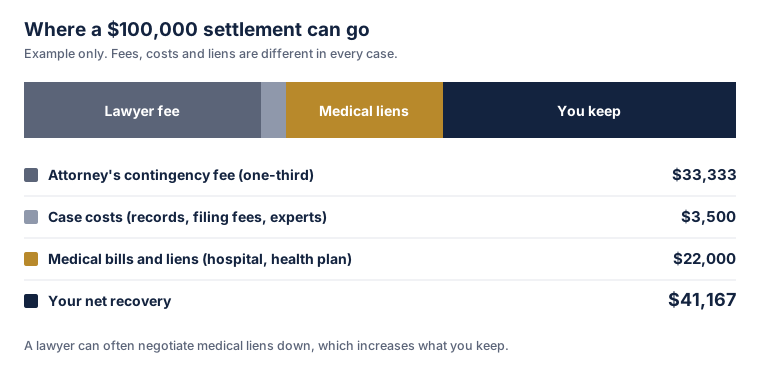
A settlement amount isn't what lands in your bank account. Several things usually come out first.
Attorney's fees
Most injury lawyers work on a contingency fee. You pay nothing up front, and the lawyer takes a percentage of what's recovered, commonly about one-third, sometimes more if a lawsuit is filed or the case goes to trial. Get the fee agreement in writing and read it.
Case costs
Costs like filing fees, medical records, expert witnesses and depositions are usually repaid from the settlement. In a case that settles early, these may be small. In a case that goes to trial, they can be large.
Medical bills and liens
Hospitals in Texas can claim a lien on your injury claim for emergency care (Texas Property Code Chapter 55). Health insurers, Medicare, Medicaid and employer health plans often have a right to be repaid from your settlement for what they paid. These liens can often be negotiated down, which is one of the most valuable things a good lawyer does.
Taxes
Under federal tax law, compensation for physical injuries or physical sickness is generally not taxable income, but punitive damages and interest generally are (IRS Publication 4345). Ask a tax professional about your settlement.
Early offers and how to evaluate one
It's common for an adjuster to make a quick offer within days or weeks of an accident, sometimes with a release attached. The offer may sound like a lot if you're behind on bills. Before you accept, ask yourself:
- Am I done treating? If you don't know what your future care will cost, you can't know what your claim is worth.
- Does it cover every bill and lien? Add up medical bills, liens and lost wages. If the offer barely covers them, you'll walk away with nothing for your pain.
- What does the release say? A release almost always ends your claim forever. You can't go back for more if your injury turns out to be worse.
- Is there more coverage? Ask what the policy limits are, and whether your own underinsured motorist coverage could add to it. In Texas, accepting a settlement from the at-fault driver can affect your underinsured claim, so check with your own insurer first.
You don't have to accept or reject an offer on the spot. It's reasonable to say you're still treating and will respond when you know the full extent of your injuries, keeping the two-year deadline in mind.
How to protect your claim's value
- Get treated right away and follow your doctor's plan
- Keep a folder of every bill, receipt, explanation of benefits and pay stub
- Keep a short journal of pain levels, sleep, missed events and things you couldn't do
- Photograph your injuries regularly as they heal, or don't
- Stay off social media about the accident and your activities; insurers look
- Don't give a recorded statement to the other side's insurer without advice
- Don't sign a release until you understand your full damages
Our guides on car accidents, truck accidents, slip-and-fall injuries and work injuries cover the evidence that matters in each kind of case.
When to call a lawyer
You may not need a lawyer for a small property-damage claim. Talk to a licensed Texas injury lawyer if:
- You needed surgery, have a lasting injury or missed significant work
- The insurer disputes fault or offers less than your bills
- The at-fault driver's coverage is too small for your losses
- A government vehicle, a doctor or a commercial truck was involved
- You're being pressured to sign a release
- Someone died
Most offer a free consultation. Ask how they'd value your case, what their fee is, and how costs and liens are handled. For a referral, contact the State Bar of Texas Lawyer Referral and Information Service at (800) 252-9690, Monday to Friday, 8:30 a.m. to 4:30 p.m., or texasbar.com/LawyerReferral. Our Find a Lawyer page has more questions to ask.
Checklist: figuring out what your claim is worth
- Gather every medical bill and the amounts actually paid by you or insurance
- Ask your doctor what future treatment you're likely to need
- Collect pay stubs or tax returns showing what you earned before the injury
- Record every day of work you missed
- Keep a pain and activity journal
- Find out the at-fault party's insurance limits and your own UM/UIM coverage
- List any liens: hospital, health insurer, Medicare or Medicaid
- Get a written breakdown of fees, costs and liens before accepting any settlement
- Don't sign a release until treatment is finished or your future care is known
Frequently asked questions
What is the average personal injury settlement in Texas?
There is no reliable average. Values range from a few thousand dollars for a minor injury to millions for a catastrophic one. What matters is your medical bills and lost income, how serious and lasting your injuries are, who was at fault, and how much insurance is available.
Is there a cap on pain and suffering in Texas?
Not in most cases. Texas has no general cap on noneconomic damages in ordinary injury cases like car crashes. Caps do apply to medical malpractice claims, claims against government units, and punitive (exemplary) damages.
Can I recover the full amount the hospital billed?
No. Under Texas Civil Practice and Remedies Code § 41.0105, recovery of medical expenses is limited to the amount actually paid or incurred by you or on your behalf. If your health insurer paid a reduced rate, the reduced amount is generally what counts.
How much does a personal injury lawyer take in Texas?
Most injury lawyers work on a contingency fee, commonly about one-third of the recovery, and sometimes more if the case goes to trial. Case costs and medical liens are usually paid out of the settlement too, so ask for a written breakdown before you agree.
Do I pay taxes on a personal injury settlement?
Under federal tax law, compensation for physical injuries or physical sickness is generally not taxable income. Punitive damages and interest generally are. Ask a tax professional about your specific settlement.
Why is the insurance company offering so little?
Early offers are often low because the insurer is betting you need money quickly and haven't finished treatment. Before accepting, make sure you know the full cost of your care, including future treatment, because a settlement usually ends your claim for good.
Sources
- Tex. Civ. Prac. & Rem. Code § 41.0105: medical expenses limited to amounts paid or incurred (text as published)
- Haygood v. De Escabedo (Tex. July 1, 2011), case summary
- Tex. Civ. Prac. & Rem. Code § 18.091: proof of lost earnings
- Tex. Civ. Prac. & Rem. Code § 41.008: exemplary damages cap (text as published)
- K&K Inez Properties v. Kolle (Tex. May 22, 2026), Gibson Dunn summary
- Tex. Civ. Prac. & Rem. Code § 33.001: proportionate responsibility
- Tex. Civ. Prac. & Rem. Code § 101.023: Tort Claims Act damage limits
- Gregory v. Chohan, No. 21-0017 (Tex. June 16, 2023)
- Thompson Coe: summary of Gregory v. Chohan
- Summary of 2025 Texas personal injury legislation (S.B. 30 not enacted)
- IRS Publication 4345: Settlements and taxability
- State Bar of Texas Lawyer Referral and Information Service (TexasLawHelp.org)
Keep reading
 Claim Basics · Texas
Talking to the Insurance Adjuster After a Texas Accident: What to Say, What Not to Say and Your Rights
The adjuster who calls after a crash sounds friendly, but their job is to pay as little as possible. Here's how to handle the first call, recorded statements, medical releases and settlement offers in Texas.
 Claim Basics · Texas
Wrongful Death Claims in Texas: Who Can Sue, the Deadline and What Families Can Recover
Texas law decides exactly which family members can bring a wrongful death claim, and it's narrower than most people expect. Here's who can sue, when, and what the law allows a family to recover.
 Claim Basics · Texas
How Long Do You Have to File an Injury Claim in Texas? Every Deadline Explained
The basic rule is two years, but some Texas injury deadlines are much shorter, and a few start before you even know you were hurt. Here's every deadline that matters and how to count it.