Claim Basics · Texas
Wrongful Death Claims in Texas: Who Can Sue, the Deadline and What Families Can Recover
Texas law decides exactly which family members can bring a wrongful death claim, and it's narrower than most people expect. Here's who can sue, when, and what the law allows a family to recover.

The short answer: in Texas, a wrongful death claim can be brought only by the person's surviving spouse, children and parents. They generally have two years from the date of death to file a lawsuit. The family can recover for lost financial support, loss of companionship, mental anguish and more, and the estate can bring a separate "survival" claim for what the person suffered before death. If no family member files within three months, the executor or administrator must file unless all of them say not to.
Losing someone suddenly to a crash, a fall or a workplace accident turns a family's life upside down. In the middle of the funeral, the bills and the grief, the legal questions can feel cold and far away. But they come quickly: an insurance adjuster calls, a trucking company sends an investigator to the scene, and the clock on the family's rights is already running.
This guide explains how Texas wrongful death law works in plain English: who can bring a claim, what the claim is worth, how it differs from the estate's survival claim, the deadlines, and a Texas Supreme Court case that changed what grieving parents can recover. It covers deaths from car and truck crashes, falls, work accidents, medical errors and other negligence.
- What counts as wrongful death in Texas
- Who can bring a wrongful death claim
- The three-month rule
- Two different claims: wrongful death and survival
- What the family can recover
- A real Texas case: Sanchez v. Schindler (1983)
- How a case usually unfolds
- Deadlines
- Special situations
- What families should do now
- Choosing a lawyer
- Checklist and FAQ
What counts as wrongful death in Texas
The Texas Wrongful Death Act is in Chapter 71 of the Civil Practice and Remedies Code (full text). Under § 71.002, a person is liable for damages when their "wrongful act, neglect, carelessness, unskillfulness, or default" causes an injury that results in someone's death.
In practice, that covers most deaths caused by someone else's fault, including:
- Car crashes, truck crashes and motorcycle crashes
- Pedestrians and cyclists hit by drivers
- Dangerous property conditions and falls
- Workplace accidents, with special rules if the employer carries workers' comp
- Medical mistakes, defective products and dog attacks
There's one important condition. Under § 71.003, the family can bring a wrongful death claim only if the person who died could have sued for the injury if they had lived. So the family's claim generally rises or falls on the same facts: was someone else at fault, and did that fault cause the death?
Who can bring a wrongful death claim
This is where Texas surprises many families. Under § 71.004, a wrongful death claim is for the "exclusive benefit" of three groups only:
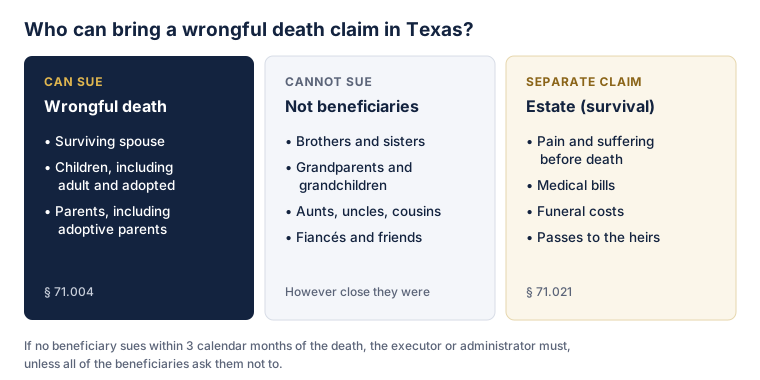
- The surviving spouse. This can include a common-law spouse if the couple met Texas's requirements for an informal marriage.
- The children, including adult children and adopted children.
- The parents, including adoptive parents.
They can each bring a claim, or one of them can sue on behalf of all of them. The jury decides the total damages and how they're divided among the family members, based on each person's own loss (§ 71.010).
Who can't sue: brothers and sisters, grandparents, grandchildren, aunts, uncles, fiancés and friends are not wrongful death beneficiaries in Texas, no matter how close they were. Some of them may still benefit indirectly if they inherit from the estate, which brings its own claim (see below).
The three-month rule
Section 71.004 has a timing rule that matters when families aren't in agreement or simply haven't acted. If none of the spouse, children or parents files a wrongful death lawsuit within three calendar months after the death, the executor or administrator of the estate must bring it, unless all of those family members ask the executor not to.
This rule exists so a claim isn't lost just because grieving relatives didn't act. But it can create tension, especially in blended families, where the executor may be someone other than a spouse or child. If more than one family member is involved, it's wise to talk to a lawyer early, so everyone's interests are protected and nobody files without the others knowing.
Two different claims: wrongful death and survival
When someone dies from an injury in Texas, there are usually two separate claims, and families often confuse them.
| Wrongful death claim | Survival claim | |
|---|---|---|
| Whose loss? | The family's own losses from the death | The losses the person who died suffered before death |
| Who brings it? | Spouse, children and parents | The estate, through its representative, or the heirs |
| Examples of damages | Lost support, loss of companionship, mental anguish, loss of inheritance | Pain and suffering before death, medical bills, funeral costs |
| Who gets the money? | The family members, divided as the jury decides | The estate, passed to heirs under the will or inheritance law |
| Law | Tex. Civ. Prac. & Rem. Code § 71.002–71.004 | § 71.021 |
The survival statute, § 71.021, says a personal injury claim doesn't end when the injured person dies. It passes to their heirs, legal representatives and estate. So if someone was hurt in a crash, spent weeks in the hospital and then died, the survival claim covers their medical bills and what they went through, while the wrongful death claim covers what the family lost. Damages recovered in a wrongful death claim are not subject to the debts of the person who died (§ 71.011).
What the family can recover
No amount of money makes up for a death, and the law doesn't pretend it does. What it tries to do is compensate the family for specific losses. In a Texas wrongful death case, the jury is generally asked to consider:
- Pecuniary loss: the financial support, care, advice, services and counsel the person would likely have provided, like income, household help and child care
- Loss of companionship and society: the loss of the love, comfort and companionship of the relationship
- Mental anguish: the grief, sorrow and emotional pain the family member suffers from the death
- Loss of inheritance: in some cases, what the person would likely have saved and left to the family if they had lived a normal life span
The estate's survival claim adds the person's own conscious pain and suffering before death, medical expenses and funeral and burial costs.
Punitive damages
If the death resulted from a defendant's willful act or omission or gross negligence, exemplary (punitive) damages may also be recovered (§ 71.009), subject to Texas's cap and standards of proof. A drunk driver, or a company that knowingly ignored a deadly hazard, are examples. Our guide to what an injury case is worth in Texas explains how those damages and caps work.
Damages still have to be proven
In 2023, the Texas Supreme Court reversed about $15 million in mental anguish and companionship damages awarded to a family after a deadly pileup, saying there must be "a rational connection, grounded in the evidence," between the loss and the amount (Gregory v. Chohan; see our case value guide). For families, that means testimony about the relationship, from you and people who knew you, matters: the daily routines, the holidays, the phone calls, what the person meant to the family.
A real Texas case: Sanchez v. Schindler (1983)
For most of Texas history, parents who lost a child could recover very little. The law limited recovery to "pecuniary" loss, mainly the money and services the child would have provided. Because most children don't support their parents financially, the death of a child was often valued at almost nothing. In 1983, the Texas Supreme Court changed that.
What happened
Johnny Sanchez, 14, was killed in a collision between his motorcycle and a pickup truck driven by Charles Schindler. His parents, Eugene and Angelica Sanchez, sued (case brief).
The trial
The jury found Schindler liable. It awarded damages for Johnny's pain and suffering, medical expenses, funeral costs and the motorcycle. It awarded the parents nothing for financial loss, but it awarded his mother $102,500 for mental anguish. The trial court threw out the mental anguish award, and the court of appeals agreed, following the old rule.
What the Supreme Court decided
On June 15, 1983, the Supreme Court of Texas reversed in Sanchez v. Schindler, 651 S.W.2d 249. It rejected the old pecuniary-loss limit and held that mental anguish damages are recoverable under the Wrongful Death Act for the death of a child. The Court recognized that love, companionship and the grief of losing a child are real harms the law should compensate (case commentary).
What this means for families today
- The death of a child is not "worth less" because the child didn't earn money. Parents can recover for their grief and the loss of their child's companionship.
- The same applies to other relationships. Spouses, children and parents of adults can recover for mental anguish and loss of companionship, not just lost income.
- But it must be proven. As Gregory v. Chohan later made clear, the amount has to be grounded in evidence about the relationship and the loss.
How a Texas wrongful death case usually unfolds
Every case is different, but most follow a similar path:
- Investigation. The family's lawyer gathers the police report, medical records, witness statements and, in vehicle cases, electronic data and video. In a truck or company case, preservation letters go out right away.
- Setting up the estate. If the estate will bring a survival claim, someone may need to be appointed as executor or administrator through probate court. In some cases, heirs can bring the survival claim without a formal estate administration.
- Claims and negotiation. The lawyer presents the claim to the insurance companies involved. Many cases settle at this stage, especially when fault is clear.
- Lawsuit. If the case doesn't settle, a lawsuit is filed, often well before the two-year deadline. Both sides exchange evidence and take depositions.
- Mediation. Most Texas courts order mediation, a meeting with a neutral mediator, before trial. Many cases settle here.
- Trial. If there's no settlement, a jury decides fault, the amount of damages and how they're divided among family members.
Cases involving several defendants, like a trucking company and another driver, or questions about who is a beneficiary, often take longer. A simple claim against one insured driver may resolve in months; a complex truck or medical case can take years.
Deadlines
A Texas wrongful death lawsuit generally must be filed within two years from the date of death, not the date of the accident (§ 16.003(b)). If someone was injured in March and died in June, the two years generally run from June.
The survival claim follows the injured person's own deadline, which generally runs from the injury. Because the timing can differ, don't assume both claims have the same deadline.
Several situations call for much faster action:
- Government vehicles or property: notice may be due within six months, or 90 days in some cities like Houston
- Medical malpractice: special notice rules and a 10-year outer limit apply
- Federal employees: a claim must first be filed with the federal agency
Our guide to Texas injury claim deadlines covers each of these.
Special situations
Death at work
If the person who died worked for an employer with workers' compensation, the family generally receives death benefits through workers' comp instead of suing the employer. But there's an exception: a surviving spouse and the person's heirs of the body may sue the employer for exemplary damages if the death was caused by the employer's intentional act or gross negligence. If the employer had no workers' comp, the family can sue for negligence. Claims against other companies, like an equipment maker or another driver, are also possible. See our work injury guide.
Death of an unborn child
Under Texas law, an "individual" for wrongful death purposes includes an unborn child at every stage of gestation (§ 71.001). Parents can bring a wrongful death claim if, for example, a negligent driver causes a pregnancy loss. The law has exceptions, including claims against the mother and against doctors acting lawfully in certain situations (§ 71.003(c)).
The person who died was partly at fault
Texas's proportionate responsibility rules apply. If the person who died is found partly responsible, the family's recovery is reduced by that percentage, and barred if it's more than 50%. Insurers may raise seat belts, helmets, speed or alcohol, so an independent investigation matters.
Children who are beneficiaries
When a minor child is entitled to part of a settlement, a court usually has to approve it, and the money is often protected in a trust or registry until the child turns 18. This protects children, but it adds steps and time.
What families should do now

You don't have to make legal decisions in the first days after a death. But a few steps protect the family's rights:
- Get the police or incident report and the names of any agencies that investigated
- Keep everything: medical records, bills, photos, the person's phone and any damaged property
- Don't give recorded statements to the other side's insurer, and don't sign releases
- Write down names of witnesses and anyone who contacts you about the death
- Ask a lawyer to send preservation letters quickly in a truck or company case, so data, video and vehicles aren't lost
- Decide who will be the estate's representative, which may require probate court
Choosing a lawyer
Wrongful death cases are among the most complex injury cases, especially when a trucking company, an employer or a hospital is involved. Most wrongful death lawyers work on a contingency fee, paid only from a recovery, and offer a free consultation. Ask:
- How many wrongful death cases have you handled, and of what kind?
- Will you represent all of the family members, and how will you handle disagreements?
- How will the survival claim and the estate be handled?
- What will happen to any amount owed to minor children?
For a referral, contact the State Bar of Texas Lawyer Referral and Information Service at (800) 252-9690, Monday to Friday, 8:30 a.m. to 4:30 p.m., or texasbar.com/LawyerReferral. Our Find a Lawyer page has more questions to ask.
Checklist: after a wrongful death in Texas
- Identify the surviving spouse, children and parents
- Mark the two-year deadline from the date of death
- If a government vehicle or property was involved, find the notice deadline right away
- Get the police or incident report and medical records
- Keep the person's phone, vehicle and personal property
- Keep funeral and burial receipts
- Don't give recorded statements or sign releases
- Decide who will represent the estate
- Talk to a lawyer within the first three months, before the executor rule applies
Frequently asked questions
Who can file a wrongful death lawsuit in Texas?
Only the surviving spouse, children and parents of the person who died. They can sue together or one can sue for all of them. If none of them files within three calendar months of the death, the executor or administrator of the estate must bring the claim unless all of them ask the executor not to.
Can siblings or grandparents sue for wrongful death in Texas?
No. Texas Civil Practice and Remedies Code § 71.004 limits wrongful death beneficiaries to the surviving spouse, children and parents. Siblings, grandparents and other relatives are not beneficiaries, though they may share in an estate's separate survival claim through inheritance.
How long do you have to file a wrongful death claim in Texas?
Generally two years from the date of death under Texas Civil Practice and Remedies Code § 16.003(b). If a government vehicle or property was involved, written notice may be due much sooner, often within six months, or 90 days in some cities.
What damages can a family recover in a Texas wrongful death case?
Family members can recover for lost financial support and services, loss of companionship and society, mental anguish, and in some cases loss of inheritance. The estate's separate survival claim can recover the person's pain before death, medical bills and funeral expenses. Exemplary damages may be available for gross negligence.
What is the difference between a wrongful death claim and a survival claim in Texas?
A wrongful death claim compensates the surviving spouse, children and parents for their own losses. A survival claim is the injured person's own claim, which continues after death and is brought on behalf of the estate for things like the person's pain and suffering and medical bills before death.
Sources
- Tex. Civ. Prac. & Rem. Code Chapter 71: Wrongful Death Act and survival statute
- Tex. Civ. Prac. & Rem. Code § 16.003: two-year limitations period, including wrongful death
- Sanchez v. Schindler, 651 S.W.2d 249 (Tex. 1983), case brief
- Commentary on Sanchez v. Schindler
- Commentary on loss of inheritance damages in Texas wrongful death claims
- Gregory v. Chohan, No. 21-0017 (Tex. June 16, 2023)
- Tex. Labor Code § 408.001: workers' comp exclusive remedy and the death exception
- State Bar of Texas Lawyer Referral and Information Service (TexasLawHelp.org)
Keep reading
 Claim Basics · Texas
Talking to the Insurance Adjuster After a Texas Accident: What to Say, What Not to Say and Your Rights
The adjuster who calls after a crash sounds friendly, but their job is to pay as little as possible. Here's how to handle the first call, recorded statements, medical releases and settlement offers in Texas.
 Claim Basics · Texas
How Much Is My Injury Case Worth in Texas? What Really Decides the Number
There's no formula and no calculator that can value your case. But Texas law decides what counts, what gets cut and what you keep. Here's how the number really gets built.
 Claim Basics · Texas
How Long Do You Have to File an Injury Claim in Texas? Every Deadline Explained
The basic rule is two years, but some Texas injury deadlines are much shorter, and a few start before you even know you were hurt. Here's every deadline that matters and how to count it.