Claim Basics · Texas
How Long Do You Have to File an Injury Claim in Texas? Every Deadline Explained
The basic rule is two years, but some Texas injury deadlines are much shorter, and a few start before you even know you were hurt. Here's every deadline that matters and how to count it.

The short answer: in Texas, most personal injury lawsuits must be filed within two years of the day you were hurt. But some deadlines are much shorter. A claim against a city or the state usually needs written notice within six months, and some cities, like Houston, require it within 90 days. A work injury covered by workers' comp must be reported to your employer within 30 days. And filing an insurance claim does not stop any of these clocks.
Most people who get hurt in Texas don't think about deadlines at first. They're dealing with doctors, a car in the shop, missed work and phone calls from an adjuster who seems friendly enough. Months go by. Then the insurance company makes a low offer, or stops returning calls, and they start asking how long they have to do something about it.
Sometimes the answer is "plenty of time." Sometimes it's "that deadline passed last month." The difference depends on who you're making the claim against, what kind of injury it is, and when the law says the clock started. This guide covers every deadline that commonly matters after an accident in Texas, how to count it, the exceptions that can pause it, and a Texas Supreme Court case where a worker lost his case by about three months.
- The basic rule: two years
- Texas injury deadlines at a glance
- When does the clock start?
- Exceptions that can pause the clock
- Claims against a city, county or the state
- Claims against the federal government
- Medical malpractice deadlines
- Defective products, deaths and work injuries
- Filing on time isn't the last step
- A real Texas case: Schlumberger v. Pasko
- Why you shouldn't wait, even with time left
- When to call a lawyer
- Checklist and FAQ
The basic rule: two years
The main Texas deadline is in Texas Civil Practice and Remedies Code § 16.003. It says a lawsuit for personal injury must be brought "not later than two years after the day the cause of action accrues." The same two-year period covers damage to your property, like your car.
This is called the statute of limitations. It applies to most of the accidents we cover on this site:
- Car accidents and truck accidents
- Motorcycle, pedestrian and bicycle accidents
- Slip-and-fall and other premises injuries
- Dog bites and most other injuries caused by someone's carelessness
- Lawsuits against a non-subscriber employer for a work injury
How to count it
In most cases, the clock starts on the day of the injury and ends on the same calendar date two years later. If you were hurt in a crash on March 3, 2025, the deadline to file a lawsuit would generally be March 3, 2027.
If the last day falls on a Saturday, Sunday or legal holiday, Texas law extends the deadline to the next day county offices are open (§ 16.072). Don't plan around that, though. Lawyers who wait until the last day are taking a risk you don't need to take.
"Filing a claim" means filing a lawsuit
This is the part that trips people up. The two-year deadline is for filing a lawsuit in court. Calling the other driver's insurance company, opening a claim, sending medical bills, or getting a settlement offer does not count, and it doesn't pause the clock.
Insurance adjusters know the deadline too. A claim that's still "under review" a few weeks before the two-year mark has very little leverage. That's one reason many injury lawyers file suit well before the deadline if a fair settlement isn't on the table.
Your own insurance policy has deadlines too
Claims under your own policy, like personal injury protection or uninsured motorist coverage, are governed by your insurance contract as well as the law. Most policies require you to report a crash promptly and cooperate with the investigation. Read the "duties after an accident or loss" section of your policy and report the crash to your insurer right away.
Texas injury deadlines at a glance
Here are the deadlines that come up most often. Several are much shorter than two years.
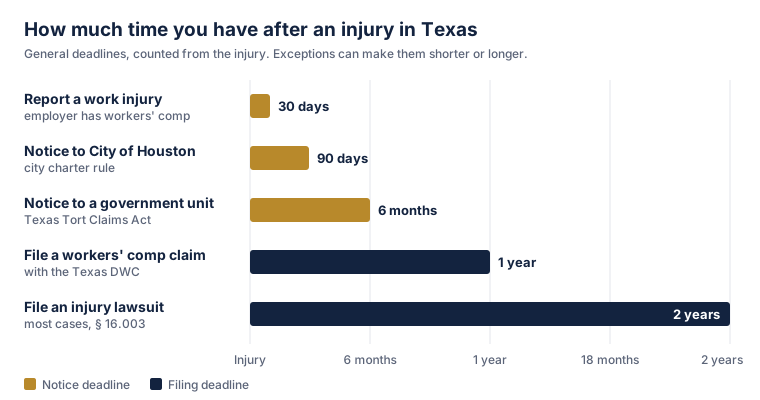
| Type of claim | Deadline | Law |
|---|---|---|
| Most personal injury and property damage lawsuits | 2 years from the injury | Tex. Civ. Prac. & Rem. Code § 16.003(a) |
| Wrongful death lawsuit | 2 years from the date of death | § 16.003(b) |
| Notice to a Texas governmental unit | 6 months from the incident | § 101.101(a) |
| Notice to the City of Houston | 90 days from the injury | Houston City Charter |
| Claim against the federal government | 2 years to file with the agency | 28 U.S.C. § 2401(b) |
| Medical malpractice lawsuit | 2 years, with a 10-year outer limit | § 74.251 |
| Defective product lawsuit | 2 years, and usually within 15 years of the sale | § 16.003, § 16.012 |
| Work injury, employer has workers' comp | Report in 30 days; file with DWC in 1 year | Tex. Labor Code |
This table is a starting point, not a substitute for advice about your situation. Exceptions can make a deadline shorter or longer, as the next sections explain.
When does the clock start?
The law says the two years run from the day the cause of action "accrues." For most accidents, that's simple: it's the day of the crash, the fall or the injury.
The legal injury rule
Texas follows what courts call the legal injury rule. A claim accrues when the wrongful act causes an injury, even if you don't yet know how serious it is. If you hurt your back in a crash and only find out a year later that you need surgery, the clock still started on the day of the crash. Learning that your injury is worse than you thought does not restart it.
The discovery rule is narrow
There's a limited exception called the discovery rule. When it applies, the clock doesn't start until you knew, or with reasonable care should have known, that you were injured and that someone else's wrongful act likely caused it. You don't need to know exactly who's to blame or the full extent of the harm.
Texas courts apply the discovery rule only in narrow situations, where the injury is the kind that is inherently hard to discover in time. A classic example is a disease from workplace exposure that doesn't show symptoms for years. For a car crash or a fall, where you know right away that you were hurt, the discovery rule almost never helps. The case below shows why.
Exceptions that can pause the clock
Texas law has a few situations where time doesn't count against you. Lawyers call this tolling.
Children
Under § 16.001, a person younger than 18 is under a "legal disability," and that time isn't counted. So for most injuries, a child's two-year clock doesn't start until their 18th birthday. A 10-year-old hurt in a crash would generally have until their 20th birthday to sue.
Two cautions. First, parents often have their own claims, like for the child's medical bills, and those may not get the same extension. Second, medical malpractice has a different rule for children, covered below. If your child was hurt, don't assume you can wait.
Unsound mind
The same section pauses the clock for a person who is "of unsound mind" when the claim accrues, such as someone left in a coma or with a serious brain injury from the accident. Two limits apply: you can't stack one disability on top of another to extend the deadline, and a disability that starts after the clock is already running doesn't stop it.
The defendant leaves Texas
Under § 16.063, if the person you'd sue is absent from Texas, the clock is suspended for the period of their absence. Courts have limited how this rule applies, especially when the defendant can still be served with the lawsuit. It's not something to count on without a lawyer's advice.
Claims against a city, county or the state
This is where people lose valid claims most often, because the deadline is so much shorter than two years.
If your injury involves a government vehicle or property, like a city garbage truck, a police car, a county road crew or a public building, the Texas Tort Claims Act may apply. It allows some claims against government units, but only if you follow its rules.
The six-month notice rule
Under § 101.101, you must give the governmental unit notice of your claim within six months of the incident. The notice must reasonably describe:
- the damage or injury you're claiming
- the time and place of the incident
- the incident itself
This notice is not a lawsuit. You still need to file suit within the two-year limitations period. But if you skip the notice or send it late, your lawsuit can fail before it starts. Texas law says statutory prerequisites to a suit, "including the provision of notice," are jurisdictional in suits against a governmental entity (Tex. Gov't Code § 311.034). In plain terms, a court may have no power to hear your case.
Cities can set shorter deadlines
The same law approves city charter rules that require notice within a shorter period. Houston is a common example. The City of Houston requires a written, notarized notice of claim within 90 days after the injury or damage. The notice must include details like how and where it happened, the amount you're claiming, the amount you'd accept to settle, your address and witness names (City of Houston Legal Department).
Other Texas cities have their own charter rules. If a city vehicle or city property was involved, look up that city's notice requirement the same week, or ask a lawyer to do it.

What about "actual notice"?
The law excuses formal notice if the government unit already had "actual notice" of the death, injury or property damage. That sounds like a safety net, but Texas courts read it narrowly. A police report or an officer at the scene doesn't automatically count. Don't rely on it. Send the written notice on time.
Claims against the federal government
If a federal employee caused your injury while on the job, like a mail carrier in a postal truck, the claim usually goes through the Federal Tort Claims Act. The rules are different from Texas law:
- You must first file a written claim with the federal agency within two years of when the claim accrues. A lawsuit can't come first.
- The agency has six months to decide. If it doesn't, you can treat that as a denial.
- If the agency denies your claim in writing, you have six months from the date it was mailed to file a lawsuit in federal court (28 U.S.C. § 2401(b)).
Federal claims have their own forms and strict requirements, so this is a situation where a lawyer is worth calling early.
Medical malpractice deadlines
Claims against doctors, hospitals and other health care providers have their own deadline in § 74.251:
- Two years from the date of the negligent act, or from the date the treatment or hospitalization at issue was completed.
- Children: a child under 12 has until their 14th birthday to file. This is shorter than the usual "wait until 18" rule for other injuries.
- A 10-year outer limit: a claim must be filed within 10 years of the act or omission, no matter what. This is called a statute of repose.
There's also a required step before you sue. Under § 74.051, you must send written notice by certified mail to each provider at least 60 days before filing, along with a medical records authorization form. Sending that notice properly pauses the two-year clock for 75 days, for all parties.
Defective products, deaths and work injuries
Defective products
If a defective product hurt you, like a car part, a tire, a power tool or a medical device, the two-year deadline generally applies. There's also a 15-year outer limit: under § 16.012, a products liability lawsuit against the manufacturer or seller generally must be filed within 15 years of the date the product was sold. There are exceptions, including some diseases from exposure that didn't show symptoms until later, and products sold with a written warranty of a longer safe life.
Wrongful death
When someone dies from an injury, the family's wrongful death lawsuit generally must be filed within two years, and the clock starts on the date of death, not the date of the accident (§ 16.003(b)). If someone was hurt in January and died in June, the two years generally run from June.
Work injuries
If your employer carries workers' compensation, the deadlines are much shorter: you must report the injury to your employer within 30 days and file a claim with the Texas Division of Workers' Compensation within one year. If your employer is a non-subscriber, a lawsuit against it generally falls under the two-year rule. Our guide to work injuries in Texas explains both paths.
Filing on time isn't the last step
Filing the lawsuit before the deadline is required, but in Texas it's not always enough. You also have to serve the defendant, meaning formally deliver the lawsuit to them. If service happens after the deadline, the case can still be thrown out unless you used diligence in trying to serve them.
The Supreme Court of Texas addressed this in Proulx v. Wells, 235 S.W.3d 213 (Tex. 2007). The plaintiff filed shortly before the two-year deadline, then spent months trying to serve the defendant, using multiple process servers and an investigator. The defendant argued the delay meant he should win. The Court disagreed. It held that the evidence didn't conclusively prove the plaintiff lacked diligence, given the sustained efforts and evidence the defendant was avoiding service (case summary).
The lesson: if you file close to the deadline, expect a fight about service. Filing early avoids this problem entirely.
A real Texas case: Schlumberger v. Pasko (2018)
On April 13, 2018, the Supreme Court of Texas decided Schlumberger Technology Corp. v. Pasko, 544 S.W.3d 830. It's a short opinion, but it shows exactly how strict the two-year rule is, and how little room the discovery rule leaves for injuries you know about right away.
What happened
Michael Pasko was working at an oil well site on May 6, 2013, when he was exposed to caustic chemicals and suffered severe burns. He knew he'd been hurt that day, and he knew he hadn't been given protective equipment. Later, he was diagnosed with cancer, which he believed was caused by the same exposure (Caselaw Access Project).
He added Schlumberger as a defendant in his lawsuit on August 13, 2015, a little more than two years and three months after the burns.
The arguments
Schlumberger argued the claim was too late because the two years started on May 6, 2013. Pasko argued the discovery rule should apply, especially given his later cancer diagnosis. The trial court sided with Schlumberger. The Thirteenth Court of Appeals reversed, applying the discovery rule.
What the Supreme Court decided
The Supreme Court reversed the court of appeals and reinstated the judgment for Schlumberger. Under the legal injury rule, Pasko's claim accrued on the day he was burned. The discovery rule didn't help him because he knew he'd been injured, and knew the likely cause, right away. A later cancer diagnosis didn't turn his burns into the kind of hidden, latent injury the discovery rule is meant for (case commentary; docket No. 17-0231).
What this means for you
- The clock starts when you're hurt, not when you learn the full extent. A worse diagnosis later doesn't usually restart it.
- Missing by a little is the same as missing by a lot. Pasko was about three months late, and that ended his claim against Schlumberger.
- Every defendant has its own deadline. Pasko had sued others first. Adding a new defendant later still had to happen within that defendant's two years. If another company may share the blame, identify it early.
Why you shouldn't wait, even with time left
Two years sounds like a long time. In practice, much of what proves an injury case starts disappearing within days or weeks:
- Video gets erased. Store, traffic and dashcam footage is often recorded over within days or weeks.
- Witnesses forget or move. A witness who clearly remembers the light was red today may be vague in a year.
- Vehicles get repaired or scrapped. Damage that shows how a crash happened can vanish when a car is fixed or sold for salvage. In truck cases, electronic data from the truck can be lost.
- Gaps in treatment hurt you. If you wait months to see a doctor, the insurer will argue the injury wasn't serious or came from something else.
- Lawyers need time. A lawyer who gets your case a month before the deadline has very little time to investigate, find every responsible party and send required notices.
When to call a lawyer
Talk to a licensed Texas injury lawyer soon if:
- A city, county, state or federal vehicle, employee or property was involved
- You're getting close to the two-year mark and the claim isn't settled
- The injured person is a child, or someone who died from their injuries
- The injury showed up later, or you're not sure when the clock started
- The claim involves a doctor, hospital or defective product
- More than one person or company may share the blame
Most injury lawyers offer a free first consultation and work on a contingency fee, meaning they're paid a percentage only if you recover money. For a referral, contact the State Bar of Texas Lawyer Referral and Information Service at (800) 252-9690, Monday to Friday, 8:30 a.m. to 4:30 p.m., or texasbar.com/LawyerReferral. Our Find a Lawyer page has questions to ask before you hire someone.
Checklist: protect your deadline
- Write down the exact date of the injury, and the date of death if someone died
- Mark the two-year date on your calendar, and a reminder six months before it
- If a government vehicle or property was involved, find the notice deadline this week
- Send any required notice by certified mail with a return receipt, and keep copies
- Report the crash or injury to your own insurer right away
- Don't treat an open insurance claim as protection; it doesn't stop the clock
- List every person or company that might share the blame
- Save photos, video, names of witnesses and medical records now
- Talk to a lawyer well before the deadline, not in the last few weeks
Frequently asked questions
What is the statute of limitations for personal injury in Texas?
Generally two years. Texas Civil Practice and Remedies Code § 16.003 requires a personal injury lawsuit to be filed no later than two years after the day the cause of action accrues, which is usually the day of the injury.
Does an insurance claim stop the two-year clock in Texas?
No. Filing an insurance claim or negotiating with an adjuster does not pause the statute of limitations. Only filing a lawsuit in court, and then serving the defendant with diligence, protects your claim.
How long do I have to file a claim against a Texas city or the state?
Under the Texas Tort Claims Act, you generally must give the government written notice within six months of the incident. Some cities set shorter deadlines in their charters; Houston, for example, requires notice within 90 days. The two-year deadline for the lawsuit itself still applies.
How long does a child have to file an injury lawsuit in Texas?
For most injury claims, the two-year clock doesn't start until the child turns 18, so the deadline is usually the child's 20th birthday. Medical malpractice is different: a child under 12 has until their 14th birthday, and a 10-year outer limit applies.
What is the deadline for a wrongful death lawsuit in Texas?
Generally two years from the date of death, not the date of the accident, under Texas Civil Practice and Remedies Code § 16.003(b).
What happens if I miss the deadline?
The defendant can ask the court to dismiss your case, and the court usually will. You would lose the right to recover anything from that defendant, no matter how strong the case was.
Sources
- Tex. Civ. Prac. & Rem. Code § 16.003: two-year limitations period, including wrongful death
- Tex. Civ. Prac. & Rem. Code § 16.001: minors and unsound mind
- Tex. Civ. Prac. & Rem. Code § 16.063: defendant's absence from Texas
- Tex. Civ. Prac. & Rem. Code § 16.072: deadlines falling on weekends and holidays
- Tex. Civ. Prac. & Rem. Code § 16.012: 15-year products liability limit
- Tex. Civ. Prac. & Rem. Code § 101.101: Tort Claims Act notice
- Tex. Gov't Code § 311.034: notice requirements are jurisdictional in suits against government
- Tex. Civ. Prac. & Rem. Code § 74.251: health care liability deadlines
- Tex. Civ. Prac. & Rem. Code § 74.051: pre-suit notice for health care claims
- City of Houston Legal Department: How to file a claim
- 28 U.S.C. § 2401(b): Federal Tort Claims Act deadlines
- Schlumberger Technology Corp. v. Pasko, 544 S.W.3d 830 (Tex. 2018)
- Supreme Court of Texas docket No. 17-0231
- Commentary on Proulx v. Wells, 235 S.W.3d 213 (Tex. 2007)
- State Bar of Texas Lawyer Referral and Information Service (TexasLawHelp.org)
Keep reading
 Claim Basics · Texas
Talking to the Insurance Adjuster After a Texas Accident: What to Say, What Not to Say and Your Rights
The adjuster who calls after a crash sounds friendly, but their job is to pay as little as possible. Here's how to handle the first call, recorded statements, medical releases and settlement offers in Texas.
 Claim Basics · Texas
Wrongful Death Claims in Texas: Who Can Sue, the Deadline and What Families Can Recover
Texas law decides exactly which family members can bring a wrongful death claim, and it's narrower than most people expect. Here's who can sue, when, and what the law allows a family to recover.
 Claim Basics · Texas
How Much Is My Injury Case Worth in Texas? What Really Decides the Number
There's no formula and no calculator that can value your case. But Texas law decides what counts, what gets cut and what you keep. Here's how the number really gets built.