Dog Bites · Texas
Texas Dog Bite Law: Who Pays, the "One Bite" Rule and How to File a Claim
Texas doesn't have a dog bite statute that makes owners automatically liable. But you can still recover in two ways, and a 2008 Texas Supreme Court case shows the owner doesn't need a history of bites to be responsible.

The short answer: if a dog bit you in Texas, the owner can be responsible in two ways. If the owner knew the dog was dangerous, they're strictly liable, meaning you don't have to prove they were careless. If they didn't know, you can still recover by showing they were negligent, like letting the dog run loose or doing nothing to stop the attack. The owner's homeowners or renters insurance usually pays. Get medical care, report the bite, and you generally have two years to file a lawsuit.
Dog bites happen fast and usually close to home. A neighbor's dog slips through a gate. A friendly-looking dog at a barbecue suddenly lunges. A delivery driver walks up a driveway and a dog comes around the side of the house. In seconds, there are puncture wounds, torn skin, and sometimes a trip to the ER, stitches, and scars that last for years.
Afterward, many people hesitate to make a claim, especially if the owner is a neighbor or a friend. It helps to know that a claim is usually paid by the owner's insurance, not out of their pocket. This guide explains how Texas law handles dog bites, the "one bite" rule and why it's often misunderstood, a 2008 Texas Supreme Court case about a woman attacked delivering products to a customer's home, and what to do right away.
- What to do in the first 24 hours
- Two ways to hold a dog owner responsible
- The "one bite" rule, explained
- Negligence: when there's no bite history
- A real Texas case: Bushnell v. Mott (2008)
- What the owner's insurer will argue
- Can anyone besides the owner be responsible?
- Who pays: insurance and dog bites
- When a dog attack is a crime: Lillian's Law
- If a child was bitten
- What you can recover
- Deadlines and when to call a lawyer
- Checklist and FAQ
What to do in the first 24 hours
1. Get away from the dog and get medical care
Move to a safe place. Wash the wound with soap and water for several minutes and apply pressure if it's bleeding. Then see a doctor, even for a bite that looks small. Dog bites carry a high risk of infection, puncture wounds can be deeper than they look, and a doctor needs to decide whether you need a tetanus shot, antibiotics or rabies treatment. For deep bites, bites to the face or hands, or heavy bleeding, go to the emergency room.
2. Find out about the dog's rabies vaccination
Get the owner's name, address and phone number, and ask whether the dog is up to date on its rabies shots. Ask for the name of the dog's veterinarian. If the dog was a stray or the owner can't be found, tell your doctor right away. Rabies treatment decisions can't wait.
3. Report the bite
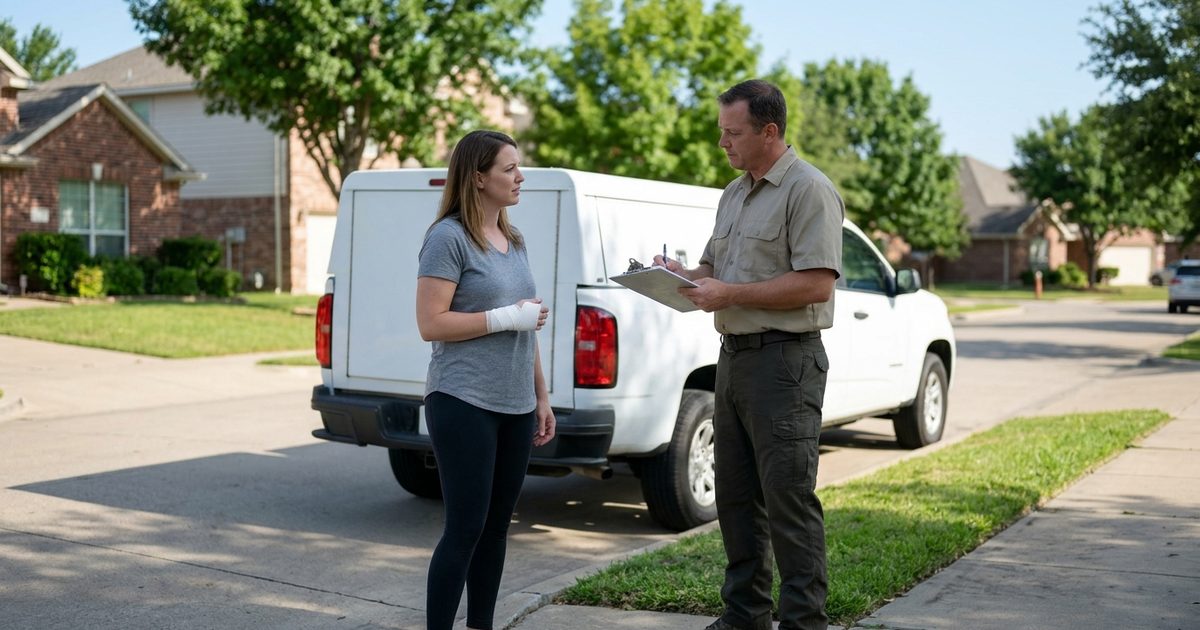
In Texas, bites from animals that can carry rabies, including dogs, must be reported to the local rabies control authority, which is usually city or county animal services. A dog that bites a person and breaks the skin is usually quarantined for 10 days to watch for signs of rabies, either at a vet clinic or at animal services (example: City of Abilene). The report also creates an official record of the bite, which matters for your claim.
4. Document everything
- Photos of the wounds right away, and again every few days as they heal or scar
- Photos of where it happened: an open gate, a broken fence, a missing leash, "Beware of Dog" signs
- Your torn or bloody clothing; keep it in a bag
- Names and phone numbers of witnesses, including neighbors who may know about earlier incidents
- All medical records and bills
5. Ask about earlier incidents
Whether the dog had bitten, attacked or threatened anyone before can make a big difference to your claim, as explained below. Neighbors, mail carriers and delivery drivers often know. Animal services may also have records of earlier complaints.
6. Be careful what you sign or say
Don't sign anything from the owner's insurer, and don't give a recorded statement without advice. Stick to facts, and don't downplay your injuries out of politeness to the owner.
Two ways to hold a dog owner responsible
Unlike some states, Texas has no statute that makes dog owners automatically liable for every bite. Instead, Texas courts use two legal theories, set out by the Texas Supreme Court in Marshall v. Ranne, 511 S.W.2d 255 (Tex. 1974).
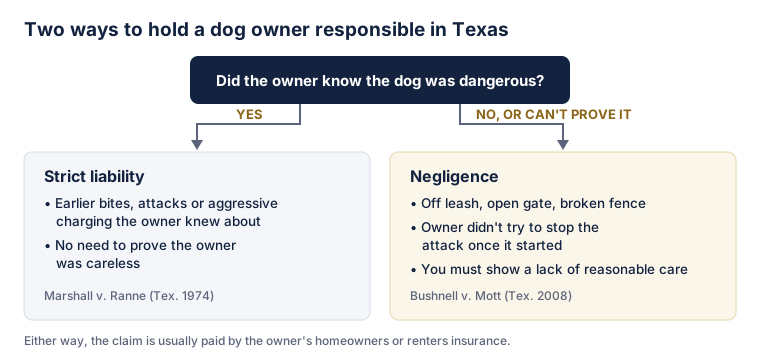
| Strict liability | Negligence | |
|---|---|---|
| When it applies | The owner knew, or should have known, the dog was dangerous | The dog had no known history, or it can't be proven |
| What you must prove | The dog had dangerous tendencies, the owner knew, and those tendencies caused your injury | The owner failed to use reasonable care to control the dog, and that caused your injury |
| Do you have to show carelessness? | No | Yes |
| Examples | Earlier bites, attacks, or aggressive charging the owner knew about | Off leash, open gate, broken fence, no effort to stop an attack |
The "one bite" rule, explained
People often say Texas is a "one bite" state, meaning a dog gets one free bite before the owner is responsible. That's only half true.
The idea comes from the strict liability rule. Once an owner knows their dog is dangerous, because it has bitten, attacked or aggressively threatened someone before, the owner is strictly liable for injuries the dog causes because of that dangerous tendency. You don't have to prove the owner did anything careless.
The case that set this rule, Marshall v. Ranne, wasn't actually about a dog. It was about a neighbor's hog that was known to be vicious: it had charged Paul Marshall several times and attacked his wife. One day, as he walked out of his house, the hog attacked him and severely injured his hand. The jury found that Marshall was careless and had accepted the risk, because he knew about the hog and hadn't done anything about it. The Texas Supreme Court reversed. It held that the injured person's own carelessness is not a defense to strict liability for a known vicious animal, and that Marshall hadn't voluntarily accepted the risk because he had no reasonable alternative (case brief).
A previous bite isn't the only thing that counts. Earlier attacks on other animals, aggressive lunging or charging at people, or an owner's own statements like "he doesn't like strangers" can all help show the owner knew.
The "one free bite" myth is the wrong half: even a dog with a spotless record can make its owner liable through negligence.
Negligence: when there's no bite history
If the dog wasn't known to be dangerous, you can still recover by showing the owner failed to use the care a reasonable person would to control the dog. Common examples:
- Violating a leash law. Many Texas cities and counties require dogs to be leashed or confined. Letting a dog run loose in violation of a local ordinance is strong evidence of negligence.
- An open gate or broken fence the owner knew about
- Leaving a dog unattended around small children or strangers
- Letting a dog greet visitors at the door without control
- Doing nothing to stop an attack once it started
That last point comes straight from a Texas Supreme Court case.
A real Texas case: Bushnell v. Mott (2008)
On March 28, 2008, the Supreme Court of Texas decided Bushnell v. Mott, 254 S.W.3d 451, a case about what an owner must do when their dog starts attacking someone (full opinion).
What happened
Genevia Bushnell sold health and wellness products. She went to the mobile home of a customer, Janet Mott, to deliver products Mott had bought. When Mott opened the door, three of her dogs pushed past her and attacked Bushnell, biting her legs, arms, back and shoulder. Bushnell said Mott made no effort to stop the attack and didn't help her afterward.
The lower courts
Bushnell sued for negligence and other claims. The trial court ruled for Mott without a trial, and the court of appeals agreed, finding there wasn't enough evidence the dogs had dangerous tendencies.
What the Supreme Court decided
The Supreme Court reversed and sent the case back for trial. It explained that under Marshall v. Ranne, the owner of a vicious animal can be strictly liable, and the owner of an animal that isn't known to be vicious can be liable for negligent handling. Because Mott's dogs weren't shown to be known as vicious, the case turned on negligence.
The key holding: the owner of a dog that isn't known to be vicious still has a duty to try to stop the dog from attacking someone once the attack has begun. Bushnell's sworn statement that Mott never even scolded the dogs during the attack was enough to raise a fact question for a jury.
What this means for you
- No bite history? You may still have a claim. An owner who stands by during an attack, or who let the dog out, can be negligent.
- Write down what the owner did during the attack. Did they call the dog off, pull it away, or do nothing? Your memory and witnesses' accounts matter.
- Delivery and service workers are protected too. Bushnell was there on business. If you were bitten while working, you may also have a workers' compensation claim; see our work injury guide.
What the owner's insurer will argue
- "You provoked the dog." Teasing, hitting or cornering a dog can reduce or defeat a claim. Witnesses who saw you weren't provoking it are valuable.
- "You were trespassing." Owners generally owe less care to trespassers. But mail carriers, delivery drivers, guests and anyone with a legitimate reason to be there aren't trespassers.
- "You were partly at fault." In a negligence claim, Texas reduces your recovery by your share of responsibility, and bars it if you're more than 50% responsible (§ 33.001). Under Marshall v. Ranne, that argument is much weaker in a strict liability case.
- "The dog wasn't dangerous." They'll say there was no history. That's why the negligence theory, and evidence of how the attack happened, matters.
Can anyone besides the owner be responsible?
Sometimes. A person who was keeping or controlling the dog, like a dog sitter or a relative watching it, may be responsible. Claims against landlords are harder. In general, a landlord who didn't own or control the dog isn't responsible, but there can be exceptions if the landlord knew about a dangerous dog and had the power to do something about it. A lawyer can look at the lease and the facts.
Who pays: insurance and dog bites
Most dog bite claims are paid by the owner's homeowners or renters insurance, through the liability part of the policy. That's worth knowing if the owner is a neighbor or friend: a claim usually doesn't come out of their pocket.
- Ask the owner for their insurance company and policy number.
- Some policies exclude certain breeds, or dogs with a bite history. If there's no coverage, the owner may be personally responsible, but collecting can be difficult.
- If the bite happened in a car, the owner's auto insurance may apply.
- Your own health insurance should pay for treatment in the meantime. It may ask to be repaid from any settlement.
When a dog attack is a crime: Lillian's Law
In 2007, Texas passed what's known as Lillian's Law, named after an elderly woman killed by dogs. Under Texas Health and Safety Code § 822.005, a dog owner commits a crime if:
- with criminal negligence, they fail to secure the dog, and it makes an unprovoked attack on someone somewhere other than the owner's property or vehicle, causing serious bodily injury or death; or
- they know their dog has been declared dangerous, and it makes an unprovoked attack outside a secure enclosure, causing serious bodily injury or death.
It's a third-degree felony, or a second-degree felony if the victim dies. A court can also order the dog destroyed. A criminal case is separate from your injury claim, but a police report or a dangerous-dog finding can support it.
Texas also has a process for declaring a dog "dangerous" after an unprovoked attack, which requires the owner to restrain the dog and carry liability insurance or financial responsibility (Health and Safety Code Chapter 822, Subchapter D). If the dog that bit you was already declared dangerous, tell your lawyer.
If a child was bitten
Children are bitten more often than adults, and more often on the face and head. A child usually can't be found at fault the way an adult can, and owners must take extra care around children.
- Get your child seen by a doctor, and ask about scarring and whether a plastic surgeon should look at a facial wound.
- Watch for nightmares, fear of dogs or anxiety afterward. Emotional harm is part of the claim.
- Keep photos of the scars over time; future scar revision surgery can be part of the damages.
What you can recover
- Medical expenses: ER, stitches, antibiotics, rabies shots, plastic surgery, and future scar treatment
- Lost wages while you recover
- Pain and suffering and mental anguish, including fear and anxiety after the attack
- Disfigurement: scarring, especially on the face or hands
- Property damage: torn clothes, broken glasses or a phone
Under Texas law, medical expenses are limited to amounts actually paid or incurred. See our guide to what an injury case is worth in Texas for how value is calculated.
Deadlines
You generally have two years from the date of the bite to file a lawsuit (§ 16.003). For a child, the clock usually doesn't start until the child turns 18, but parents' own claims, like for medical bills, may have a shorter deadline. Don't wait: evidence about the dog's history and the scene can disappear. Our guide to Texas injury claim deadlines explains the exceptions.
When to call a lawyer
Talk to a licensed Texas injury lawyer if:
- The bite needed stitches, surgery or left a scar
- A child was bitten, especially on the face
- The owner denies the dog was theirs, or has no insurance
- The insurer says you provoked the dog or were trespassing
- The bite happened at work, or at a rental property
For a referral, contact the State Bar of Texas Lawyer Referral and Information Service at (800) 252-9690, Monday to Friday, 8:30 a.m. to 4:30 p.m., or texasbar.com/LawyerReferral. See our Find a Lawyer page for questions to ask.
Checklist: after a dog bite in Texas
- Wash the wound and see a doctor the same day
- Get the owner's name, address, phone and the dog's rabies status
- Report the bite to animal services or the local rabies control authority
- Photograph the wounds, the scene, gates, fences and leash
- Keep torn or bloody clothing in a bag
- Write down what the owner did during and after the attack
- Ask neighbors and animal services about earlier incidents
- Get the owner's homeowners or renters insurance information
- Don't give a recorded statement or sign anything from the insurer
- Photograph scars over time, and mark the two-year deadline
Frequently asked questions
Is Texas a one bite state for dog bites?
Partly. Texas has no statute that makes dog owners automatically liable. Under the Texas Supreme Court's decision in Marshall v. Ranne, an owner who knew the animal was dangerous is strictly liable. But an owner can also be liable for negligence even without a history of bites, for example by letting the dog run loose or failing to try to stop an attack.
Who pays for a dog bite in Texas?
Usually the dog owner's homeowners or renters insurance pays, if the owner has a policy that covers dog bites. Some policies exclude certain breeds or dogs with a bite history, so the owner's coverage should be checked early.
Do I have to report a dog bite in Texas?
Yes, you should. Texas law requires bites from animals that can carry rabies, including dogs, to be reported to the local rabies control authority. A dog that bites a person is usually quarantined for 10 days to watch for signs of rabies.
Can a dog owner go to jail in Texas if their dog attacks someone?
Yes, in serious cases. Under Lillian's Law, Texas Health and Safety Code § 822.005, an owner whose dog makes an unprovoked attack off the owner's property and causes serious bodily injury can be charged with a third-degree felony, or a second-degree felony if the victim dies.
How long do I have to file a dog bite claim in Texas?
Generally two years from the date of the bite under Texas Civil Practice and Remedies Code § 16.003. For a child, the two-year period usually doesn't start until the child turns 18, but parents' own claims for medical bills may have a shorter deadline.
Sources
- Bushnell v. Mott, 254 S.W.3d 451 (Tex. Mar. 28, 2008)
- Marshall v. Ranne, 511 S.W.2d 255 (Tex. 1974), case brief
- Tex. Health & Safety Code § 822.005: Lillian's Law
- H.B. 1355 (2007) bill analysis
- Texas DSHS: Health and Safety Code Chapter 822
- City of Abilene: When an animal bites a human
- Tex. Civ. Prac. & Rem. Code § 33.001: proportionate responsibility
- Tex. Civ. Prac. & Rem. Code § 16.003: two-year limitations period
- State Bar of Texas Lawyer Referral and Information Service (TexasLawHelp.org)
Keep reading
 Divorce & Family · Texas
Child Custody and Child Support in a Texas Divorce: What Parents Should Know
Texas calls custody 'conservatorship' and visitation 'possession and access.' Here's how judges decide, what the standard schedule looks like, how child support is calculated, and how orders can change.
 Divorce & Family · Texas
How Property Is Divided in a Texas Divorce: Community Property Explained
Texas is a community property state, but that doesn't always mean a 50/50 split. Here's how courts decide who keeps the house, the retirement accounts and the debts, and how to protect what's yours.
 Divorce & Family · Texas
How to File for Divorce in Texas: Steps, Costs and the 60-Day Waiting Period
Thinking about divorce in Texas? Here's the whole process in plain English: who can file and where, what it costs, why you have to wait 60 days, and how agreed and contested divorces end.