Motorcycle · Texas
Motorcycle Accident in Texas? Helmet Law, Fault and Your Right to Compensation
Nearly 600 motorcyclists died on Texas roads in 2024. If you were hurt, here's how fault works, what the helmet and lane-splitting laws mean for your claim, and the arguments insurers will make.

The short answer: if a driver caused your motorcycle crash in Texas, you can make a claim against that driver's insurance for your medical bills, lost income, pain and suffering, and the damage to your bike, even if you weren't wearing a helmet. Your recovery is reduced by any share of blame put on you, and you get nothing if you're found more than 50% at fault. Expect the insurance company to argue about your speed, your lane position and your helmet. You generally have two years to file a lawsuit.
Most motorcycle riders have heard some version of it: "Sorry, I never saw him." A driver pulls out of a parking lot, changes lanes, or turns left across traffic, and a rider who was doing everything right ends up on the pavement. A crash that would mean a dented bumper between two cars can mean broken bones, road rash or a brain injury on a motorcycle.
After the crash, riders often face a second problem: the assumption that motorcyclists are reckless. Insurance adjusters know juries can share that bias, and they use it. This guide explains how Texas law handles motorcycle crashes, the rules about helmets and lane splitting, how fault is divided, two Texas Supreme Court decisions that affect riders, and the steps that protect your claim.
- How dangerous Texas roads are for riders
- What to do after a motorcycle crash
- The crashes that hurt riders most
- The Texas helmet law
- Lane splitting is illegal in Texas
- How fault is divided
- A real Texas case: Nabors v. Romero and the helmet argument
- If the driver didn't stop, or never touched you
- What you can recover
- What the insurance company will argue
- Deadlines
- When to call a lawyer
- Checklist and FAQ
How dangerous Texas roads are for riders
In 2024, 585 people riding motorcycles were killed in crashes in Texas, and 2,532 more suffered suspected serious injuries, according to the Texas Department of Transportation (TxDOT crash records). Of the riders killed, 216 were not wearing a helmet.
TxDOT has also reported that more than a third of motorcycle deaths happen at intersections, and its "Share the Road: Look Twice for Motorcycles" campaign asks drivers to let oncoming motorcycles pass before turning left (TxDOT). That's a useful fact for your claim: the state itself recognizes that drivers failing to see motorcycles is a leading cause of these crashes.
What to do after a motorcycle crash
1. Get to safety and call 911
If you can move, get yourself out of traffic. Don't stand in the road to inspect your bike. Call 911 so police and medical help come to the scene. Texas law requires a report to police for any crash with an injury or death (our car accident guide explains the reporting rules, which apply to motorcycles too).
2. Get checked, even if you feel OK
Adrenaline hides pain. Riders often walk away from a crash and find out hours later that they have a concussion, a fractured wrist or internal injuries. Let paramedics check you, and see a doctor the same day if you don't go to the hospital. Gaps between the crash and your first treatment are one of the first things an insurer will use against you.
3. Keep your helmet and gear
Don't throw away a damaged helmet, jacket, gloves or boots. Scrapes and cracks show where you hit the road and how hard. If you weren't wearing a helmet, that matters too, so be honest with your lawyer about it from the start.
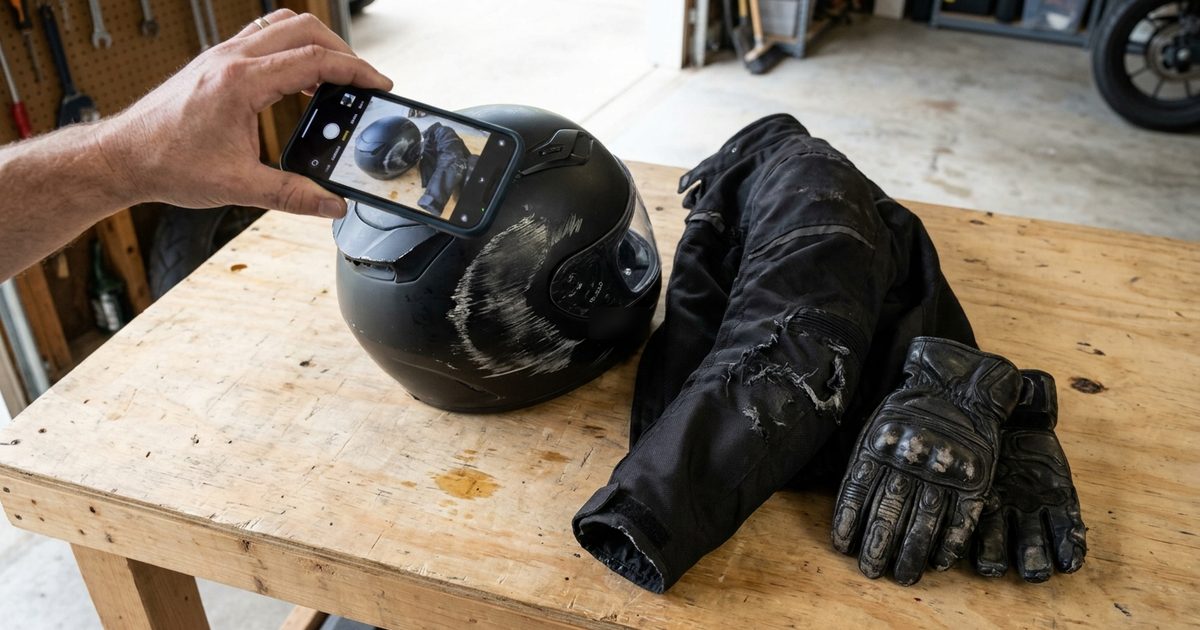
4. Photograph everything
- Your motorcycle and the other vehicle, from several angles, before either is moved if it's safe
- Skid marks, debris, gravel, potholes and the position of the vehicles
- Traffic signals, stop signs and anything that blocked the driver's view
- Your injuries, the same day and over the following weeks
- The other driver's license, insurance card and license plate
5. Get witness names and look for video
Other riders, drivers and pedestrians often see more than the people in the crash. Get names and phone numbers. Look for cameras at nearby gas stations and stores, and ask other drivers about dashcams. Footage can be recorded over within days.
6. Be careful what you say
Stick to facts with the police and the other driver. Don't apologize or guess about your speed. When the other driver's insurer calls, you don't have to give a recorded statement. It's reasonable to say you'll respond in writing or through a lawyer.
The crashes that hurt riders most
Most serious motorcycle crashes follow a few patterns, and in most of them the other driver failed to see the motorcycle.
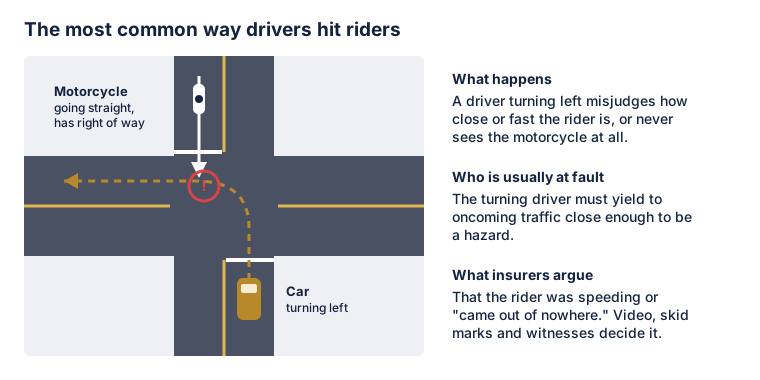
Left turns in front of the rider
A driver turning left at an intersection or into a driveway must yield to oncoming traffic that is close enough to be a hazard. A motorcycle is narrow and easy to misjudge, so drivers often turn into its path. In these crashes, the driver is usually primarily at fault.
Lane changes into the rider
A motorcycle can sit entirely in a car's blind spot. When a driver changes lanes without checking, the rider has nowhere to go. Texas law says a motorcycle is entitled to the full use of a lane, and a driver may not drive in a way that takes that away (Tex. Transp. Code § 545.0605).
Rear-end crashes
A car tapping a car's bumper at a red light is minor. The same tap can throw a rider off the bike. Drivers who follow too closely or are distracted by their phones cause many of these.
Road hazards
Gravel, potholes, uneven pavement and debris are much more dangerous on two wheels. If a road defect caused your crash, the claim may be against a government agency or a contractor, and the deadlines are much shorter (see Deadlines).
The Texas helmet law
Texas doesn't require every rider to wear a helmet. Under Texas Transportation Code § 661.003:
- Riders and passengers under 21 must wear a helmet that meets the safety standard.
- Riders and passengers 21 and older may ride without a helmet if they have completed an approved motorcycle operator training and safety course, or are covered by a health insurance plan that pays medical benefits for injuries from a motorcycle accident.
- A police officer may not stop or detain a rider just to check whether they meet one of those exceptions.
These exceptions have been in place since 1997 (Texas Legislature bill analysis). Riding without a helmet when you qualify isn't illegal. But it can still come up in your injury claim, as explained below.
Lane splitting is illegal in Texas
Lane splitting means riding between lanes of slow or stopped traffic. Some states allow it. Texas doesn't. A law that took effect on September 1, 2023, says a motorcycle may not be operated "between lanes of traffic moving in the same direction" and may not pass a vehicle while in the same lane. It allows two motorcycles to ride side by side in one lane, but no more than two. Police officers on duty are exempt (H.B. 4122, adding § 545.0605).
Why this matters for your claim: if you were splitting lanes when you were hit, the insurer will argue you broke the law and caused the crash. That doesn't automatically end your claim, since the driver may still share the blame, but it can sharply cut what you recover.
How fault is divided
Texas uses proportionate responsibility, sometimes called modified comparative fault (Tex. Civ. Prac. & Rem. Code § 33.001). A jury, or the insurers in a settlement, assigns each person a percentage of responsibility.
- If you're found 50% or less responsible, you can recover, but your damages are reduced by your percentage.
- If you're found more than 50% responsible, you recover nothing.
Example: your damages are $200,000. The jury finds the driver who turned left 80% at fault and finds you 20% at fault for speeding. You'd recover $160,000. If the jury instead put you at 51%, you'd recover nothing. That line is why insurers work so hard to shift blame onto riders.
A real Texas case: Nabors v. Romero and the helmet argument
Riders often ask: "If I wasn't wearing a helmet, can they use that against me?" The most important Texas Supreme Court decision on this kind of question is actually about seat belts. Insurers make the same kind of argument about helmets, so riders should understand it.
What happened
A Nabors Well Services truck and a Chevrolet Suburban collided on U.S. Highway 285 in Texas as the Suburban tried to pass the truck while it was turning left. The Suburban carried eight people. Several were injured and one died. The evidence was in dispute about whether the occupants were wearing seat belts (case brief).
The trial
Nabors wanted to show the jury expert evidence that not wearing seat belts made the injuries worse. The trial court refused, following a decades-old rule that kept seat-belt evidence out of Texas trials. The jury found Nabors 51% responsible and awarded about $2.3 million. The court of appeals agreed with excluding the seat-belt evidence.
What the Supreme Court decided
On February 13, 2015, the Supreme Court of Texas overruled the old rule. In Nabors Well Services, Ltd. v. Romero, 456 S.W.3d 553, it held that relevant evidence of whether someone used a seat belt is admissible to help decide how responsibility is divided. The Court reasoned that the Legislature had repealed its ban on seat-belt evidence, and that Texas's proportionate responsibility law asks juries to consider a plaintiff's conduct that contributed to their own injuries, not just conduct that caused the crash (Lewis Brisbois summary; related opinion, Tex. 2015).
What this means for riders
- The insurer will raise your helmet. Following the same logic, expect the defense to argue that riding without a helmet made your injuries worse and that your damages should be reduced.
- It has to be relevant to the injury. Not wearing a helmet doesn't cause a crash. It matters only to the extent it made a particular injury worse. A missing helmet has little to do with a broken leg or road rash on your arm.
- The defense usually needs proof. In the Nabors case, the issue was expert evidence about how seat-belt use would have changed the injuries. Arguments about helmets tend to turn on similar medical and engineering evidence.
- Being legal doesn't end the argument. Even if you were 21 or older and qualified to ride without a helmet, the insurer can still argue it affected your head injuries.
If the driver didn't stop, or never touched you
Many motorcycle crashes are "phantom vehicle" crashes. A car swerves into your lane, you brake hard or swerve to avoid it, and you go down, while the car drives away without ever touching you.
Your own uninsured motorist coverage may pay when the at-fault driver can't be identified. But Texas law requires actual physical contact between the unidentified vehicle and you or your property for that kind of claim (Tex. Ins. Code § 1952.104, discussed here).
The Supreme Court of Texas has applied that rule strictly. In Nationwide Insurance Co. v. Elchehimi, decided March 28, 2008, a family's car was hit by an axle-and-wheel assembly that had broken off an 18-wheeler. The truck was never identified. The Court held that hitting the detached wheels was not "actual physical contact" with a motor vehicle, so the uninsured motorist claim failed (IRMI summary; docket No. 06-0106).
For riders, the lesson is practical:
- Identify the driver if you possibly can. If the driver is found, the claim goes against their insurance, and the contact rule for unknown drivers no longer applies.
- Look for witnesses and video right away. A plate number from a witness or a dashcam can turn a dead-end claim into a valid one.
- Report it to police immediately. A prompt report helps prove the crash happened the way you say.
- Check whether your policy covers motorcycles. Some riders have uninsured motorist coverage on their car policy but rejected it on their motorcycle policy. Texas insurers must offer it, but you can reject it in writing.
What you can recover
If another driver caused the crash, you can claim:
- Medical expenses, past and future, including surgery, rehab and therapy
- Lost wages and lost earning capacity if you can't work, or can't do the same work
- Pain and suffering and mental anguish
- Physical impairment and disfigurement, including scarring from road rash
- Property damage: your motorcycle, helmet, riding gear and anything else damaged
Texas requires drivers to carry at least $30,000 per person in liability coverage. In a serious motorcycle crash, injuries can far exceed that, so your own uninsured/underinsured motorist coverage and any other responsible parties, like an employer whose driver was working, can matter a great deal.
What the insurance company will argue
Expect some or all of these:
- "You were speeding." Insurers may use damage photos, skid marks or witness guesses to claim you were going too fast. Accident reconstruction can push back on this.
- "You came out of nowhere." A driver who didn't look will say the motorcycle appeared suddenly. Sight lines, video and the time of day can show you were visible.
- "You were splitting lanes or weaving." Witness statements and the point of impact on each vehicle often show where you really were.
- "Your helmet." As explained above, they may argue your injuries would have been less serious with a helmet.
- "Your injuries are from something else." Gaps in treatment and prior injuries get used to minimize your claim. Prompt, consistent medical care is your best defense.
Deadlines
You generally have two years from the date of the crash to file a lawsuit in Texas (§ 16.003). Insurance negotiations don't stop that clock.
If a city vehicle, a county truck or a road defect was involved, you may need to send written notice within six months, and some cities, like Houston, require notice within 90 days. Our guide to Texas injury claim deadlines explains every deadline and how to count it.
When to call a lawyer
Talk to a licensed Texas lawyer who handles motorcycle cases if:
- You were seriously injured, especially a head, spine or brain injury
- The insurer blames you for speeding, lane splitting or not wearing a helmet
- The driver fled, or you crashed avoiding a car that never touched you
- The other driver's coverage won't cover your losses
- A commercial truck, company vehicle or government vehicle was involved
- Someone died in the crash
Most injury lawyers offer a free first consultation and work on a contingency fee. Some focus on motorcycle cases and ride themselves, which can help with a jury. For a referral, contact the State Bar of Texas Lawyer Referral and Information Service at (800) 252-9690, Monday to Friday, 8:30 a.m. to 4:30 p.m., or texasbar.com/LawyerReferral. See our Find a Lawyer page for questions to ask.
Checklist: after a motorcycle crash in Texas
- Get out of traffic and call 911
- Let paramedics check you, and see a doctor the same day
- Keep your helmet, jacket, gloves and boots, even if they're damaged
- Photograph both vehicles, the road, signals and your injuries
- Get the driver's license, insurance and plate number
- Get witness names and look for nearby cameras and dashcams
- If the driver fled, report it to police right away
- Don't give a recorded statement to the other driver's insurer
- Check your own policy for uninsured motorist coverage on the motorcycle
- Keep every medical bill, receipt and record of missed work
- Mark the two-year deadline, and any government notice deadline
Frequently asked questions
Is it illegal to ride a motorcycle without a helmet in Texas?
Riders under 21 must wear a helmet. Riders 21 and older may ride without one if they have completed an approved motorcycle operator training and safety course or are covered by a health insurance plan that pays for injuries from a motorcycle accident. Police can't stop a rider just to check whether they qualify.
Can I still get compensation if I wasn't wearing a helmet?
Usually, yes, if the other driver caused the crash. Not wearing a helmet doesn't cause a crash. But the insurer may argue it made your injuries worse, especially head injuries. Under Texas law, your recovery is reduced by your share of responsibility, and you recover nothing if you are found more than 50% responsible.
Is lane splitting legal in Texas?
No. Since September 1, 2023, Texas Transportation Code § 545.0605 expressly says a motorcycle may not be operated between lanes of traffic moving in the same direction, or pass a vehicle in the same lane, with an exception for police officers on duty.
What if the driver who caused my motorcycle crash drove off?
Report it to police right away and check for witnesses or video. Your uninsured motorist coverage may pay, but for an unidentified driver Texas law requires actual physical contact between the other vehicle and you or your motorcycle. If the driver forced you off the road without touching you, that claim can be denied.
How long do I have to file a motorcycle accident lawsuit in Texas?
Generally two years from the date of the crash. Claims involving a government vehicle need written notice much sooner, often within six months, and some cities require it within 90 days.
Sources
- TxDOT: Motorcyclist Fatalities and Injuries by Age Group and Helmet Use, 2024
- TxDOT: Motorcyclist deaths on the rise in Texas
- Tex. Transp. Code § 661.003 helmet requirement and exceptions (as summarized)
- Texas Legislature bill analysis: helmet exemptions since 1997
- H.B. 4122 (2023), enrolled: Tex. Transp. Code § 545.0605
- Tex. Civ. Prac. & Rem. Code § 33.001: proportionate responsibility
- Tex. Civ. Prac. & Rem. Code § 16.003: two-year limitations period
- Nabors Well Services, Ltd. v. Romero, 456 S.W.3d 553 (Tex. Feb. 13, 2015), summary
- Nabors v. Romero case brief
- Nationwide Ins. Co. v. Elchehimi (Tex. 2008), IRMI summary
- Supreme Court of Texas docket No. 06-0106
- Physical contact rule, Tex. Ins. Code § 1952.104
- State Bar of Texas Lawyer Referral and Information Service (TexasLawHelp.org)
Keep reading
 Divorce & Family · Texas
Child Custody and Child Support in a Texas Divorce: What Parents Should Know
Texas calls custody 'conservatorship' and visitation 'possession and access.' Here's how judges decide, what the standard schedule looks like, how child support is calculated, and how orders can change.
 Divorce & Family · Texas
How Property Is Divided in a Texas Divorce: Community Property Explained
Texas is a community property state, but that doesn't always mean a 50/50 split. Here's how courts decide who keeps the house, the retirement accounts and the debts, and how to protect what's yours.
 Divorce & Family · Texas
How to File for Divorce in Texas: Steps, Costs and the 60-Day Waiting Period
Thinking about divorce in Texas? Here's the whole process in plain English: who can file and where, what it costs, why you have to wait 60 days, and how agreed and contested divorces end.