Car Accidents · Texas
Hit by an Uninsured Driver in Texas? Here's How You Still Get Paid
When the driver who hit you has no insurance, or not nearly enough, the money usually has to come from your own policy. Here's how uninsured and underinsured motorist coverage works in Texas, and how to use it.

The short answer: if you're hit by a driver with no insurance, or with too little, the money usually has to come from your own policy. Uninsured/underinsured motorist (UM/UIM) coverage, Personal Injury Protection (PIP) and collision coverage can all help. Report the crash to police right away, get the other driver's details, see a doctor, and notify your own insurer quickly.
The other driver is apologetic, but when you ask for proof of insurance, they look away. Maybe the policy lapsed last month. Maybe they never had one. Maybe they drive off before you can even ask. Your car is damaged, your neck hurts, and the one thing that's supposed to fix this, the other driver's insurance, doesn't exist.
This happens in Texas every day. The good news is that Texas law gives you tools for exactly this situation, and you may already be paying for them. This guide explains where the money can come from, how hit-and-run claims work, what changes when the other driver is underinsured rather than uninsured, and a real Texas Supreme Court case about a driver whose insurer offered him $500.
- What to do at the scene
- Where the money can come from
- How UM/UIM coverage works in Texas
- Hit-and-run: the physical contact rule
- When the other driver is underinsured
- Getting your car fixed
- Can you sue the uninsured driver?
- Your own insurer is now the other side
- A real Texas case: Allstate v. Irwin
- Check your policy today
- When to call a lawyer
- Checklist and FAQ
What to do at the scene
Start with the basics from our guide to the first 72 hours after a Texas car accident: get safe, call 911 if anyone is hurt or a car can't be driven, and photograph everything. When the other driver can't show insurance, a few steps become even more important.
1. Call the police, even for a smaller crash
An official crash report is your best proof of who was involved and what happened. It matters even more when the other driver is uninsured, because your own insurance company will want independent evidence before it pays a UM claim. If the other driver leaves, a police report made right away is essential.
2. Get every detail you can about the other driver
Texas law requires every driver in a crash to give their name, address, vehicle registration number and insurance company, and show their license if asked (Tex. Transp. Code § 550.023). If they say they don't have insurance, write that down too, along with:
- A photo of their driver's license
- The license plate, and the make, model and color of the car
- The name of the vehicle's owner, if it's not the driver
- Exactly what they said about insurance, in their words
3. Don't make side deals
Uninsured drivers sometimes offer cash on the spot or promise to pay later if you don't call the police. It's tempting, especially for a dent. But injuries can show up days later, repair estimates are often higher than expected, and a promise to pay later is hard to enforce. Get the police report and let insurance handle it.
4. Find witnesses and cameras
Witness names and phone numbers help prove fault. Nearby businesses, doorbell cameras and traffic cameras may have video. Ask quickly, because many systems record over footage within days.
Where the money can come from
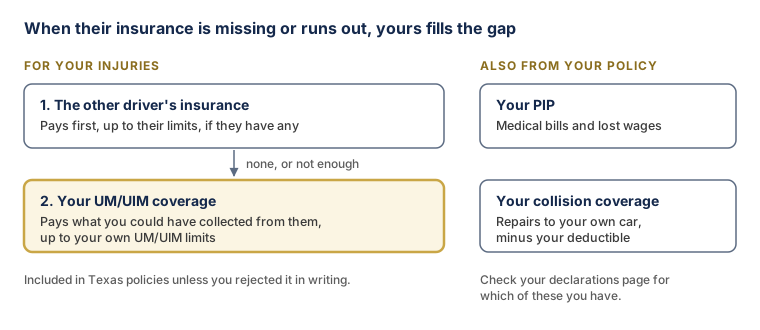
When the at-fault driver has no insurance, you usually look to your own coverage first. Here are the possible sources, and what each one generally covers.
| Source | What it can pay for | Good to know |
|---|---|---|
| Your uninsured/underinsured motorist (UM/UIM) coverage | Injuries, and property damage if your policy includes it, caused by an uninsured or underinsured driver | Included in Texas policies unless you rejected it in writing |
| Your Personal Injury Protection (PIP) | Medical bills and lost wages for you and your passengers | Included unless rejected in writing |
| Your collision coverage | Repairs to your own car | Optional; usually has a deductible |
| Your health insurance | Medical treatment | May seek repayment later from any settlement |
| The uninsured driver personally | Anything a court awards | Many uninsured drivers can't pay a judgment |
Sources: the Texas Department of Insurance auto insurance guide and Tex. Ins. Code § 1952.101.
How UM/UIM coverage works in Texas
Uninsured/underinsured motorist coverage protects you when the driver who caused the crash can't pay. In Texas, it's built into every auto liability policy unless you turned it down in writing.
It's included unless you rejected it
Under Texas Insurance Code § 1952.101, an insurer can't issue an auto liability policy in Texas without UM/UIM coverage, either in the policy or added to it. The coverage must be at least the state minimum limits, and it covers people who are legally entitled to recover from an uninsured or underinsured driver for injury, death or property damage.
The coverage doesn't apply if the named insured rejected it in writing. And a rejection generally carries over: if you turned it down once, your renewals with the same insurer (or an affiliate) won't include it unless you ask for it in writing.
That means some people discover after a crash that they signed a rejection form years ago, sometimes without realizing it. That's why the "check your policy today" section below matters.
What "legally entitled to recover" means
UM/UIM coverage pays what you could have collected from the at-fault driver if they'd had enough insurance. So you still have to show two things: the other driver was at fault, and your damages were real. Texas's usual fault rules apply. If you were partly to blame, your recovery is reduced, and if you were more than 50% at fault, you recover nothing (CPRC § 33.001).
Hit-and-run: the physical contact rule
Texas UM coverage can pay for a hit-and-run, but there's an important catch. When the at-fault driver is unknown, you can recover only if their vehicle made actual physical contact with you or your property (Tex. Ins. Code § 1952.104).
This rule matters most in "phantom vehicle" crashes: a car swerves into your lane, you jerk the wheel to avoid it, hit a guardrail, and the other car drives off without ever touching you. If the driver is never identified, UM coverage may not apply, even though they caused the crash. The rule exists to prevent fake claims, but it can be harsh in real ones.
What to do after a hit-and-run
- Call 911 immediately and report the hit-and-run. Give any part of the plate, the car's color, make and direction of travel.
- Photograph the point of impact. Paint transfer, dents and broken parts from the other car help prove there was physical contact.
- Keep any debris left by the other vehicle, like pieces of a bumper or mirror.
- Look for witnesses and cameras right away, before they're gone.
- Tell your insurer quickly. Your policy will require prompt notice.
If the driver is later found, the claim may be handled differently, so keep your insurer and the police updated.
When the other driver is underinsured
Being underinsured is just as common a problem as being uninsured, and often a bigger one after a serious crash. Texas only requires drivers to carry 30/60/25 liability coverage: $30,000 per injured person, $60,000 per crash for injuries, and $25,000 for property damage (TDI).
A short hospital stay and a few months of physical therapy can easily cost more than $30,000. When the at-fault driver's insurance runs out, the underinsured part of your UM/UIM coverage can pay the difference, up to your own policy limits.
A typical UIM claim goes like this:
- You make a claim against the at-fault driver's insurance.
- Their insurer offers its policy limits because your damages are higher.
- Before accepting, you notify your own insurer. Many policies have rules about settling with the other driver, so read yours or ask a lawyer first.
- You then make a UIM claim for the rest of your damages, up to your UIM limits.
Getting your car fixed
Car repairs are often the first worry after a crash with an uninsured driver, and the answer depends on what coverage you have.
- If you have collision coverage, your insurer can pay for repairs to your car, minus your deductible, no matter who was at fault. Your insurer may then try to recover what it paid from the uninsured driver.
- If your UM coverage includes property damage, it may pay for your car when an uninsured driver was at fault. Check your declarations page for the limits and any deductible, and ask your agent how it works alongside collision.
- If you have neither, your options are usually limited to asking the uninsured driver to pay or suing them, which can be slow and uncertain.
Either way, get a written repair estimate, keep photos of the damage, and save receipts for towing and a rental car. Ask your insurer before you authorize repairs, so there's no dispute later about the cost.
Can you sue the uninsured driver?
Yes. Being uninsured doesn't protect a driver from being sued, and you can file a claim against them personally for your injuries and property damage. The usual Texas deadline of two years from the crash applies (CPRC § 16.003).
The hard part is collecting. Many people drive uninsured because they can't afford insurance, which often means they can't pay a court judgment either. A judgment you can't collect costs time and money and may never pay you anything. That's why lawyers usually look first at the insurance that does exist, like your UM/UIM, PIP and collision coverage, and at any other party who may share the blame, such as the owner of the car or the driver's employer if they were working at the time.
Suing the driver can still make sense in some cases, for example if they own property or a business. A lawyer can help you decide whether it's worth it.
Your own insurer is now the other side
This surprises a lot of people: in a UM/UIM claim, your own insurance company stands in the shoes of the at-fault driver. It can dispute whether the other driver was at fault, argue you were partly to blame, and question how badly you were hurt, just as the other driver's insurer would.
Texas courts also have a special rule for these claims. In Brainard v. Trinity Universal Insurance Co. (2006), the Supreme Court of Texas held that a UIM insurer has no contractual duty to pay benefits until the insured gets a judgment establishing the other driver's liability and underinsured status (as described in Allstate v. Irwin). In practice, many UIM claims still settle without a trial. But when they don't, you may need to go to court to prove fault and damages before your insurer has to pay.
Texas lawmakers have debated changing parts of these rules, so the details can change. Ask a lawyer about the current law before you file a lawsuit over a UM/UIM claim.
A real Texas case: Allstate Insurance Co. v. Irwin
In 2021, the Supreme Court of Texas ruled that a driver could use a declaratory judgment lawsuit against his own insurer to prove his underinsured motorist claim, and recover attorney's fees. His insurer had offered him $500. A jury later found his damages were nearly $500,000.
What happened
On April 5, 2016, Daniel Irwin was injured in a crash with an underinsured driver. His Allstate policy on his truck included $50,000 in UIM coverage. Irwin settled with the other driver for her $30,000 policy limits, then asked Allstate for his $50,000 UIM limits. Allstate offered $500 (opinion via Justia).
The lawsuit
Irwin sued Allstate. He asked the court to determine his damages and declare that he was entitled to UIM benefits, and he asked for attorney's fees under the Texas Uniform Declaratory Judgments Act. A jury found his damages were $498,960.36. Allstate then paid its $50,000 policy limits and court costs, but fought the attorney's fees. The trial court awarded them, and the court of appeals agreed.
What the Supreme Court decided
On May 21, 2021, the Supreme Court of Texas affirmed. Justice Devine wrote for the majority, joined by Justices Lehrmann, Boyd, Blacklock and Busby. The Court held that a declaratory judgment was a proper way to establish the facts needed for UIM coverage, like the other driver's liability and underinsured status. Because Irwin had no breach-of-contract claim yet under the Brainard rule, attorney's fees were available under the declaratory judgment law, as long as they're equitable and just. Chief Justice Hecht dissented, joined by Justices Guzman, Bland and Huddle.
What this means for you
- A low first offer isn't the final word. Irwin's insurer offered $500 on a claim a jury valued at nearly $500,000.
- Your policy limits cap what you get. Even with damages near $500,000, Irwin's UIM payment was limited to his $50,000 coverage. Higher UM/UIM limits matter.
- The legal rules are technical. How you bring a UIM claim, and whether fees are recoverable, depends on Texas case law and any later changes by the Legislature. This is a good reason to talk to a lawyer when you're hurt.
Check your policy today
The best time to deal with uninsured drivers is before you're hit by one. Take five minutes with your policy's declarations page, or call your agent, and check:
- Do you have UM/UIM coverage, or did you sign a rejection?
- What are your UM/UIM limits? The state minimum may not go far after a serious injury.
- Does your UM coverage include property damage, and what's the deductible?
- Do you have PIP, or did you reject it in writing?
- Do you have collision coverage for your own car?
If you rejected UM/UIM or PIP in the past, you can ask your insurer in writing to add it back.
What happens to the uninsured driver?
Driving without insurance is a crime in Texas. A first offense is a misdemeanor with a fine of $175 to $350; a repeat offense brings a fine of $350 to $1,000 (Tex. Transp. Code § 601.191). Texas also runs TexasSure, a statewide database that helps identify vehicle owners without required insurance. But a fine paid to the state doesn't pay your medical bills, which is why your own coverage matters.
When to call a lawyer
If the crash only damaged your car and you have collision or UM property damage coverage, you can often handle it with your insurer. Talk to a licensed Texas personal injury lawyer if:
- You or a passenger were hurt and needed medical treatment
- It was a hit-and-run with no physical contact, or the driver hasn't been found
- Your insurer disputes fault, says you rejected UM/UIM coverage, or makes a low offer
- The at-fault driver's insurer offers its policy limits and you need to bring a UIM claim
State Bar of Texas Lawyer Referral and Information Service: (800) 252-9690, Monday to Friday, 8:30 a.m. to 4:30 p.m., or texasbar.com/LawyerReferral. See our Find a Lawyer page for questions to ask.
Checklist: hit by an uninsured driver
- Call 911 and get a police report, even for a smaller crash
- Photograph the other driver's license, plate and car
- Write down exactly what the driver said about insurance
- Get witness names and look for cameras
- Don't accept cash or promises to pay later
- See a doctor within 24 hours
- Notify your own insurer and ask about UM/UIM, PIP and collision
- Hit-and-run? Photograph paint transfer and keep any debris
- Talk to a lawyer if you were hurt
Frequently asked questions
What happens if I'm hit by an uninsured driver in Texas?
You can still be paid through your own policy if you have uninsured/underinsured motorist (UM/UIM) coverage, Personal Injury Protection (PIP) or collision coverage. You can also sue the uninsured driver, but many uninsured drivers don't have money to pay a judgment.
Is uninsured motorist coverage required in Texas?
Texas insurers must include UM/UIM coverage in every auto liability policy unless the named insured rejects it in writing. A rejection generally carries over to renewals with the same insurer unless you ask for the coverage in writing.
Does uninsured motorist coverage pay for a hit-and-run in Texas?
It can. When the at-fault driver is unknown, Texas law requires that their vehicle made actual physical contact with you or your property for the UM coverage to apply.
What is underinsured motorist coverage?
It pays when the at-fault driver has insurance, but not enough to cover your damages. Texas only requires 30/60/25 liability coverage, which can run out quickly after a serious injury.
What is the fine for driving without insurance in Texas?
A first offense is a misdemeanor with a fine of $175 to $350. A repeat offense carries a fine of $350 to $1,000.
Do I need a lawyer for an uninsured motorist claim?
For minor property damage, often not. If you were hurt, a lawyer can help, because in a UM/UIM claim your own insurance company is on the other side and Texas has special rules for how these claims must be proved.
Sources
- Tex. Ins. Code § 1952.101: UM/UIM coverage required unless rejected in writing
- Tex. Ins. Code § 1952.104: actual physical contact rule for unknown drivers
- Texas Department of Insurance: Auto insurance guide: minimum coverage, PIP, UM/UIM
- Tex. Transp. Code § 601.191: penalties for driving without insurance
- Tex. Transp. Code § 550.023: information drivers must exchange
- Tex. Civ. Prac. & Rem. Code § 33.001: proportionate responsibility
- TxDMV: TexasSure insurance verification
- Allstate Insurance Co. v. Irwin, No. 19-0885 (Tex. May 21, 2021), which also describes Brainard v. Trinity Universal Insurance Co. (Tex. 2006)
- Texas Civil Justice League: proposed 2023 legislation on the Brainard rule
- State Bar of Texas Lawyer Referral and Information Service (TexasLawHelp.org)
Keep reading
 Car Accidents · Texas
Rear-End Collisions and Whiplash in Texas: Who Is at Fault and What Your Claim Is Worth
Rear-end crashes are among the most common in Texas, and whiplash is the injury insurers doubt most. Here's how fault works, what can change it, and how to prove a neck or back injury.
 Car Accidents · Texas
Brain Injury After a Car Accident in Texas: Symptoms, Proving Your Claim and Compensation
A brain injury can hide behind a normal CT scan and a 'you're fine' at the scene. Here's how to spot the warning signs after a Texas crash, prove the injury and protect your claim.
 Car Accidents · Texas
Hit by a City Bus, Police Car or Government Vehicle in Texas? Your Rights Under the Tort Claims Act
Crashes with city buses, police cars, garbage trucks and other public vehicles follow special rules in Texas. Miss a notice deadline that can be as short as 90 days and your claim may be gone.