Pedestrian & Bike · Texas
Hit by a Car While Walking or Biking in Texas? Your Rights and Who Pays
768 pedestrians and 78 cyclists died on Texas roads in 2024. If a driver hit you, here's who had the right of way, which insurance pays, and what a 2024 Texas Supreme Court case says about who else can be blamed.

The short answer: if a driver hit you while you were walking or riding a bike in Texas, you can usually claim your medical bills, lost income and pain and suffering from the driver's insurance. Drivers must stop and yield to pedestrians in crosswalks, and cyclists have the same rights on the road as drivers. Even if you were partly at fault, like crossing mid-block, you can still recover as long as you're found 50% or less responsible. Your own auto policy may help pay your bills too, even though you weren't in a car.
When a car hits a person on foot or on a bicycle, there's no bumper, no airbag and no seat belt. A low-speed collision that would barely dent two cars can break bones, cause a brain injury or kill. And afterward, the injured person is often the one being blamed: "She stepped out without looking." "He came out of nowhere on that bike."
Texas law gives pedestrians and cyclists real protection, but it also sets rules they're expected to follow. This guide explains who has the right of way, how fault is divided when both sides made mistakes, which insurance pays your bills, a 2024 Texas Supreme Court case about a nurse killed crossing to a hospital parking lot, and what to do right after a crash.
- How common these crashes are in Texas
- What to do right after being hit
- Pedestrian right-of-way rules
- Bicycle rules in Texas
- If you were partly at fault
- Which insurance pays your bills
- Who else might be responsible
- A real Texas case: HNMC v. Chan (2024)
- If the driver left the scene
- What you can recover
- Deadlines
- When to call a lawyer
- Checklist and FAQ
How common these crashes are in Texas
In 2024, Texas recorded 6,077 crashes involving pedestrians and 2,748 involving cyclists. Those crashes killed 768 pedestrians and 78 cyclists, and left another 1,452 pedestrians and 428 cyclists with suspected serious injuries, according to the Texas Department of Transportation (TxDOT crash records).
Put another way, a pedestrian died on a Texas road about every 11 hours in 2024.
What to do right after being hit
1. Get out of the road and call 911
If you can move, get to the curb or shoulder. Call 911, or ask someone to call for you. You want police to come and write a crash report, and you want medical help. Don't let the driver talk you into "handling it without the police."
2. Get medical care, even if you feel OK
Head injuries, internal injuries and fractures don't always hurt right away. Let paramedics check you, and see a doctor the same day if you don't go to the hospital. Tell the doctor exactly how you were hit and where your body struck the car or the ground.
3. Get the driver's information
Get the driver's name, phone number, driver's license, insurance company and policy number, and license plate. Take a photo of the insurance card and plate if you can. If the driver was working, like a delivery driver or someone in a company vehicle, write down the company name.
4. Photograph the scene
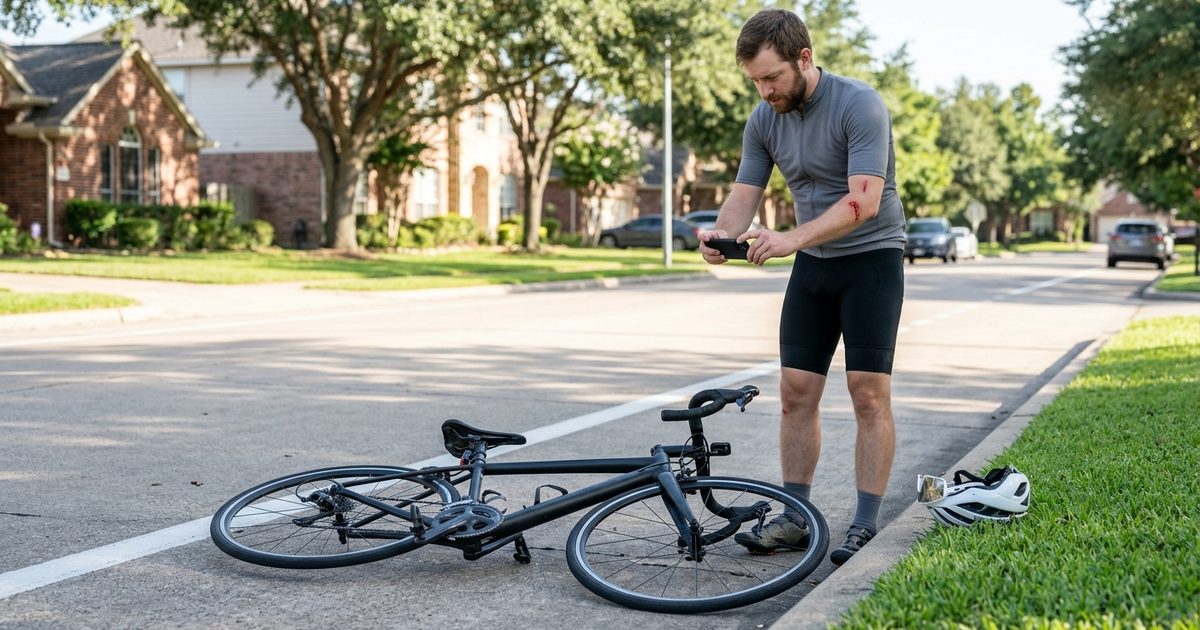
- The car, especially any damage to the hood, windshield or bumper where you were hit
- The crosswalk, signals, signs, lighting and where you ended up
- Your bike, helmet, bag and anything that was damaged
- Your injuries, the same day and in the weeks that follow
5. Find witnesses and video
Pedestrian and bike crashes often come down to who had the light or where you were when you were hit. Witnesses matter. Get names and phone numbers. Look for cameras on nearby businesses, doorbells, buses and traffic signals, and ask other drivers about dashcams. Footage is often recorded over within days.
6. Be careful what you say
Don't apologize or say "I didn't see the car." Stick to facts. If the driver's insurance company calls, you don't have to give a recorded statement. You can say you'll respond in writing or through a lawyer.
Pedestrian right-of-way rules
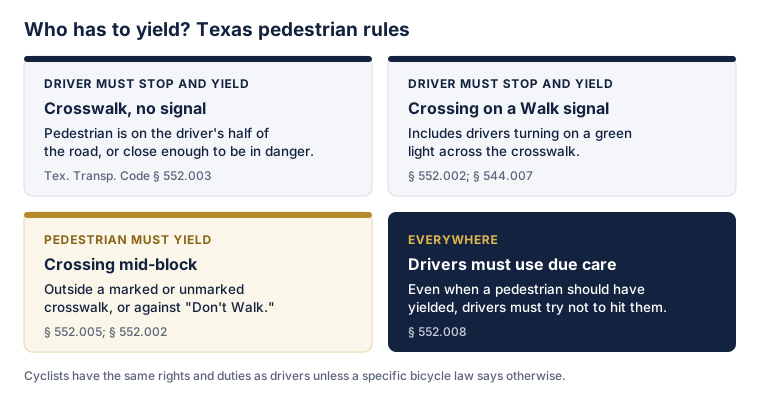
Texas doesn't give pedestrians the right of way everywhere. Who had to yield depends on where you were crossing and what the signals said. These rules are in Chapter 552 of the Texas Transportation Code (full text).
In a crosswalk with no signal
Where no traffic signal is working, a driver must stop and yield to a pedestrian in a crosswalk who is on the driver's half of the road, or who is approaching from the other half closely enough to be in danger (§ 552.003). A driver also may not pass another vehicle that has stopped for a pedestrian at a crosswalk. That's a common way pedestrians are hit: one car stops, and the car in the next lane doesn't.
There's a duty on the pedestrian too. You may not suddenly leave the curb and walk or run into the path of a car that's too close to stop.
A crosswalk doesn't need paint. At most intersections, the area where the sidewalks would connect across the street counts as an unmarked crosswalk.
At a signal
If you're crossing on a "Walk" signal, drivers must stop and yield to you (§ 552.002). Drivers turning on a green light must also stop and yield to pedestrians lawfully in the intersection or the crosswalk. Texas strengthened these "stop and yield" rules in 2021 (S.B. 1055). If the signal says "Don't Walk," you may not start crossing. If it changes while you're already crossing, keep going to the other side or a safety island.
Crossing mid-block
If you cross somewhere other than a marked or unmarked crosswalk, you must yield to vehicles (§ 552.005). Between two intersections that both have working traffic signals, you may cross only in a marked crosswalk.
Walking along the road
If there's a usable sidewalk, you must use it. If there isn't, walk on the left side of the road or shoulder, facing oncoming traffic, when that's safe (§ 552.006). Drivers pulling out of a driveway, alley or parking lot must yield to pedestrians on the sidewalk.
Drivers must always use due care
Even when a pedestrian should have yielded, drivers must still use due care to avoid hitting them, sound the horn when necessary, and take extra care around children and people who are obviously confused or impaired (§ 552.008). Not having the right of way doesn't mean a driver can hit you.
Crosswalk crashes can be a crime
Since September 1, 2021, a driver who causes bodily injury to a pedestrian or cyclist in a crosswalk through criminal negligence commits a Class A misdemeanor. If the injury is serious, it's a state jail felony (Tex. Transp. Code § 545.428, added by S.B. 1055). A criminal case is separate from your injury claim, but a conviction or police findings can support it.
Bicycle rules in Texas
A person riding a bicycle generally has the same rights and duties as the driver of a car, unless a specific bicycle law says otherwise (TxDOT). That means you can use the road, and drivers have to treat you like any other vehicle. It also means you have to follow signals, stop signs and lane rules.
Where you can ride
If you're riding slower than the other traffic, you generally should ride as near as practicable to the right edge of the road. But you can move left when:
- you're passing another vehicle going the same direction
- you're preparing to turn left
- you need to avoid hazards like debris, parked cars or potholes
- the lane is less than 14 feet wide with no bike lane, too narrow for a car and a bike to share safely side by side
On a one-way street, you can ride near the left edge. You can ride two abreast as long as you don't impede traffic. No state law bans riding on sidewalks, but some cities do, so check local rules.
Lights at night
At night, your bike needs a white headlight visible from at least 500 feet and a red rear reflector or red taillight. Riding without lights at night gives the insurer an easy argument that the driver couldn't see you.
There's no statewide 3-foot law
Many states require drivers to give cyclists at least three feet when passing. Texas doesn't have a statewide rule. A safe passing bill, S.B. 488, passed the Legislature in 2009 but was vetoed (Austin Chronicle). Some Texas cities have their own safe passing ordinances. Everywhere, drivers must still pass at a safe distance, and a driver who clips a cyclist while passing has usually been careless.
Helmets
Texas has no statewide bicycle helmet law for adults, though some cities have rules for children. As with motorcycles, the insurer may argue that not wearing a helmet made a head injury worse. Our motorcycle accident guide explains how that argument works under the Texas Supreme Court's Nabors v. Romero decision.
If you were partly at fault
Insurance companies often argue that the pedestrian or cyclist caused the crash. Texas uses proportionate responsibility (Tex. Civ. Prac. & Rem. Code § 33.001):
- If you're found 50% or less responsible, you can recover, but your damages are reduced by your percentage.
- If you're found more than 50% responsible, you recover nothing.
Example: you cross mid-block at dusk, and a driver who was looking at a phone hits you. Your damages are $150,000. A jury might find the driver 75% responsible and you 25% responsible for crossing outside a crosswalk. You'd recover $112,500.
So crossing mid-block, riding without a light, or running a stop sign on a bike doesn't automatically end your claim. It gives the insurer a reason to push your percentage up. Evidence like video, the point of impact on the car, skid marks and lighting conditions can decide where that line falls.
Which insurance pays your bills
This surprises a lot of people: you may have coverage even though you weren't driving.
The driver's liability insurance
The main source of payment is usually the liability insurance of the driver who hit you. Texas requires at least $30,000 per person for injuries. For a serious pedestrian injury, that minimum can run out fast.
Your own auto policy
If you or someone in your household has a car insurance policy, check it:
- Medical payments coverage: the Texas Department of Insurance says this coverage pays if you're hurt "while walking or biking" (TDI auto insurance guide).
- Personal injury protection (PIP): every Texas auto policy includes PIP unless it was rejected in writing. Many policies extend PIP to you when you're struck as a pedestrian. Read your policy's PIP section.
- Uninsured/underinsured motorist coverage: if the driver had no insurance, too little, or drove off, this coverage may pay. Our uninsured driver guide explains how it works.
Report the crash to your own insurer promptly, even if you think the driver's insurance will pay. Late notice can cause problems with your own claims.
Health insurance
Use your health insurance for treatment. It may ask to be repaid from your settlement later, which is normal, but it keeps you getting care while the claim is pending.
Who else might be responsible
The driver isn't always the only one. Depending on what happened, a claim might also involve:
- The driver's employer, if the driver was working, like a delivery or rideshare driver, or a company truck
- A bar or restaurant that kept serving a driver who was obviously drunk
- A government agency responsible for a dangerous road, a broken signal or a missing sidewalk, though these claims have special notice rules and limits
- A vehicle or bike manufacturer, if a defect played a part
What about nearby property owners, like a business whose customers cross a busy street to reach its parking lot? The Texas Supreme Court answered that question in 2024.
A real Texas case: HNMC v. Chan (2024)
On January 19, 2024, the Supreme Court of Texas decided HNMC, Inc. v. Chan, No. 22-0053, about a nurse killed while crossing the street from her hospital to its parking lot (opinion).
What happened
A hospital in northwest Houston sat on one side of Cali Drive, a county road, and its fenced parking lot sat on the other. Many people crossed mid-block between them instead of walking to the crosswalks at the ends of the block. An old mid-block crosswalk had been abandoned by the county, and its markings had faded. There had been several pedestrian accidents on the street between 2008 and 2012, and the hospital had asked the county for safety improvements.
In 2015, Leny Chan, a nurse who had worked at the hospital for more than 30 years, was crossing mid-block toward the parking lot driveway when a driver leaving the lot turned left and hit her. She died.
The trial
Her family sued the driver and his employer, and later the hospital. The jury found everyone negligent and divided responsibility this way: the driver 40%, Harris County 30%, the hospital 20% and Ms. Chan 10%. The family settled with the driver and his employer, and the case against the hospital went up on appeal.
What the Supreme Court decided
The Court ruled for the hospital and rendered a judgment that the family take nothing from it. It started from a general rule: a property owner usually has no duty to keep people safe once they leave its property and are hurt on an adjacent public road. The Court recognized that an owner can have a limited duty for areas of the public right-of-way it actually controls. Here, the hospital had built a concrete pad, a driveway and signs in the right-of-way. But the Court found no evidence that any of those caused the crash. The faded crosswalk was the county's, not the hospital's, and the signs didn't block the driver's view. It also said a careless driver is an open and obvious danger, not a hidden one.
What this means for you
- The driver is the main target. In Chan, the driver and his employer were the parties who settled. If the driver was working, the employer's insurance may be available.
- Crossing mid-block didn't bar recovery. The jury put only 10% of the blame on Ms. Chan, well below the 51% that would have barred her family's claims.
- Businesses near the road usually aren't liable. Unless a property owner controlled the area where you were hurt and created a dangerous condition there, a claim against it is hard to win.
- Road design claims go against the government. If a missing crosswalk or a bad signal played a part, that's usually a claim against a city, county or the state, with short notice deadlines.
If the driver left the scene
A driver involved in a crash that injures someone must stop, give their information and render reasonable help. Leaving is a crime. If the driver fled:
- Call 911 and report it as a hit-and-run right away
- Write down everything you remember about the car: color, make, partial plate, damage
- Ask witnesses and nearby businesses about video
- File a claim under your own uninsured motorist coverage, if you have it, and check for medical payments or PIP coverage
What you can recover
If the driver was at fault, you can claim:
- Medical expenses, past and future, including surgery, rehab and therapy
- Lost wages and reduced ability to earn in the future
- Pain and suffering and mental anguish
- Physical impairment and disfigurement, like scarring or a permanent limp
- Property damage: your bike, phone, glasses, clothing and gear
If a loved one was killed, the family may have a wrongful death claim.
Deadlines
You generally have two years from the date of the crash to file a lawsuit in Texas. If a government vehicle hit you, or a road defect played a part, written notice may be due within six months, and some cities, like Houston, require it within 90 days. Insurance negotiations don't stop the clock. See our guide to Texas injury claim deadlines for every deadline and how to count it.
When to call a lawyer
Talk to a licensed Texas injury lawyer if:
- You were seriously hurt, or a loved one died
- The insurer says you were jaywalking, riding unsafely or "came out of nowhere"
- The driver fled, or had little or no insurance
- The driver was working, or a company, bar or government agency may share the blame
- You're being asked to sign a release or give a recorded statement
Most injury lawyers offer a free first consultation and work on a contingency fee. For a referral, contact the State Bar of Texas Lawyer Referral and Information Service at (800) 252-9690, Monday to Friday, 8:30 a.m. to 4:30 p.m., or texasbar.com/LawyerReferral. Our Find a Lawyer page has questions to ask before you hire someone.
Checklist: hit by a car while walking or biking
- Get out of the road and call 911 so police write a report
- Get checked by paramedics or a doctor the same day
- Get the driver's license, insurance, plate and employer if working
- Photograph the car, the crosswalk, signals, lighting and your injuries
- Keep your damaged bike, helmet and clothing
- Get witness names and look for doorbell, business and dashcam video
- Report the crash to your own auto insurer and check medical payments, PIP and UM coverage
- Don't give a recorded statement to the driver's insurer
- If a government vehicle or road defect was involved, find the notice deadline this week
- Mark the two-year lawsuit deadline on your calendar
Frequently asked questions
Do pedestrians always have the right of way in Texas?
No. Drivers must stop and yield to pedestrians in a crosswalk, and to pedestrians crossing on a Walk signal. But a pedestrian crossing outside a crosswalk must yield to vehicles. Even then, drivers must still use due care to avoid hitting a pedestrian.
Can I get compensation if I was jaywalking when I was hit?
Often, yes. Texas divides responsibility by percentage. If you're found 50% or less responsible, you can recover, reduced by your share. If you're found more than 50% responsible, you recover nothing.
Whose insurance pays if a car hits me while I'm walking or biking?
Usually the driver's liability insurance pays for your injuries. Your own auto policy may also help even though you weren't in a car: Texas Department of Insurance guidance says medical payments coverage pays if you're hurt while walking or biking, and many policies extend personal injury protection and uninsured motorist coverage to you as a pedestrian or cyclist.
Do cyclists have to ride on the far right in Texas?
A cyclist moving slower than traffic generally must ride as near as practicable to the right curb or edge, but there are exceptions, including when passing, preparing to turn left, avoiding hazards, or when the lane is too narrow to share safely. Cyclists have the same rights and duties as drivers unless a specific law says otherwise.
Is there a 3-foot passing law for cyclists in Texas?
Texas has no statewide three-foot passing law. A safe passing bill passed in 2009 but was vetoed. Some Texas cities have their own safe passing ordinances, and drivers everywhere must still pass at a safe distance.
How long do I have to sue after being hit by a car in Texas?
Generally two years from the date of the crash. If a government vehicle was involved, written notice may be due within six months, or even 90 days in some cities.
Sources
- TxDOT: Pedestrian and Pedalcyclist Related Injuries and Crashes, 2024
- Tex. Transp. Code Chapter 552: pedestrian rights and duties
- S.B. 1055 (2021) bill analysis: stop and yield; § 545.428 offense
- TxDOT: Bicycle laws and regulations FAQ
- Tex. Transp. Code Chapter 551: bicycle rules
- Austin Chronicle: Perry and the demise of safe passage (2009)
- Tex. Civ. Prac. & Rem. Code § 33.001: proportionate responsibility
- Texas Department of Insurance: Auto insurance guide
- HNMC, Inc. v. Chan, No. 22-0053 (Tex. Jan. 19, 2024)
- State Bar of Texas Lawyer Referral and Information Service (TexasLawHelp.org)
Keep reading
 Divorce & Family · Texas
Child Custody and Child Support in a Texas Divorce: What Parents Should Know
Texas calls custody 'conservatorship' and visitation 'possession and access.' Here's how judges decide, what the standard schedule looks like, how child support is calculated, and how orders can change.
 Divorce & Family · Texas
How Property Is Divided in a Texas Divorce: Community Property Explained
Texas is a community property state, but that doesn't always mean a 50/50 split. Here's how courts decide who keeps the house, the retirement accounts and the debts, and how to protect what's yours.
 Divorce & Family · Texas
How to File for Divorce in Texas: Steps, Costs and the 60-Day Waiting Period
Thinking about divorce in Texas? Here's the whole process in plain English: who can file and where, what it costs, why you have to wait 60 days, and how agreed and contested divorces end.