Truck Accidents · Florida
Truck Accidents in Florida: Who Is Liable, Insurance Limits and Your Rights
A crash with an 18-wheeler is different from a car crash, especially in Florida, where most car drivers carry little insurance. Here's who can be responsible, how much coverage trucks must carry, and how to protect your claim.

The short answer: after a truck crash in Florida, your own PIP pays first, so get medical care within 14 days. Beyond that, the trucking company and others, like the truck's owner, a cargo loader or a maintenance shop, can be liable. Trucks must carry far more insurance than cars, often $750,000 or more. You generally have two years to sue, and you recover nothing if you're found more than 50% at fault.
Florida's interstates carry an enormous amount of freight. I-95, I-75, I-4 and I-10 move goods to ports, distribution centers and tourist hubs, and the state's growth keeps adding trucks to roads already crowded with commuters and visitors. When an 80,000-pound tractor-trailer collides with a passenger car, the injuries are usually far more serious than in a car-on-car crash.
Truck cases are also legally different. Several companies may share responsibility, federal safety rules come into play, and key evidence sits in the truck's computers and the company's files. This guide explains who can be liable in Florida, how much insurance trucks must carry, how PIP and the 51% fault rule apply, a Florida jury verdict against two trucking companies, and the steps to take right away. For the basics of any crash in the state, see our Florida car accident guide.
- Why truck crashes are different
- Common causes of truck crashes
- What to do after a truck crash
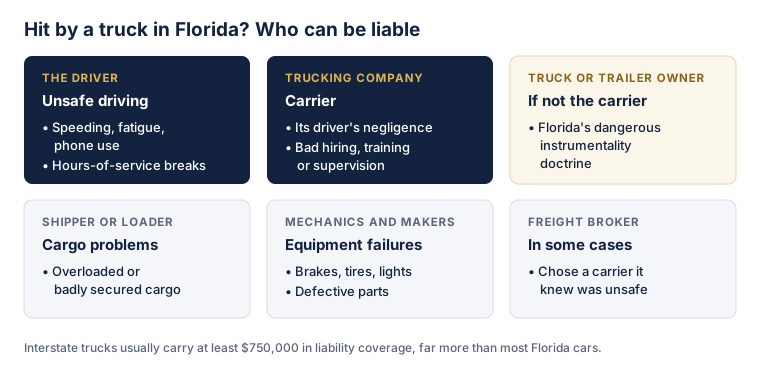
- Who can be liable
- The federal trucking rules that matter
- How much insurance trucks carry
- How PIP and Florida's thresholds apply
- A real Florida case: the Dzion verdict
- The 51% fault rule in truck cases
- Evidence to save, fast
- Deadlines and when to call a lawyer
- Checklist and FAQ
Why truck crashes are different
- Size and weight. A loaded tractor-trailer can weigh 20 to 30 times as much as a car and needs far more distance to stop.
- More defendants. The driver, the motor carrier, the truck and trailer owners, the shipper, loaders, mechanics and brokers can all be involved.
- Federal rules. Interstate trucking is regulated by the Federal Motor Carrier Safety Administration (FMCSA), with rules on driving hours, driver qualifications, maintenance and drug testing.
- More insurance, and more resistance. Trucks carry larger policies, and trucking insurers often send rapid-response teams to the scene to start building a defense within hours.
Common causes of truck crashes
- Driver fatigue and violations of hours-of-service limits
- Speeding, especially into slowed or stopped traffic
- Distraction from phones and dispatch devices
- Following too closely, given the truck's stopping distance
- Wide right turns and unsafe lane changes in blind spots
- Brake, tire and lighting failures from poor maintenance
- Overloaded or badly secured cargo
- Inexperienced or unqualified drivers
- Florida's sudden downpours and wet roads, which make stopping harder still
What to do after a truck crash
1. Call 911 and get medical care
Truck crashes require a police report, and serious injuries are common. Let paramedics check you, and get care within 14 days so your PIP medical benefits stay available.
2. Photograph the truck and the scene
- The truck's company name, USDOT number on the cab door, and trailer number
- The license plates of the tractor and the trailer, which may be different
- Damage to every vehicle, skid marks, debris and where the vehicles stopped
- Any spilled or shifted cargo
3. Get witness information
Other drivers often see things the truck driver won't admit, like speeding, drifting across lanes or phone use. Get their names and numbers.
4. Don't talk to the trucking company's insurer
Their adjusters may call within hours. You don't have to give a recorded statement. Refer them to your lawyer, or stick to basic facts. See our guide to talking to insurance adjusters.
5. Talk to a lawyer quickly
Key evidence can disappear in days or weeks. A lawyer can demand that the carrier preserve it.
Who can be liable
- The truck driver, for negligent driving.
- The trucking company (motor carrier), which is generally responsible for its driver's negligence on the job, and can also be directly liable for negligent hiring, training or supervision, or for pushing drivers to break hours rules.
- The owner of the truck or trailer. Under Florida's dangerous instrumentality doctrine, a vehicle's owner can be liable when it lets someone else operate the vehicle and that person causes a crash. A federal law, the Graves Amendment, generally protects rental and leasing companies that aren't negligent themselves.
- The shipper or loader, if cargo was overloaded or badly secured.
- Maintenance companies and parts manufacturers, for brake, tire or other failures.
- Freight brokers, in some cases. In Montgomery v. Caribe Transport II, LLC (May 14, 2026), the U.S. Supreme Court unanimously held that federal law doesn't block state-law negligent hiring claims against freight brokers that choose unsafe carriers, so those claims can go forward (JD Supra summary).
The federal trucking rules that matter
- Hours of service: property-carrying drivers are generally limited to 11 hours of driving after 10 consecutive hours off duty, within a 14-hour window, with required breaks and weekly limits.
- Electronic logging devices (ELDs): most interstate trucks must record driving time electronically.
- Driver qualifications: commercial driver's licenses, medical certificates, and a driver qualification file kept by the carrier.
- Drug and alcohol testing after certain crashes.
- Inspection and maintenance requirements, including annual inspections.
Violations don't automatically prove a case, but they're often strong evidence of negligence. You can look up a carrier's safety record, inspections and crashes using its USDOT number on the FMCSA's public website.
How much insurance trucks carry
Florida requires most car drivers to carry only PIP and property damage coverage, with no bodily injury liability, so a car that hits you may have little coverage for your injuries. Trucks are different:
| Truck | Minimum liability coverage |
|---|---|
| Florida intrastate, 26,000 to under 35,000 lbs | $50,000 per occurrence |
| Florida intrastate, 35,000 to under 44,000 lbs | $100,000 per occurrence |
| Florida intrastate, 44,000 lbs or more | $300,000 per occurrence |
| Interstate general freight (federal minimum) | $750,000 |
The Florida amounts come from Fla. Stat. § 627.7415, which also requires trucks subject to federal rules to carry the federal minimums instead (§ 627.7415). Many carriers carry $1 million or more, plus excess policies, and hazardous materials carriers must carry more.
How PIP and Florida's thresholds apply
Florida's no-fault rules still apply when a truck hits a car:
- Your PIP pays first, up to $10,000, covering 80% of medical bills and 60% of lost income, if you get care within 14 days. See our guide to Florida no-fault and PIP.
- To recover pain and suffering from the at-fault side, your injury must meet the serious injury threshold: a permanent injury within a reasonable degree of medical probability, significant and permanent scarring or disfigurement, significant and permanent loss of an important bodily function, or death (§ 627.737). Truck crashes cause these injuries more often than ordinary crashes do.
- Economic losses PIP doesn't cover, like the rest of your medical bills and lost wages, can be claimed from the trucking company.
A real Florida case: the Dzion verdict
A 2021 Florida jury verdict shows how a trucking company's choices, not just one driver's mistake, can drive a case (Transport Topics; Heavy Duty Trucking).
What happened
On the night of September 4, 2017, on I-95 near the State Road 200 interchange north of Jacksonville, a box truck driven by Russel Rogatenko crashed and flipped, blocking the highway and backing up traffic. Rogatenko didn't have a commercial driver's license, was distracted by his phone, was over his legal hours, and had a long record of prior moving violations. About an hour and a half later, a tractor-trailer driven by Yadwinder Sangha, who had been driving for about 25 hours on a trip from Montreal to Miami, slammed into the stopped traffic at about 70 mph on cruise control. He didn't brake until about a second before impact. The truck struck the car of Connor Dzion, an 18-year-old college student, and killed him.
The verdict
Connor's parents, Mellissa and David Dzion, sued both trucking companies. On August 20, 2021, a Nassau County jury awarded about $100 million in wrongful death damages against AJD Business Services and Kahkashan Carrier, and $900 million in punitive damages against AJD, which was accused of being grossly negligent in hiring and employing Rogatenko.
What this means for you
- Hiring and supervision matter. A carrier that puts an unqualified or dangerous driver on the road can be held directly responsible.
- Hours-of-service evidence is powerful. Logs and trip records can show a fatigued driver who should never have been behind the wheel.
- Verdicts and collections are different. A huge verdict doesn't guarantee payment. Recovery usually depends on the companies' insurance and assets, and in this case one insurer later went to court over how much it owed.
- More than one company can be responsible for the same crash.
The 51% fault rule in truck cases
Trucking companies often argue that the car driver cut in front of the truck, stopped suddenly, or lingered in a blind spot. Under Florida's modified comparative negligence rule, your recovery is reduced by your share of fault, and you recover nothing if you're found more than 50% at fault (§ 768.81(6)). Truck data, dash cameras and witnesses are often the best answer to these arguments.
Evidence to save, fast
A lawyer should send the carrier a preservation letter as soon as possible, demanding that it keep:
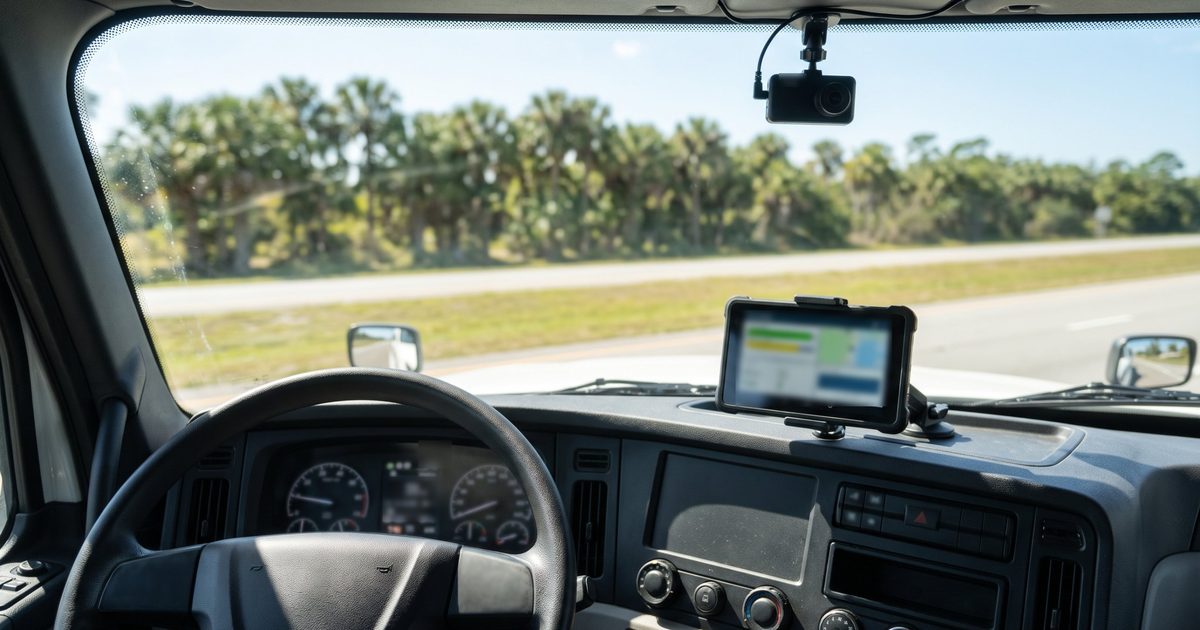
- Electronic logging device data and engine control module ("black box") data, including speed and braking
- Dash camera and driver-facing camera video
- The driver's hours-of-service records, trip records, fuel and toll receipts
- The driver qualification file, training records and prior violations
- Post-crash drug and alcohol test results
- Maintenance and inspection records for the truck and trailer
- Dispatch communications and the cargo's bill of lading
Deadlines
- 14 days: get initial medical care to keep PIP medical benefits
- Two years: file a negligence lawsuit for crashes after March 24, 2023 (§ 95.11)
- Two years: wrongful death claims
- Days to weeks: the practical window to preserve truck data before it may be overwritten
When to call a lawyer
Truck cases are among the most complex injury cases. Talk to a licensed Florida lawyer if a commercial truck was involved and you were hurt, especially if:
- You or a family member suffered serious injuries, or someone died
- The trucking company or its insurer is blaming you
- More than one company was involved
- You suspect fatigue, speeding, phone use or poor maintenance
For a referral, contact The Florida Bar Lawyer Referral Service at (800) 342-8011, Monday to Friday, 8:00 a.m. to 5:30 p.m., or online at floridabar.org/public/lrs. Our Find a Lawyer page has questions to ask.
Checklist: after a truck crash in Florida
- Call 911 and get medical care within 14 days
- Photograph the truck's company name, USDOT number and both plates
- Photograph the scene, damage and any cargo
- Get witness names and numbers
- Open a PIP claim with your own insurer
- Don't give the trucking company's insurer a recorded statement
- Have a lawyer send a preservation letter quickly
- Keep medical records, bills and a record of missed work
- Mark the two-year deadline
Frequently asked questions
Who is liable for a truck accident in Florida?
Depending on the facts, the truck driver, the trucking company, the owner of the truck or trailer, the company that loaded the cargo, a maintenance shop, a parts manufacturer, and in some cases a freight broker can all share responsibility. Florida's dangerous instrumentality doctrine can also make a vehicle's owner liable for the negligence of a driver it allowed to use the vehicle.
How much insurance does a truck have to carry in Florida?
Florida requires commercial motor vehicles that stay within the state to carry minimum combined liability coverage of $50,000 to $300,000 per occurrence depending on weight. Trucks hauling freight across state lines must meet federal minimums, which start at $750,000 for most general freight and are higher for hazardous materials.
Does PIP apply if a truck hits me in Florida?
Yes. Your own personal injury protection pays first, regardless of fault, and you must get medical care within 14 days to use it. Because truck crashes usually cause serious injuries, many victims also meet Florida's serious injury threshold and can bring a claim against the trucking company for pain and suffering and other losses.
How long do I have to sue after a truck accident in Florida?
For negligence claims arising after March 24, 2023, Florida generally allows two years from the crash to file a lawsuit. Wrongful death claims also generally must be filed within two years of the death.
What evidence matters most after a truck crash?
The truck's electronic logging device and engine data, the driver's hours-of-service records, drug and alcohol test results, maintenance records, dash camera video and the driver's qualification file. Some of this can be overwritten or discarded quickly, so a lawyer should send a preservation letter right away.
Sources
- Fla. Stat. § 627.7415: commercial motor vehicle insurance requirements
- Fla. Stat. § 627.737: serious injury threshold
- Fla. Stat. § 768.81: comparative fault
- Fla. Stat. § 95.11: limitations periods
- Transport Topics: jury issues $1 billion verdict against two carriers in fatal crash
- Heavy Duty Trucking: 5 takeaways from a billion-dollar verdict
- JD Supra: Montgomery v. Caribe Transport II (U.S. 2026)
- The Florida Bar: Lawyer Referral Service FAQ
Keep reading
 Truck Accidents · Texas
Jackknife and Underride Truck Crashes in Texas: Why They Happen and Who Is Liable
When an 18-wheeler jackknifes across a highway, or a car slides under a trailer, the results are often fatal. Here's why these crashes happen, which federal rules apply, and how Texas courts decide who pays.
 Truck Accidents · Texas
Hit by an 18-Wheeler in Texas? Who's Responsible and What to Do Next
A crash with a semi-truck isn't just a bigger car accident. More people can be responsible, federal safety rules come into play, and key evidence can vanish within months. Here's how it works in Texas.
 Claim Basics · Florida
Florida No-Fault Insurance Explained: PIP, the $10,000 Limit and When You Can Sue
In Florida, your own insurance pays first after a crash, no matter who caused it. Here's what personal injury protection covers, what it doesn't, and when you can step outside no-fault and sue.