Car Accidents · Texas
Hit by a Drunk Driver in Texas? How to Get Compensated, Including From the Bar That Served Them
More than 1,000 people died in alcohol-related crashes in Texas in 2024. If a drunk driver hurt you or someone you love, you may have claims against the driver, a bar that kept serving them, and the state's crime victims fund.

The short answer: if a drunk driver hurt you in Texas, you can make a claim against the driver's insurance and sue the driver for your medical bills, lost income, pain and suffering, and possibly punitive damages. If a bar, restaurant or store kept serving the driver when they were obviously intoxicated, it may also be liable under the Texas Dram Shop Act. If the driver had little or no insurance, your own uninsured motorist coverage and the state's Crime Victims' Compensation Program may help. You don't have to wait for the criminal case, and you generally have two years to file a lawsuit.
Being hit by a drunk driver feels different from an ordinary crash. Someone made a choice that put you in danger, and you're left with injuries, bills and, in the worst cases, the loss of someone you love. There's often a police investigation, an arrest and a criminal case going on at the same time, and it's easy to assume that the criminal case will take care of everything. It won't. A criminal case punishes the driver; it doesn't usually pay your bills.
This guide explains every source of compensation available to drunk driving victims in Texas, how the dram shop law works and when it doesn't, a 2025 Texas Supreme Court decision that shows how hard it can be to prove a bar knew, and what to do right away.
- How common drunk driving crashes are in Texas
- The criminal case and your civil claim
- Every source of compensation
- Your claim against the drunk driver
- Punitive damages
- Suing the bar: the Texas Dram Shop Act
- A real Texas case: Raoger Corp. v. Myers (2025)
- Party hosts and minors
- The Crime Victims' Compensation Program
- What to do after a drunk driving crash
- Deadlines and when to call a lawyer
- Checklist and FAQ
How common drunk driving crashes are in Texas
According to the Texas Department of Transportation, more than 1,000 people were killed in alcohol-related crashes in Texas in 2024, about one-quarter of all traffic deaths in the state, or roughly three people every day (TxDOT, reported June 2025). TxDOT's "Drive Sober. No Regrets." campaign targets holiday weekends and late nights, when these crashes peak.
Behind each of those numbers are families and survivors who have to deal with medical care, lost income and grief, while also trying to figure out who is going to pay.
The criminal case and your civil claim
After a drunk driving crash, there are usually two separate legal tracks:
| Criminal case | Civil injury claim | |
|---|---|---|
| Who brings it? | The State of Texas, through the district or county attorney | You, the injured person or family |
| Purpose | Punish the driver: jail, fines, license suspension | Compensate you for your losses |
| Charges or claims | DWI, intoxication assault, intoxication manslaughter | Negligence, gross negligence, dram shop, wrongful death |
| Standard of proof | Beyond a reasonable doubt | More likely than not (higher for punitive damages) |
| Who pays you? | Possibly restitution ordered by the court, often limited | Insurance companies, the driver, a bar, your own coverage |
You don't control the criminal case and don't have to wait for it. You can make insurance claims and file a civil lawsuit while it's pending. A guilty plea or conviction can be powerful evidence in your civil case, and a conviction for intoxication assault or manslaughter matters for punitive damages, as explained below. But you can win a civil case even if the driver is never convicted.
Every source of compensation
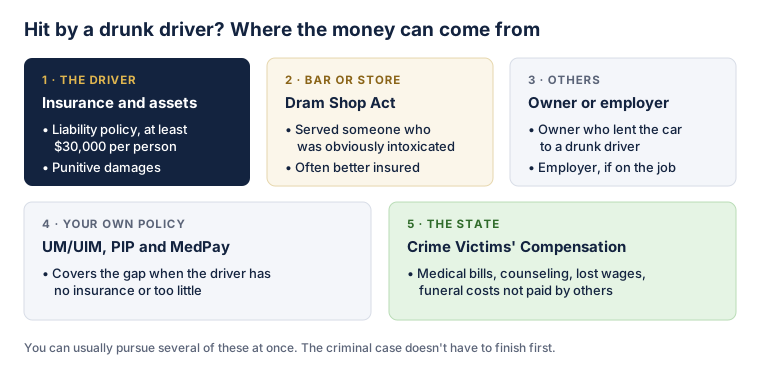
- The drunk driver's auto insurance, at least $30,000 per person in Texas, often more
- The drunk driver personally, including for punitive damages, which insurance may not cover
- A bar, restaurant or store that overserved the driver, under the Dram Shop Act
- The owner of the vehicle, if they knowingly lent it to someone who was drunk or unlicensed (negligent entrustment)
- The driver's employer, if the driver was working at the time
- Your own policy: uninsured/underinsured motorist coverage, personal injury protection and medical payments coverage
- The Texas Crime Victims' Compensation Program, for certain out-of-pocket losses
Your claim against the drunk driver
In most drunk driving cases, liability is the easy part. Driving while intoxicated is negligent, and often grossly negligent. The harder questions are usually how much insurance the driver has and how badly you were hurt.
You can claim the same damages as in any Texas injury case: medical expenses, lost wages and earning capacity, pain and suffering, mental anguish, physical impairment, disfigurement and property damage. If someone died, the spouse, children and parents can bring a wrongful death claim; see our wrongful death guide.
Evidence that helps prove intoxication includes the police crash report, breath or blood test results, field sobriety test results, dashcam and bodycam video, receipts from bars, and witnesses who saw the driver drinking. A lawyer can request the criminal case file and records from the arresting agency.
Punitive damages
Texas calls punitive damages exemplary damages. They punish especially bad conduct, and driving drunk can qualify as gross negligence. The plaintiff must prove gross negligence by clear and convincing evidence, and the jury must be unanimous.
Texas normally caps exemplary damages at the greater of two times economic damages plus up to $750,000 of noneconomic damages, or $200,000 (§ 41.008). But the cap does not apply when the conduct is a crime listed in the statute, including intoxication assault and intoxication manslaughter under the Penal Code. That's one reason the outcome of the criminal case can matter to your civil claim.
A practical note: many auto insurance policies don't pay punitive damages, so they may have to be collected from the driver personally, which isn't always possible. Our guide to what an injury case is worth in Texas explains damages in more detail.
Suing the bar: the Texas Dram Shop Act
Texas lets injured people hold alcohol sellers responsible in limited situations. Under the Dram Shop Act, Texas Alcoholic Beverage Code § 2.02, a provider like a bar, restaurant, liquor store or convenience store can be liable for damages caused by a customer's intoxication if:
- at the time of the sale, it was apparent to the provider that the customer was "obviously intoxicated to the extent that he presented a clear danger to himself and others"; and
- the customer's intoxication was a proximate cause of the damages
That standard is demanding. It's not enough that the driver was legally drunk, or that the bar sold a lot of drinks. What matters is what the server could see: slurred speech, stumbling, spilling drinks, loud or aggressive behavior, falling asleep, or being refused service elsewhere (summary of § 2.02).
The training "safe harbor"
Under Alcoholic Beverage Code § 106.14, an employer isn't responsible for an employee's sale to an intoxicated person if the employer requires its employees to attend state-approved seller training, the employee actually attended, and the employer didn't directly or indirectly encourage the employee to break the law. A policy on paper isn't enough: if managers pushed staff to keep serving, the safe harbor may not apply.
Fault is divided
In F.F.P. Operating Partners v. Dueñez (Tex. 2007), a man who said he had drunk 36 beers while cutting wood bought more beer at a liquor store, drove a short distance and crashed into the Dueñez family's car. The jury awarded $35 million. The Texas Supreme Court held that the jury must be allowed to compare the drunk driver's responsibility with the store's, so each pays its own share (case summary). In practice, a bar is rarely assigned the largest share, but it may have far more insurance than the driver.
Evidence in a dram shop case
- Receipts and credit card records showing how many drinks and when
- Surveillance video inside the bar and in the parking lot
- Witnesses: other customers, staff, rideshare drivers, friends
- The bar's training records and policies
- Police reports showing where the driver was drinking
Video is often recorded over within days, so ask a lawyer to send a preservation letter right away.
A real Texas case: Raoger Corp. v. Myers (2025)
On April 11, 2025, the Supreme Court of Texas decided Raoger Corporation v. Myers, No. 23-0662, a dram shop case that shows exactly what victims have to prove, and how a high blood alcohol test isn't enough on its own (opinion).
What happened
On November 29, 2018, Nasar Khan drank at Cadot Restaurant in Dallas. Just after midnight, he rear-ended a car driven by Barrie Myers. A blood test taken around 3:06 a.m. showed a blood alcohol content of 0.139, well over the legal limit. Myers sued the restaurant under the Dram Shop Act.
The evidence
The record was unclear about how much Khan drank and when. Khan, the bartender, the restaurant's owner and the officer who responded to the crash all testified that Khan didn't appear intoxicated, either at the restaurant or at the crash scene. Myers relied on the blood test, some of Khan's statements in his deposition, and expert opinions to argue that Khan must have looked intoxicated while he was being served. The trial court ruled for the restaurant; the court of appeals reversed.
What the Supreme Court decided
The Supreme Court reversed again and reinstated judgment for the restaurant. The Dram Shop Act requires evidence that it was apparent to the provider that the customer was obviously intoxicated to the point of being a clear danger. Expert inferences based only on the blood test, with nothing connecting them to how Khan actually looked and acted at the restaurant, were speculation, not evidence.
What this means for you
- A high BAC isn't enough against a bar. You need evidence of what the server could see: behavior, speech, coordination, the number and timing of drinks.
- Witnesses and video matter most. People who saw the driver at the bar, and video from inside, are often the key to a dram shop claim.
- Move fast. Video and memories fade quickly. A lawyer should identify where the driver was drinking and send preservation letters right away.
- Your claim against the driver doesn't depend on this. Even if a dram shop claim fails, the drunk driver is still responsible.
Party hosts and minors
Texas generally does not make social hosts, like someone who serves drinks at a party in their home, liable to people later injured by an adult guest. The Dram Shop Act applies to providers who sell or serve alcohol commercially.
There's an important exception for minors. Under § 2.02(c), an adult 21 or older who isn't the minor's parent, guardian or spouse can be liable for knowingly serving alcohol to, or allowing alcohol to be served to, a person younger than 18 on property the adult owns, leases or controls, if the minor's intoxication causes injury. Selling or providing alcohol to minors can also be a crime.
The Crime Victims' Compensation Program
Innocent victims of DWI, intoxication assault and intoxication manslaughter may be eligible for help from the Texas Crime Victims' Compensation Program, run by the Office of the Attorney General (program brochure). It can help pay:
- medical, hospital, therapy and counseling costs
- lost earnings or loss of support
- child or dependent care
- funeral and burial expenses
- travel and lost wages for attending court
Claims may be approved for up to $50,000, with up to an additional $75,000 for certain catastrophic, permanently disabling losses. The program generally pays only after other sources, like health and auto insurance, are used. It doesn't cover property damage. You must report the crime to law enforcement, and you should generally apply within three years of the crime. Call (800) 983-9933 for information. Victim advocates at the district attorney's office can help you apply.
What to do after a drunk driving crash
1. Call 911 and tell them you suspect drunk driving
Say so to the dispatcher and the officer if you noticed signs: the smell of alcohol, slurred speech, stumbling, open containers. Police can test the driver only if they're at the scene and alerted.
2. Get medical care
Go to the hospital or see a doctor the same day. Many drunk driving crashes involve high speed or wrong-way driving, and injuries can be serious even when you feel OK at first.
3. Don't confront the driver
Stay safe and let police handle it. Take photos of the cars, the scene, the driver's plate and anything you can see, like open bottles, from a distance.

4. Get the case number and contact the victim advocate
Ask for the police report number and the arresting agency. The district attorney's office usually has a victim services division that can keep you updated on the criminal case, help you write a victim impact statement and assist with the compensation program.
5. Find out where the driver was drinking
Police reports sometimes note it. Receipts, witnesses and the driver's statements may reveal it too. That's the starting point for any dram shop claim.
6. Be careful with insurance companies
Don't give a recorded statement to the drunk driver's insurer, and don't sign a release. Report the crash to your own insurer promptly, since your uninsured motorist and PIP coverage may come into play.
Deadlines
- Injury lawsuit: generally two years from the crash (§ 16.003)
- Wrongful death lawsuit: generally two years from the date of death
- Dram shop claim: the same two-year limits
- Crime Victims' Compensation: generally within three years of the crime
Evidence against a bar disappears long before those deadlines. Our guide to Texas injury claim deadlines covers the exceptions.
When to call a lawyer
Talk to a licensed Texas injury lawyer if:
- You were seriously injured, or a loved one died
- The drunk driver had little or no insurance
- The driver had been drinking at a bar, restaurant or party
- You want to pursue punitive damages
- The driver was working, or driving someone else's car
Most injury lawyers offer a free consultation and work on a contingency fee. For a referral, contact the State Bar of Texas Lawyer Referral and Information Service at (800) 252-9690, Monday to Friday, 8:30 a.m. to 4:30 p.m., or texasbar.com/LawyerReferral. See our Find a Lawyer page for questions to ask.
Checklist: after being hit by a drunk driver
- Call 911 and tell police you suspect the driver is drunk
- Get medical care the same day
- Photograph the scene, both cars and the plate
- Get witness names and phone numbers
- Get the police report number and arresting agency
- Contact the district attorney's victim services office
- Find out where the driver was drinking
- Ask a lawyer to preserve bar video and receipts quickly
- Report the crash to your own insurer; check UM and PIP coverage
- Apply to the Crime Victims' Compensation Program within three years
- Mark the two-year lawsuit deadline
Frequently asked questions
Can I sue a bar that served a drunk driver in Texas?
Sometimes. Under the Texas Dram Shop Act, Alcoholic Beverage Code § 2.02, a bar, restaurant or store can be liable if it was apparent to the server that the customer was obviously intoxicated to the extent that he presented a clear danger to himself and others, and the intoxication caused your injuries. A provider that required and enforced approved seller training may be protected.
Can I get punitive damages from a drunk driver in Texas?
Possibly. Driving drunk can be gross negligence, which can support exemplary (punitive) damages. Texas normally caps those damages, but the cap does not apply when the driver is convicted of intoxication assault or intoxication manslaughter.
Do I have to wait for the criminal DWI case to finish before filing a claim?
No. The criminal case and your civil injury claim are separate. You can make an insurance claim and file a civil lawsuit while the criminal case is pending. A conviction can help your civil case, but you don't need one to recover.
What if the drunk driver has no insurance?
Your own uninsured or underinsured motorist coverage may pay. You may also be eligible for help from the Texas Crime Victims' Compensation Program, which can pay up to $50,000 for certain expenses for innocent victims of DWI crimes, after other sources are used.
How long do I have to file a claim against a drunk driver in Texas?
Generally two years from the date of the crash for injuries, and two years from the date of death for a wrongful death claim. Applications to the Crime Victims' Compensation Program are generally due within three years of the crime.
Sources
- TxDOT: One quarter of total traffic fatalities in Texas in 2024 were DUI-alcohol related (June 2025)
- Texas Dram Shop Act, Alcoholic Beverage Code §§ 2.02 and 106.14 (summary)
- Raoger Corp. v. Myers, No. 23-0662 (Tex. Apr. 11, 2025)
- F.F.P. Operating Partners v. Dueñez (Tex. 2007), summary
- Tex. Civ. Prac. & Rem. Code § 41.008: exemplary damages cap and exceptions
- Texas Attorney General: Crime Victims' Compensation Program brochure
- Tex. Civ. Prac. & Rem. Code § 16.003: two-year limitations period
- State Bar of Texas Lawyer Referral and Information Service (TexasLawHelp.org)
Keep reading
 Car Accidents · Texas
Rear-End Collisions and Whiplash in Texas: Who Is at Fault and What Your Claim Is Worth
Rear-end crashes are among the most common in Texas, and whiplash is the injury insurers doubt most. Here's how fault works, what can change it, and how to prove a neck or back injury.
 Car Accidents · Texas
Brain Injury After a Car Accident in Texas: Symptoms, Proving Your Claim and Compensation
A brain injury can hide behind a normal CT scan and a 'you're fine' at the scene. Here's how to spot the warning signs after a Texas crash, prove the injury and protect your claim.
 Car Accidents · Texas
Hit by a City Bus, Police Car or Government Vehicle in Texas? Your Rights Under the Tort Claims Act
Crashes with city buses, police cars, garbage trucks and other public vehicles follow special rules in Texas. Miss a notice deadline that can be as short as 90 days and your claim may be gone.