Car Accidents · Texas
Uber or Lyft Accident in Texas? Who Pays and How Much Insurance Covers You
How much insurance covers an Uber or Lyft crash in Texas depends on one thing: what the driver's app was doing at that moment. Here's how the three coverage periods work, and why suing the company itself is hard.

The short answer: if you were hurt in an Uber or Lyft crash in Texas, how much insurance is available depends on what the driver's app was doing. During a trip, from the moment the driver accepts your ride until you get out, Texas law requires at least $1 million in liability coverage. When the driver is logged in but waiting for a request, the minimum drops to $50,000 per person. When the app is off, it's just the driver's personal policy. Suing Uber or Lyft as a company is hard in Texas, so most claims go through that insurance.
Rideshare has changed how Texans get around. A ride home from a bar on Sixth Street, a trip to DFW Airport, a late shift that ends after the buses stop. Most rides are uneventful. But with millions of trips, crashes happen, and when they do, the first question is usually the same: whose insurance pays?
The answer is more complicated than in an ordinary car crash, because the driver is using a personal car for a business, and the coverage changes depending on the moment. This guide explains Texas's rideshare insurance rules, how they apply to passengers, other drivers, pedestrians and the rideshare drivers themselves, a 2025 Texas court decision about suing Uber, and what to do after a crash.
- What to do after a rideshare crash
- The three coverage periods
- If you were a passenger
- If a rideshare driver hit you
- If you're the rideshare driver
- Special situations
- Can you sue Uber or Lyft?
- A real Texas case: Acosta v. Uber (2025)
- Safety rules rideshare companies must follow
- Evidence that matters in rideshare cases
- What you can recover
- Deadlines and when to call a lawyer
- Checklist and FAQ
What to do after a rideshare crash
1. Get safe and call 911
If you can, get out of traffic. Call 911 so police and medical help come and a crash report is written. Don't rely on the driver to call. Texas law requires a police report when someone is injured (our car accident guide covers the reporting rules).
2. Screenshot the trip
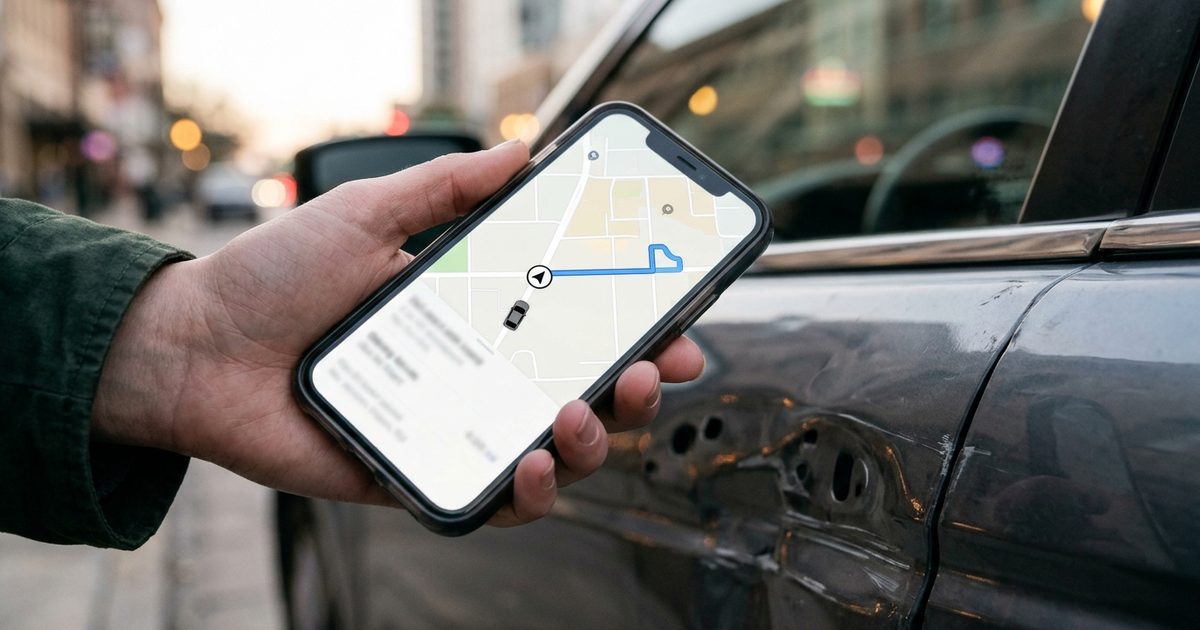
Before anything else on your phone, take a screenshot of the trip in the app. It shows the driver's name, the car, the plate, and the time. That proves you were on an active trip, which decides which insurance applies. Apps can change or hide trip details later.
3. Get information from everyone
- The rideshare driver's name, phone, license and personal insurance
- The other driver's name, phone, license, plate and insurance
- Names and phone numbers of witnesses, including other passengers
- Photos of both cars, the scene, traffic signals and your injuries
4. Report it in the app
Both Uber and Lyft let you report a crash in the app. Do it the same day. Stick to facts; don't guess about speeds or blame.
5. Get medical care
Passengers often hit the seat in front, the door or the window, especially in the back seat. Neck, back and head injuries may not hurt right away. See a doctor the same day if you don't go to the hospital.
6. Be careful with insurance calls
You may hear from more than one insurer: the rideshare company's carrier, the driver's personal insurer and the other driver's insurer. You don't have to give a recorded statement to any of them. It's reasonable to respond in writing or through a lawyer.
The three coverage periods
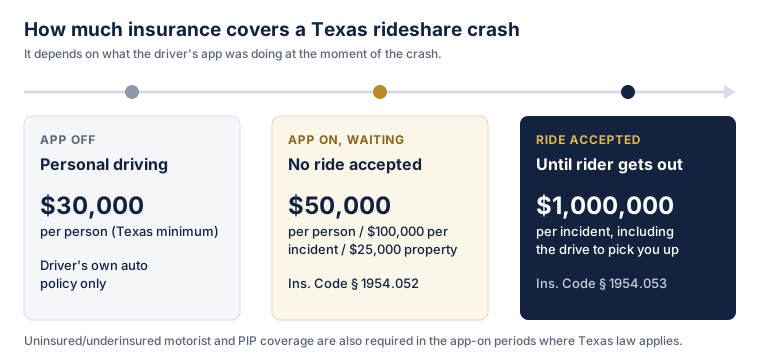
Texas sets rideshare insurance rules in Chapter 1954 of the Insurance Code. The required coverage depends on the driver's status at the moment of the crash (Tex. Ins. Code ch. 1954).
App off
If the driver wasn't logged into the app, they're just a regular driver. Their personal auto insurance applies, and Texas's minimum is $30,000 per person and $60,000 per crash for injuries.
App on, waiting for a ride
When the driver is logged in and available but hasn't accepted a ride, Texas requires at least:
- $50,000 per person for bodily injury or death
- $100,000 per incident for bodily injury or death
- $25,000 for property damage
Uninsured/underinsured motorist and personal injury protection coverage are also required where Texas law calls for them (§ 1954.052).
This is the period that causes the most disputes. Many personal auto policies exclude using your car for rides for pay, while the company's policy may say the driver's policy should pay first. Texas law handles this: the coverage can come from the driver's policy, the company's policy, or both, and if the driver's policy has lapsed or doesn't provide the required coverage, the rideshare company must provide it "beginning with the first dollar of a claim" (§ 1954.054).
Ride accepted through drop-off
From the moment the driver accepts a ride request until the last passenger gets out, Texas requires a total of at least $1 million per incident for death, bodily injury and property damage, plus uninsured/underinsured motorist and PIP coverage where applicable (§ 1954.053). That includes the drive to pick you up, even before you're in the car.
If you were a passenger
Passengers are in the strongest position. You weren't driving, so you're rarely found at fault. Who pays depends on who caused the crash:
- The rideshare driver caused it: the $1 million policy that applies during the trip is available for your injuries.
- Another driver caused it: that driver's insurance pays first. If that driver had no insurance or too little, the rideshare policy's uninsured/underinsured motorist coverage may help. Your own auto policy's coverage may also apply; see our uninsured driver guide.
- Both drivers share the blame: you can claim against both, and Texas divides responsibility between them by percentage.
If you were hurt, not wearing a seat belt in the back seat can come up. Under the Texas Supreme Court's 2015 Nabors v. Romero decision, seat-belt evidence can be used to argue your injuries would have been less serious. Our motorcycle guide explains that case.
If a rideshare driver hit you
If you were in another car, on a bike or walking and a rideshare driver hit you, the coverage depends on the driver's app status at that moment. You may not know it at the scene. Ask the driver directly whether they were logged in or on a trip, write down the answer, and photograph any rideshare signs on the car.
Your lawyer can request the app records to prove the driver's status. If the driver was on a trip or heading to a pickup, the $1 million coverage applies. If they were waiting for a request, the lower minimums apply. If the app was off, it's the driver's personal policy. Pedestrians and cyclists hit by a rideshare driver should also see our pedestrian and bicycle guide.
If you're the rideshare driver
If another driver caused the crash, you can claim against that driver's insurance like anyone else. For your own injuries and car damage, check:
- The rideshare policy's uninsured/underinsured coverage if the at-fault driver had little or no insurance and you were on a trip
- Your own personal policy, and whether you have a rideshare endorsement. Without one, your insurer may deny coverage for crashes while the app was on.
- Collision coverage for your car. Coverage for damage to the driver's own car often isn't part of the required minimums, and it may depend on whether you carry collision coverage yourself.
Because Texas treats rideshare drivers as independent contractors, drivers generally aren't covered by the company's workers' compensation. Read your driver agreement and your policies, ideally before you have a crash.
Special situations
Hurt getting in or out of the car
Injuries don't only happen in collisions. A driver who pulls away while you're still stepping out, or who opens a door into traffic, can cause serious injuries. The trip period runs until the last passenger gets out, so the $1 million coverage generally still applies. Report it in the app right away and take photos of where it happened.
The rideshare driver was drunk, speeding or on their phone
Rideshare companies must have a zero-tolerance policy for impaired drivers, and Texas law already prohibits drunk driving and texting while driving. If you noticed signs of impairment, reckless driving or phone use before the crash, write down what you saw as soon as you can, and tell the police officer at the scene. In serious cases, a drunk driver may also face punitive damages, which are explained in our guide to what an injury case is worth.
Several passengers were hurt
The $1 million limit during a trip is a total for the whole incident, not per person. If several people were badly hurt, including passengers and people in other cars, that limit may have to be shared. That's one reason to talk to a lawyer early when there are multiple injured people.
The car wasn't the one in the app
If the car or driver didn't match the app, don't get in. If you already did and there was a crash, tell police and the rideshare company. Coverage can become disputed when a driver uses an unapproved vehicle or lets someone else drive their account, so your screenshot of the trip details matters even more.
Can you sue Uber or Lyft?
Injured people often want to sue the company, because it has the deepest pockets. In Texas, that's difficult.
Normally, an employer can be responsible for an employee's careless driving on the job. But Texas Occupations Code § 2402.114 says a rideshare driver is an independent contractor, "for all purposes," and not an employee, if:
- the company doesn't set the hours the driver must be logged in;
- doesn't stop the driver from using other rideshare apps;
- doesn't restrict where the driver can give rides;
- doesn't stop the driver from working another job; and
- the company and driver agree in writing that the driver is an independent contractor.
Uber and Lyft structure their arrangements to meet these conditions. That's why the insurance requirements are so important: the Legislature put the $1 million coverage in place instead of making the companies liable like employers.
A real Texas case: Acosta v. Uber (2025)
On February 28, 2025, a Texas court of appeals decided Acosta v. Uber Technologies, Inc., No. 08-24-00099-CV, a case about whether injured passengers could hold Uber itself responsible (Texas Civil Justice League summary).
What happened
An Uber driver in the Austin area collided with another vehicle. Two riders, Guillermo Acosta and Jose Molina, said they were injured. They sued Uber directly, arguing Uber was responsible for its driver and for how its app affected his driving.
The arguments
The riders made several arguments. They said the driver wasn't really an independent contractor because Uber didn't have a state permit at the time. They said Uber controlled drivers by requiring them to keep the app on while driving, and that the app's design encouraged distracted driving. They also argued Uber was responsible under agency and joint enterprise theories.
What the court decided
The trial court ruled for Uber without a trial, and the court of appeals, sitting in El Paso on a case transferred from Austin, affirmed. It found that the permit rules took effect after the crash, so Uber's lack of a permit didn't defeat the independent contractor statute. It found Uber doesn't require drivers to interact with the app while driving, and it declined to recognize a new claim based on app design and distracted driving. The agency theory failed because the rider agreement says drivers are third-party providers, and the joint enterprise theory failed under § 2402.114.
What this means for you
- Plan on the insurance, not the company. In most Texas rideshare crash cases, the realistic path is the driver and the coverage the law requires.
- Proving the app status is key. Since the coverage amount depends on it, screenshots and app records matter more than ever.
- The law may keep developing. This was a court of appeals decision, and the arguments about app design and distracted driving may come up again. A lawyer can tell you whether anything has changed.
Safety rules rideshare companies must follow
Texas regulates rideshare companies through the Texas Department of Licensing and Regulation. Under state rules, companies must hold a TDLR permit and must run background checks on drivers, including local, state and national criminal checks, a sex offender registry check and a driving record check, repeated at least once a year (TDLR).
Drivers are disqualified for certain convictions in the past seven years, including DWI and violent crimes, and for driving records with more than three moving violations, reckless driving or fleeing police in the past three years. Companies must also have a zero-tolerance policy for drivers who are impaired while logged in (TDLR).
If a driver who should have been disqualified caused your crash, tell your lawyer. It may not make the company liable under Texas's contractor rule, but it can matter to your case.
Evidence that matters in rideshare cases
- Trip screenshots and receipts showing the time, route and driver
- App records showing when the driver logged in, accepted the ride and was moving. A lawyer can ask for these.
- The police crash report, which you can request from TxDOT
- Dashcam footage. Many rideshare drivers use dashcams. Ask the driver, and ask your lawyer to request it quickly before it's recorded over.
- Photos and witnesses, as in any crash
- Medical records from the same day forward
What you can recover
Passengers and others hurt in a rideshare crash can claim the same damages as in any Texas injury case: medical expenses, lost wages, pain and suffering, mental anguish, physical impairment, disfigurement and property damage. The difference is often how much insurance is available, which can be much more than in an ordinary crash if the driver was on a trip. See our guide to what an injury case is worth in Texas.
Deadlines
You generally have two years from the date of the crash to file a lawsuit in Texas (§ 16.003). Insurance claims and in-app reports don't stop that clock. If a city vehicle or road defect was involved, much shorter notice deadlines may apply. See our guide to Texas injury claim deadlines.
When to call a lawyer
Talk to a licensed Texas injury lawyer if:
- You were seriously hurt as a passenger, another driver or a pedestrian
- Insurers are arguing over who pays or whether the app was on
- The other driver had no insurance or fled
- You're the rideshare driver and your insurer denied coverage
- Someone died in the crash
For a referral, contact the State Bar of Texas Lawyer Referral and Information Service at (800) 252-9690, Monday to Friday, 8:30 a.m. to 4:30 p.m., or texasbar.com/LawyerReferral. See our Find a Lawyer page for questions to ask.
Checklist: after an Uber or Lyft accident
- Get out of traffic and call 911
- Screenshot the trip in the app before anything else
- Get the rideshare driver's and other driver's information and insurance
- Photograph the cars, the scene and your injuries
- Get witness names, including other passengers
- Report the crash in the app, sticking to facts
- See a doctor the same day
- Ask about dashcam footage
- Don't give recorded statements to any insurer without advice
- Mark the two-year lawsuit deadline
Frequently asked questions
Who pays if I'm hurt as an Uber or Lyft passenger in Texas?
If the rideshare driver caused the crash, Texas law requires at least $1 million in liability coverage from the moment the driver accepts a ride until the last passenger gets out. If another driver caused the crash, that driver's insurance pays first, and the rideshare policy's uninsured or underinsured motorist coverage may help if the other driver had too little insurance.
What insurance applies if an Uber driver hits me while waiting for a ride request?
When the driver is logged into the app but hasn't accepted a ride, Texas law requires lower minimums: $50,000 per person and $100,000 per incident for injuries, and $25,000 for property damage. The driver's own policy or the rideshare company's policy can provide it.
Can I sue Uber or Lyft directly in Texas?
It's difficult. Texas Occupations Code § 2402.114 treats rideshare drivers as independent contractors, not employees, when certain conditions are met. In 2025, a Texas court of appeals upheld judgment for Uber in a passenger injury case on that basis. Your claim usually goes against the driver and the insurance the law requires.
What if the Uber or Lyft driver wasn't using the app when the crash happened?
Then the rideshare rules don't apply, and the driver's personal auto insurance is the main coverage, just like any other car crash. Texas minimum coverage is $30,000 per person and $60,000 per crash for injuries.
How long do I have to file a claim after a rideshare accident in Texas?
Generally two years from the date of the crash to file a lawsuit. Report the crash in the app and to police right away, and keep a screenshot of the trip.
Sources
- Tex. Ins. Code Chapter 1954: insurance for transportation network companies
- H.B. 1733 (2015), enrolled text
- Tex. Occ. Code § 2402.114: drivers as independent contractors
- Acosta v. Uber Technologies, No. 08-24-00099-CV (Tex. App.—El Paso Feb. 28, 2025), summary
- TDLR: Information for TNC drivers
- TDLR: TNC operations guide
- Tex. Civ. Prac. & Rem. Code § 16.003: two-year limitations period
- State Bar of Texas Lawyer Referral and Information Service (TexasLawHelp.org)
Keep reading
 Car Accidents · Texas
Rear-End Collisions and Whiplash in Texas: Who Is at Fault and What Your Claim Is Worth
Rear-end crashes are among the most common in Texas, and whiplash is the injury insurers doubt most. Here's how fault works, what can change it, and how to prove a neck or back injury.
 Car Accidents · Texas
Brain Injury After a Car Accident in Texas: Symptoms, Proving Your Claim and Compensation
A brain injury can hide behind a normal CT scan and a 'you're fine' at the scene. Here's how to spot the warning signs after a Texas crash, prove the injury and protect your claim.
 Car Accidents · Texas
Hit by a City Bus, Police Car or Government Vehicle in Texas? Your Rights Under the Tort Claims Act
Crashes with city buses, police cars, garbage trucks and other public vehicles follow special rules in Texas. Miss a notice deadline that can be as short as 90 days and your claim may be gone.